Ever since the melancholic strains of Duffy’s “Distant Dreamer” faded over the rebooted horizon of Stone Ocean in late 2022, a collective, breathless hush has fallen over the global anime community. For over a decade, David Production pulled off what critics once considered impossible: faithfully translating Hirohiko Araki’s eccentric, multi-generational epic into a modern pop-culture juggernaut. Yet, as the original Joestar timeline closed its doors, every veteran fan knew the real trial by fire was still on the horizon. The horizon, in this case, is a sun-bleached, blood-spattered 1890s American frontier. The prize is not merely the Steel Ball Run race purse, but the adaptation of Araki’s undisputed masterpiece: JoJo’s Bizarre Adventure: Part 7 – Steel Ball Run.
The anticipation surrounding a potential Steel Ball Run anime is not routine franchise hype. It carries the weight of a mythic transformation. Routinely sitting near the pinnacle of MyAnimeList’s top-rated manga of all time, Part 7 isn’t just another chapter in the lineage; it is Araki’s renaissance. Bridging historical sports fiction, existential tragedy, and high-concept Stand warfare, Steel Ball Run demands an unprecedented production scale. As David Production works through rumors, anniversary events, and hush-hush development schedules, the reality of adapting this 24-volume leviathan poses both an artistic triumph and a logistical nightmare.
The Ultra Jump Pivot: Rebuilding the Mythos from the Soil Up
To understand the sheer magnitude of the Steel Ball Run anime buzz, one must first appreciate the manga’s historic context. Initially serialized in Weekly Shonen Jump in 2004 under the standalone title Steel Ball Run, the series shifted in 2005 to Shueisha’s monthly seinen imprint, Ultra Jump. This editorial relocation completely altered Araki’s artistic canvas. Unshackled from the relentless weekly grind and juvenile censorship standards, Araki’s storytelling matured into something profoundly contemplative and visually staggering.
The premise is deceptively accessible: thousands of intrepid racers converge on San Diego Beach to race cross-country to New York City for a staggering fifty-million-dollar bounty. But beneath the dust, steam engines, and spurs lies a narrative web of theological horror, espionage, and national identity. The race is merely the stage; the actual catalyst is the search for the mummified relics of the Saint’s Corpse, scattered across the American wilderness. By untethering the story from the prior six parts and dropping readers into an alternate reality, Araki offered a fresh ideological slate. For David Production, adapting this means abandoning the garish 80s/90s urban aesthetics of Morioh and Cairo in favor of sprawling natural vistas, desolate badlands, and an earthy, cinematic palette that looks more like Sergio Leone than standard Saturday-morning anime.
A Dynamic Forged in Dust: Johnny, Gyro, and the Geometry of the Spin
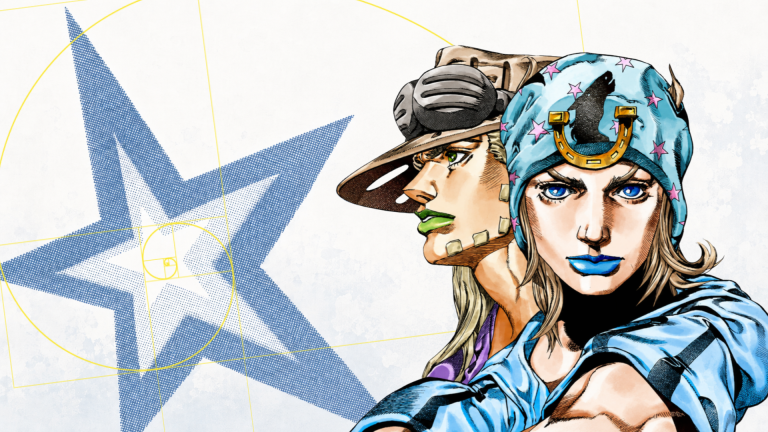
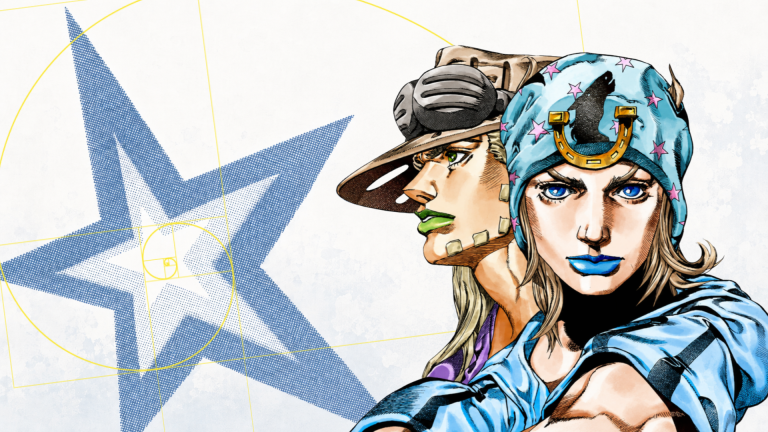
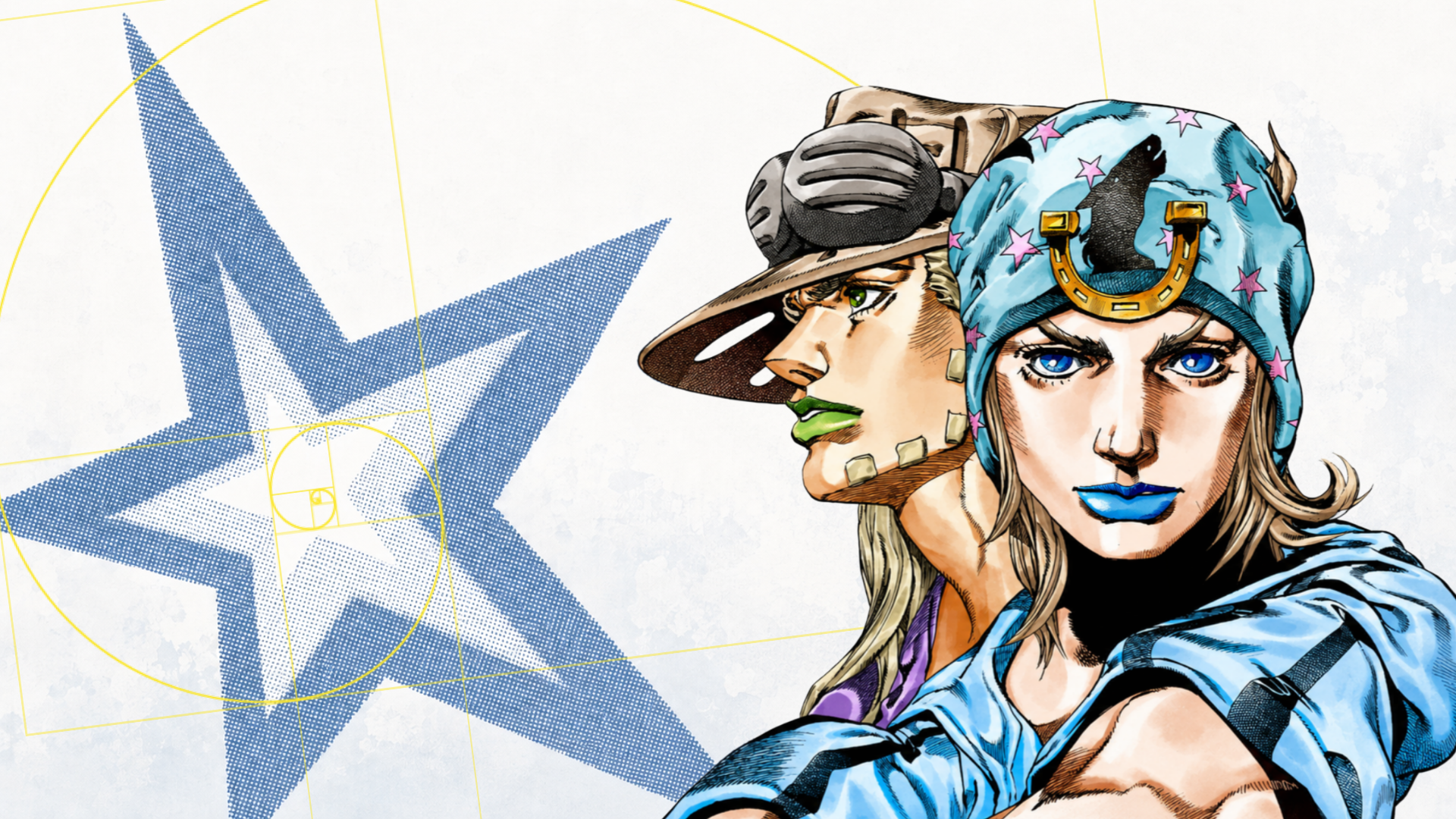
At the center of this storm are two of the most richly written protagonists in modern comic history. Their dynamic diverges sharply from the archetypal shonen bonds previously depicted in the franchise.
The Subversion of the Shonen Hero: Johnny’s Dark Determination
Johnny Joestar is not a virtuous crusader like Jonathan, nor a cool-headed trickster like Joseph. He begins his journey as an arrogant former equestrian prodigy, crippled from the waist down by a senseless act of vanity, discarded by society, and hollowed out by depression. Johnny’s pursuit of the race is not born of heroism; he is driven by an obsessive, deeply human desire to discover what he calls the “negative into zero.” His Stand, Tusk, doesn’t emerge fully formed as an invincible brawler; it evolves through four distinct acts alongside his own psychological resurrection. Johnny possesses what Araki explicitly labels a “dark determination”—a cold, unyielding willingness to kill to reclaim his dignity. Adapting this requires voice acting and directional nuance that avoids sanitizing his moral flaws.
Gyro Zeppeli and the Miracle of the Golden Ratio
Balancing Johnny’s brooding desperation is Gyro Zeppeli, a disgraced executioner from the Kingdom of Naples whose boisterous, gold-toothed exterior hides an excruciating ethical crisis. Gyro does not rely on a Stand for the majority of the journey. Instead, he introduces the Spin: an ancient, mathematically derived martial technique that harnesses the Golden Ratio through revolving steel spheres. The visual language of the Spin—manipulating muscle memory, kinetic inertia, and spatial geometry—presents David Production with a dazzling creative challenge. Animating the physical distortions and kinetic shockwaves of Gyro’s spheres will necessitate a completely redesigned visual effects suite, vastly different from the punch-ghost visual grammar fans have grown accustomed to since Stardust Crusaders.
The Equestrian Gauntlet: Why David Production Faces Its Toughest Test
If the narrative potential of Steel Ball Run is boundless, the technical hurdles are daunting. In the animation industry, there is an infamous, universally acknowledged rule: horses are a production manager’s worst nightmare.
Unlike humanoid Stand battles staged in cramped alleyways or static rooms, Steel Ball Run takes place largely in motion, atop galloping steeds spanning hundreds of miles. Hand-drawing four-legged animal locomotion with accurate weight, muscle deformation, and varying camera angles across dozens of episodes is borderline suicidal for standard 2D television budgets. Even studio titans like Wit Studio and MAPPA relied heavily on controversial 3DCG models for horses in franchises like Attack on Titan.
For David Production, finding the sweet spot between fluid 3D modeling and the hyper-detailed, cross-hatched linework of late-era Araki is the project’s central bottleneck. Fans will not tolerate clunky, PS2-era CGI models disrupting the emotional resonance of the race. The studio must devise a hybrid pipeline, perhaps utilizing custom cel-shaded 3D rigs with heavy 2D draw-overs for close-up maneuvers, ensuring the tactile grit of hooves, mud, and leather feels organic. The lengthy gap between Stone Ocean and any formal Part 7 announcement strongly suggests that pre-production R&D is taking this technical mountain very seriously.
“Dojyaaa~n”: Funny Valentine and Araki’s Most Complex Antagonist
Beyond the logistical sprint, an anime adaptation hinges upon the thematic execution of its central villain: the 23rd President of the United States, Funny Valentine. Boasting an unshakeable utilitarian ideology and the multiverse-hopping Stand Dirty Deeds Done Dirt Cheap (D4C), Valentine elevates Part 7 beyond a simple adventure into a scathing deconstruction of exceptionalism and sacrifice.
Valentine’s chilling conviction—that whoever “takes the first napkin” dictates the morality of the world—makes him a terrifying foil to Johnny. He is charismatic, genuinely patriotic, and utterly merciless. The localized battles surrounding Valentine, including the mind-bending “Who Shot Johnny Joestar?” arc, rely on non-linear narrative delivery and alternate-dimension overlaps. Directing these sequences requires meticulous pacing and editorial dexterity, ensuring audiences remain enthralled rather than alienated by the reality-bending chaos.
The Waiting Game: Fandom Fever Pitch and the Road Ahead
The digital sphere remains electric with speculation. Fan-made animated trailers regularly amass millions of views, while fan castings—debating whether game veterans like Yuki Kaji (Johnny) and Shinichiro Miki (Gyro) will reprise their roles or yield to fresh blood—dominate social media forums. The community understands that David Production cannot treat Steel Ball Run like an ordinary seasonal anime. It is a prestigious, genre-defying odyssey that could easily run for 40 to 50 episodes across multiple cours, requiring extraordinary endurance from its staff.
When David Production finally flashes that iconic green-tinted, golden-ratio logo on our screens, it will signal more than just the return of a beloved anime; it will herald the screen adaptation of one of the greatest graphic novels ever conceived. Until then, JoJo enthusiasts must exercise the same patience Gyro preached to Johnny: lesson five isn’t about rushing the finish line, but respecting the journey that gets you there.
What are your biggest hopes and fears for the Steel Ball Run anime adaptation? Should David Production embrace hybrid 3D animation for the horses, or wait until hand-drawn schedules permit? Drop your thoughts in the comments below, and keep your browsers locked to Wibux.com for all your breaking JoJo updates!