Ever since the bittersweet, cosmos-shattering chords of *Stone Ocean* faded into Netflix’s release catalog, a singular, deafening murmur has reverberated across the anime landscape: When does the race begin? For over a decade, David Production has pulled off one of the most audacious, faithful adaptations in modern animation history, transforming Hirohiko Araki’s generational manga odyssey into a global pop-culture titan. Yet, every previous season—from Jonathan Joestar’s Victorian tragedy to Jolyne Cujoh’s Floridian prison break—was merely the prologue. The true Everest of Araki’s creative journey is JoJo’s Bizarre Adventure: Part 7 – Steel Ball Run.
Widely celebrated as Araki’s undisputed magnum opus and consistently ranked among the greatest manga runs of all time on MyAnimeList, Steel Ball Run represents a seismic shift for the franchise. It is a reinvention that traded the flamboyant alleys of Morioh and the urban canals of Venice for the brutal, sun-bleached expanse of late 19th-century America. But as anticipation builds to a fever pitch, so too does a collective anxiety. Between narrative reinvention, complex character psychologies, and an animation hurdle infamous enough to terrify industry veterans, adapting Steel Ball Run is David Production’s most perilous gamble yet.
The Seinen Rebirth: Araki’s Radical Tabula Rasa
To understand the immense buzz surrounding Steel Ball Run, one must understand its historical context within the medium. Serialized in 2004, the story initially debuted without the “JoJo” moniker attached to its main title, running in Weekly Shōnen Jump before transitioning to the monthly seinen magazine Ultra Jump in 2005. This editorial migration was nothing short of miraculous for Araki’s artistic trajectory. Unshackled from the punishing weekly deadlines and demographic constraints of traditional shōnen, Araki unlocked a new gear of narrative complexity, visceral violence, and visual grandeur.
Set in 1890, the premise is deceptively simple: a cross-country equestrian race spanning 6,000 grueling kilometers from San Diego Beach to New York City, backed by an astronomical $50 million grand prize. Organized by the eccentric promoter Stephen Steel, this race attracts outlaws, aristocrats, and supernatural entities from across the globe. Yet beneath the veneer of Manifest Destiny lies an intricate geopolitical conspiracy involving sacred artifacts, divine intervention, and the ideological soul of an emerging superpower. By resetting the continuity following the universe-altering climax of Part 6, Araki delivered a clean slate that was simultaneously an intoxicating love letter to Western cinema and a dark deconstruction of heroic archetypes.
Johnny, Gyro, and the Subversion of the Shōnen Dynamic
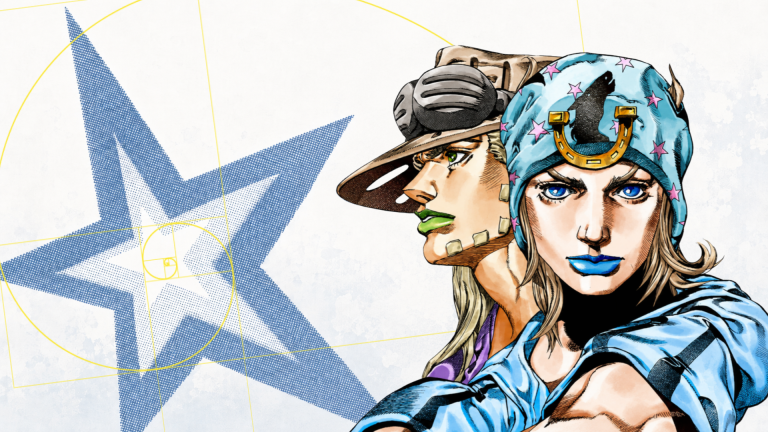
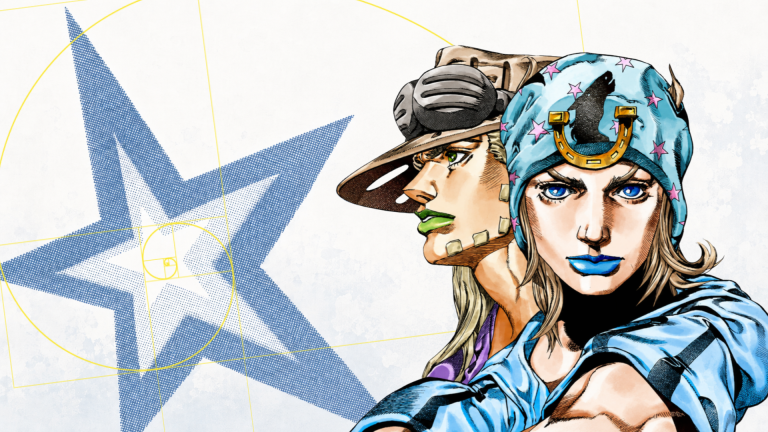
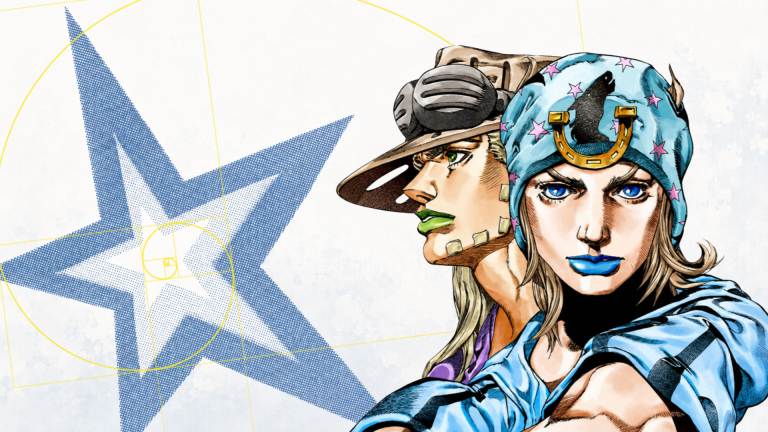
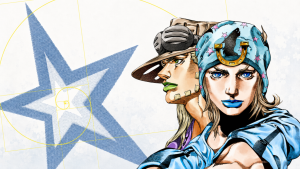
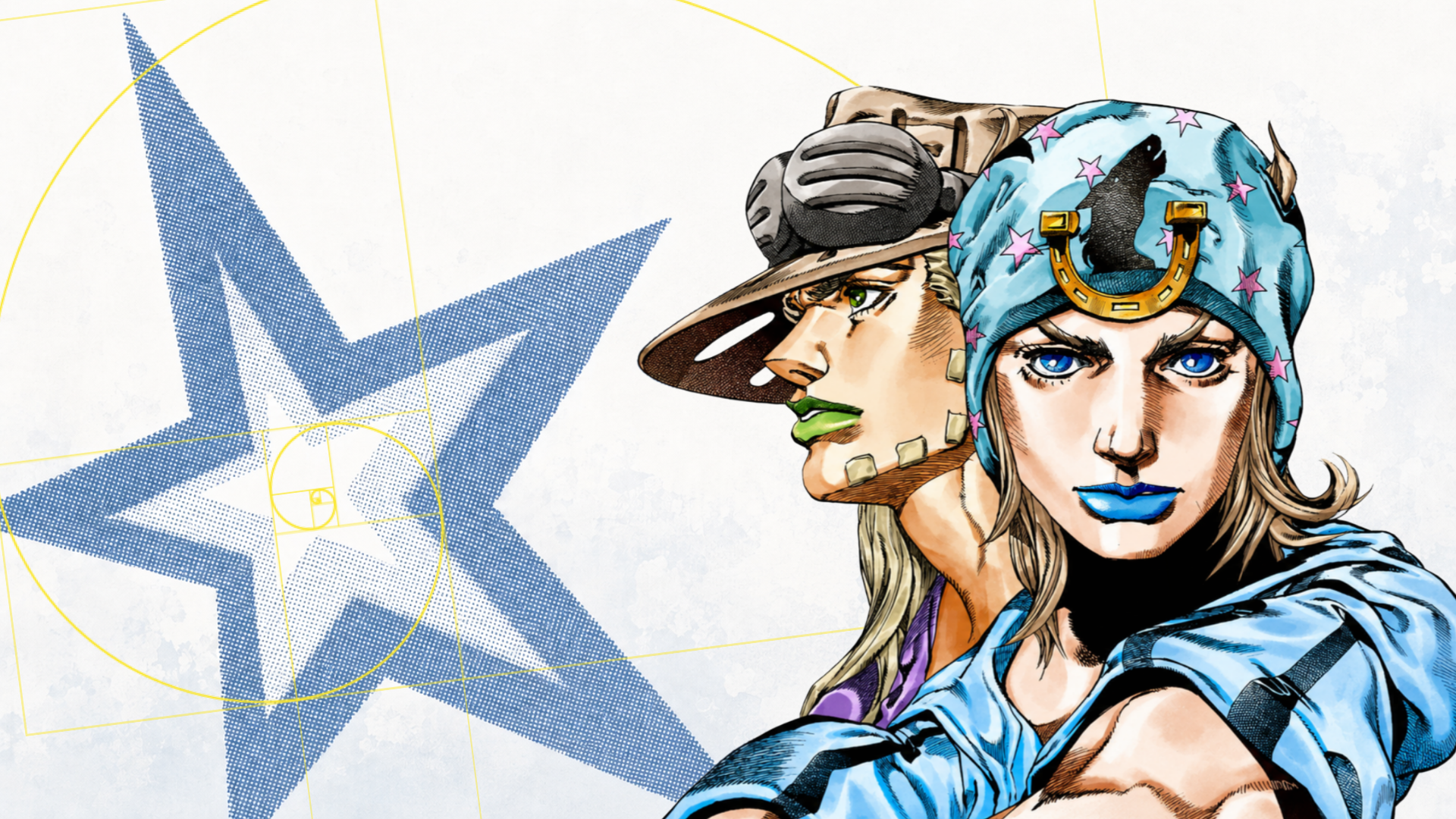
At the beating heart of this trans-American odyssey is a protagonist pairing unlike any other in anime canon: Johnny Joestar and Gyro Zeppeli. Where previous JoJo duos thrived on chivalric brotherhood or flamboyant camaraderie, Johnny and Gyro operate in a murky, gray-scale reality dictated by survival, trauma, and redemption.
A Paraplegic Jockey’s Ruthless Determination
Johnny Joestar is perhaps the most unconventional protagonist Araki has ever penned. A former horse-racing prodigy whose hubris and arrogance left him paralyzed from the waist down, Johnny enters the narrative not as a beacon of justice, but as a hollowed-out cynic. His motivation is purely self-serving: after witnessing Gyro’s mysterious, spinning steel spheres temporarily stimulate his dead legs, Johnny joins the race solely to unlock that secret. He possesses what Araki explicitly describes as a “dark determination”—a cold, borderline sociopathic willingness to kill if it means reclaiming his dignity. Watching Johnny’s Stand, Tusk, evolve across four distinct Acts mirrors his painful emotional maturation from crawling desperation to absolute transcendence.
Gyro Zeppeli and the Mastery of the Spin
Counterbalancing Johnny’s brooding ruthlessness is Gyro Zeppeli, a disgraced Neapolitan executioner’s son armed with eccentric humor, customized grill teeth that read “GO! GO! ZEPPELI,” and a deadly ancestral martial art known simply as The Spin. Far more than a mere substitute for Hamon or Stands, the Spin is a metaphysical discipline grounded in mathematics, anatomy, and the Golden Ratio—a visual and conceptual motif that allows users to manipulate kinetic energy through nature’s divine geometry. Gyro’s quest to win the race to secure amnesty for a wrongfully condemned child anchors the emotional core of the narrative, serving as the moral compass that Johnny so desperately lacks.
The Elephant in the Production Room: The Equestrian Nightmare
If the thematic depth of Steel Ball Run has fans salivating, its technical execution has animators sweating. The elephant in the room—or rather, the thoroughbred on the track—is the sheer logistical nightmare of animating horses. Historically, quadrupeds are the bane of traditional 2D animation pipelines. The intricate skeletal mechanics, the shifting muscle groups under tension, and the frantic cadence of galloping hooves require an exorbitant amount of frames, technical precision, and time.
Multiply that challenge by dozens of horses jostling in close proximity across shifting prairie dust, torrential rain, and rocky canyons, and the production scope balloons astronomically. Industry observers widely believe this technical barrier is precisely why David Production took a prolonged breather after Stone Ocean. To bring Steel Ball Run to life without bankrupting the project or breaking the animators, David Production will likely have to pioneer an unprecedented hybrid approach:
“You cannot treat Steel Ball Run like Golden Wind,” notes the growing consensus among anime industry analysts. “A standard television schedule would collapse under the weight of Part 7’s racing scenes.” Speculation points toward heavily stylized 3D CGI models for the horses—akin to the boundary-pushing hybrid work seen in Studio Orange’s productions or MAPPA’s high-octane sequences—blended seamlessly with artisanal 2D hand-drawn character animation for the riders. Getting this visual balance wrong could alienate one of the most passionate fanbases in the medium; getting it right could establish a brand-new technical benchmark for televised anime.
Patriotism, the Corpse, and Ideological Warfare
Beyond the races and the technical hurdles lies the overarching narrative engine that elevates Steel Ball Run into high art: the hunt for the Saint’s Corpse. Scattering holy relics across the American frontier transforms the race into an ideological battlefield. Araki juxtaposes the individualistic, broken morality of his protagonists against the grand, terrifying utilitarianism of the series’ antagonist: the 23rd President of the United States, Funny Valentine.
Valentine is not a mustache-twirling megalomaniac; he is an uncompromising patriot driven by absolute conviction. Armed with his reality-hopping Stand, Dirty Deeds Done Dirt Cheap (D4C), Valentine seeks the Corpse Parts to ensure that America claims the “first napkin”—metaphorically dictating global prosperity by deflecting all misfortune onto other nations. It is a stunning, sophisticated critique of imperialism and nationalism that forces audiences into an uncomfortable corner: who is truly in the right? The selfish boy seeking to walk again, or the charismatic leader willing to sacrifice everything for his country’s eternal glory?
The Verdict: Anime’s Most Anticipated Frontier
The cultural appetite for Steel Ball Run is no longer just niche internet chatter; it is an unavoidable event horizon. Between Araki’s masterclass in character development, the metaphysical thrill of the Golden Spin, and the sheer audacity of its American historical canvas, Part 7 has all the makings of a generational masterpiece. David Production stands on the precipice of their defining legacy. If they can tame the mechanical beast of equestrian animation and honor the gritty, seinen ethos of Araki’s vision, Steel Ball Run won’t just be another great JoJo season—it will redefine what cinematic action anime can achieve.
Over to you, Wibux readers: Do you think David Production should rely on high-end CGI for the race sequences, or wait out a longer production cycle for traditional 2D? And who is your dream voice cast for Gyro and Johnny? Let us know your theories in the comments below!