



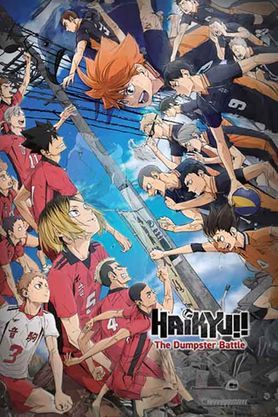
Few rivalries in contemporary anime carry the generational baggage, emotional weight, and poetic resonance of the “Battle at the Garbage Dump” (Gomi Suteba no Kessen). After breaking domestic box office records in Japan and generating over $70 million globally in limited theatrical windows, Haikyu!! The Dumpster Battle has officially arrived on global streaming services. For millions of fans who have watched Karasuno High scratch and claw their way from being branded “fallen champions” and “flightless crows,” this release is far more than another tournament round. It represents the cinematic culmination of an obsession—a long-promised showdown passed down from two aging, stubborn coaches to a modern generation of hyper-athletic teenage prodigies.
Clocking in at an economical, breathless 85 minutes, director Susumu Mitsunaka’s feature-length adaptation of Haruichi Furudate’s seminal manga arc does not merely adapt a volleyball match; it crystallizes why Haikyu!! reigns as the gold standard of modern sports anime. With pristine production values and an uncommon emotional depth, the film bridges the gap between pure athletic adrenaline and introspective character study.
The Inherited Grudge: Redefining Shonen Conflict Through Empathy
Modern sports anime typically thrives on personal animosity, towering walls of villainy, or existential stakes. Whether it is the monstrous isolation of Ushijima Wakatoshi in Haikyu!! Season 3 or the ego-driven ruthlessness celebrated in contemporary peers like Blue Lock, sports narratives often rely on a clear antagonist to generate friction. Karasuno vs. Nekoma systematically dismantles this paradigm.
This match is not built on animosity; it is built on mutual reverence. The generational tether between former Karasuno Coach Ikkei Ukai and Nekoma’s Yasufumi Nekomata established a foundational identity for both schools: the predatory, aggressive evolution of the Crows set against the patient, connective, and suffocating persistence of the Cats. Nekoma does not enter the Orange Court to destroy Karasuno; they enter it to engage in an unbroken conversation that has been delayed for decades.
A Contrast in Court Philosophies
What makes this clash historically brilliant within the medium is the diametric opposition of their systems:
- Karasuno’s Omnivorous Chaos: A hyper-aggressive offensive engine built on reckless spatial awareness, relentless minus-tempo spikes, and an insatiable appetite to steal the opponent’s rhythm.
- Nekoma’s Cerebral Attrition: A living, breathing defensive grid. As their mantra declares, they are the “blood” that circulates oxygen to keep the “brain” functioning. They absorb impossible attacks, prolong rallies, and wait patiently for their prey to choke on their own impatience.
Because these teams refined each other during the Tokyo training camps—where Tetsuro Kuroo mentored Kei Tsukishima, and Kotaro Bokuto helped polish Shoyo Hinata—there are no secrets on this court. Every single rotation is an intimate exchange between brothers-in-arms who desperately want to see who survives when neither side pulls their punches.
Kenma Kozume’s Cage: A Masterclass in Psychological Chess
While Hinata and Kageyama are the marquee poster boys of the franchise, The Dumpster Battle belongs entirely to Nekoma’s reclusive setter, Kenma Kozume. Kenma is an anomaly within shonen sports storytelling: introverted, physically unathletic, notoriously apathetic, and motivated entirely by conservation of energy. He approaches high school volleyball not as an arena of fiery passion, but as a tedious, complex video game that must be methodically broken and cleared.
The film’s central narrative conflict is not about who scores more points; it is Kenma’s systematic construction of an invisible cage around Shoyo Hinata. Recognizing that Hinata’s true power lies in his unfettered horizontal freedom and the psychological momentum of his leaps, Kenma deploys calculated ball placements that systematically strip Hinata of his run-up space. Every touch from Nekoma is deliberately engineered to tether the flightless crow to the hardwood floor.
The tension this generates is agonizing. For an extended stretch of the second set, viewers are forced to watch Hinata suffocate under the weight of Kenma’s calculations. When Hinata finally breaks the cage—not by sheer speed, but by elevating with a sky-high jump off an open set from Kageyama—it provides an emotional payoff that transcends sports choreography. It is the moment an apex strategist realizes his algorithm cannot account for the sheer tenacity of human evolution.
Production I.G’s Kinetic Triumph: Sweat, Breath, and the POV Climax
When it was announced that the climactic Spring Tournament arcs would be condensed into a two-part theatrical project rather than a multi-episode television season, the fandom was understandably anxious. Yet, what The Dumpster Battle sacrifices in peripheral manga panels, it reclaims entirely through the visual language of cinematic prestige.
Under the veteran eye of Susumu Mitsunaka, Production I.G delivers some of the most mechanically fluid, expressive animation the studio has produced since the heights of Kuroko’s Basketball and Haikyu!! Season 2. The tactile realism of the animation is astounding: sneakers sliding against wood with friction-induced squeaks, uniforms clinging to sweat-drenched shoulders, and the subtle microscopic shifts in shoulder angles before a block jump.
The Subjective Masterpiece: Kenma’s Final Rally
The unquestioned zenith of the film arrives during the final, exhausting rally of the third set. Rather than relying on sweeping, omniscient camera movements, the direction locks the audience squarely into a first-person POV from Kenma Kozume’s eyes. The camera sways erratically. Sweat blurs the periphery of the frame. Strands of Kenma’s bleached hair obstruct the lens. The audio drops into a muffled, suffocating drone of ragged breathing and heartbeat thumps.
In this sequence, the animation abandons idealized sports heroics to capture the unvarnished, brutal exhaustion of competitive athletics. When the ball finally slips from Kenma’s sweat-slicked palms to end the match, it is not framed as a tragic failure, but as a transcendent physical release. Kenma collapsing to the court, looking up at Kuroo, and breathlessly uttering, “Thank you for teaching me volleyball. It’s fun,” acts as the structural spine of the entire franchise. The unmotivated gamer finally found something worth giving his absolute all to.
The Verdict: An Unbroken Rally for the Ages
There will always remain purists who lament the exclusion of specific character interactions from the manga, particularly the secondary backstories of Nekoma’s bench players. Yet, by stripping the narrative down to its absolute thematic core, Haikyu!! The Dumpster Battle achieves a level of breakneck, unrelenting kinetic urgency that episodic television simply cannot replicate.
Sports anime at its highest level is not about winning championships; it is about the transient beauty of a single fleeting moment that demands everything you have before it is gone forever. Karasuno and Nekoma gave each other the game of their lives, where nobody was the villain, and everybody walked away transformed. Now that the match is finally streaming worldwide, anime fans have front-row seats to absolute perfection.
What was your favorite moment from Karasuno and Nekoma’s long-awaited clash? Did Kenma’s POV sequence leave you as breathless as it left us? Sound off in the comments below!



One thought on “Haikyu!! The Dumpster Battle Hits Global Streaming: Why the Karasuno vs Nekoma Rivalry Is Sports Anime Perfection”