When Jolyne Cujoh’s fated clash against Father Enrico Pucci brought the original JoJo timeline to its cosmic, melancholic climax at the end of Stone Ocean, an unmistakable tremor echoed through the global anime ecosystem. For casual viewers, it felt like an ending. For seasoned manga loyalists, however, the Made in Heaven reset signified something far more exhilarating: the inevitable clearing of the board for Hirohiko Araki’s undisputed magnum opus. Enter Steel Ball Run—a sweeping, sun-bleached, alternate-universe epic that sits comfortably among the highest-rated manga of all time on MyAnimeList. As the rumors swirling around David Production reach a fever pitch, the prospect of an adaptation is no longer a question of “if,” but an anxiety-ridden “how.”
A Trans-American Crucible: Araki’s Transition to Seinen Greatness
To understand the near-religious reverence surrounding Steel Ball Run, one must grasp the pivotal career pivot Araki made during its serialization. Beginning in Weekly Shonen Jump in 2004 before shifting to the monthly seinen magazine Ultra Jump in 2005, Part 7 unshackled the author from the relentless pacing and demographic constraints of typical teenage-oriented fiction. The canvas broadened, the line work transformed into hyper-detailed crosshatched realism, and the stakes matured dramatically.
Set in 1890, the narrative chronicles the titular cross-country horseback race—a grueling, 6,000-kilometer trek from San Diego to New York City boasting a $50 million grand prize. Yet, beneath the rugged dust and sweat of historic Americana lies a covert, supernatural geopolitical war. By grafting classic Western tropes onto supernatural intrigue, Araki delivered a serialized journey that feels less like a traditional battle shonen and more like a high-octane intersection between Sergio Leone’s cinema, Cormac McCarthy’s stark grit, and David Lynch’s surrealist body horror.
The Dynamic Duo: Johnny’s “Dark Determination” Meets Gyro’s Eccentric Grace
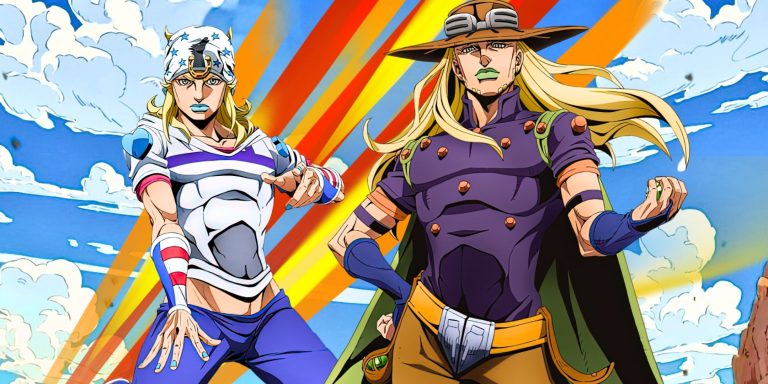
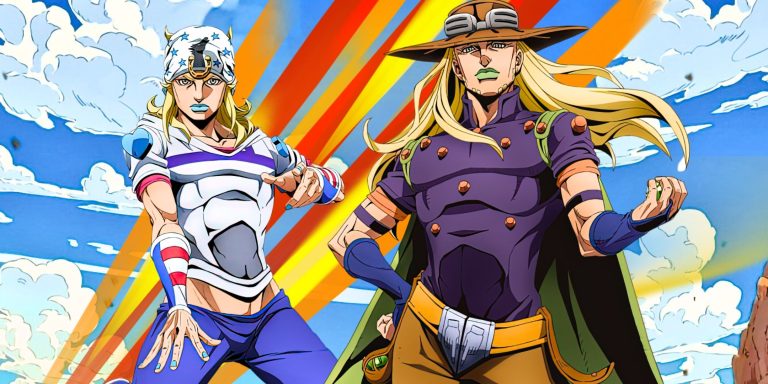
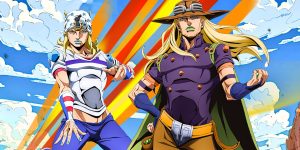
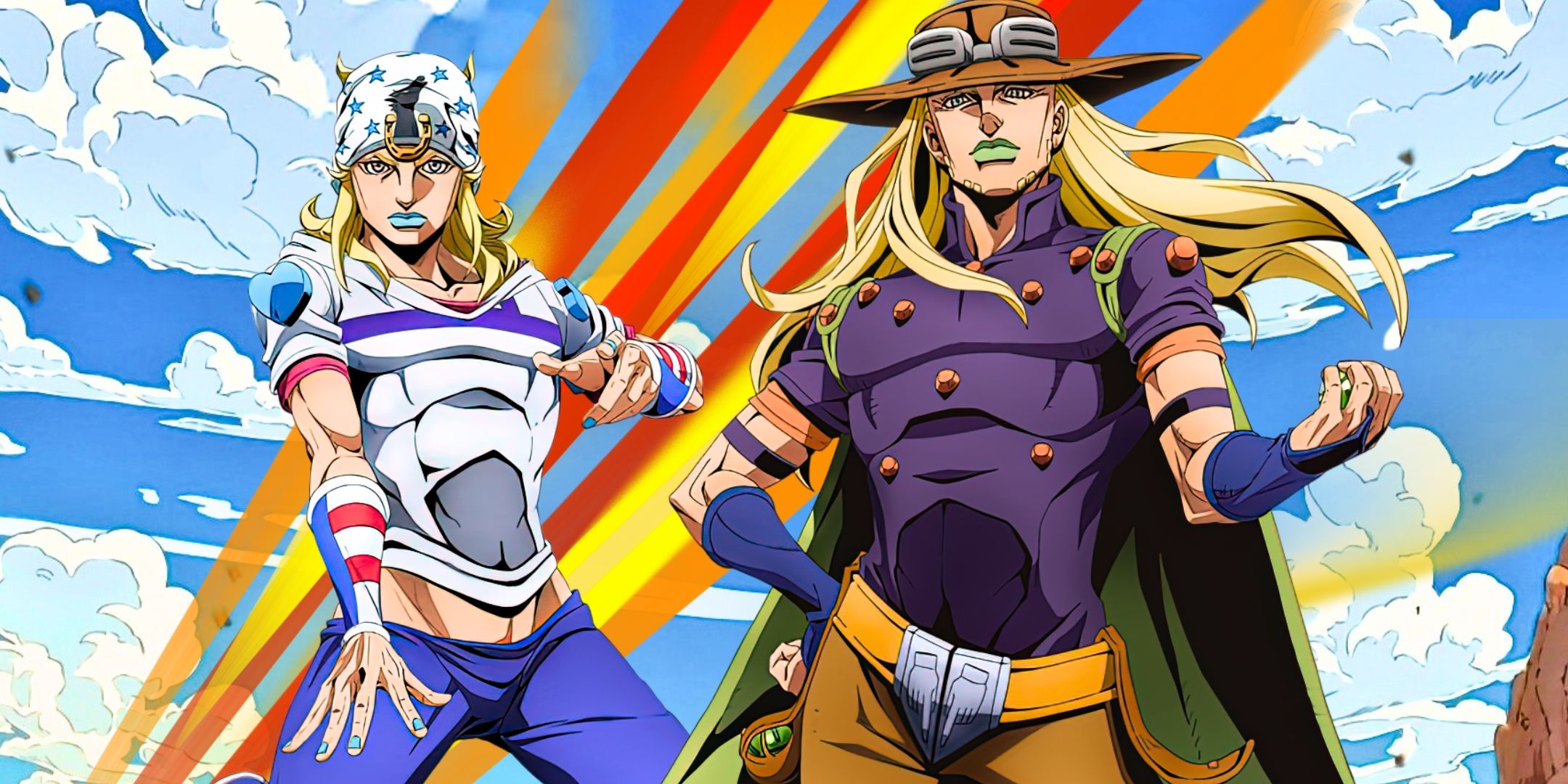
At the center of this sun-scorched odyssey is what is widely considered Araki’s most fully realized character dynamic: the co-dependent, profoundly moving partnership between Johnny Joestar and Gyro Zeppeli.
Johnny Joestar: The Flawed Hero Driven by Desperation
Unlike his upright predecessors—the chivalrous Jonathan or the effortlessly cool Jotaro—Johnny Joestar begins his narrative at absolute rock bottom. A former prodigy jockey struck down by paraplegia following an act of arrogant vanity, Johnny is stripped of his status, his mobility, and his pride. When he discovers that the kinetic rotation of Gyro Zeppeli’s mystical steel spheres can briefly stimulate his severed nerves, Johnny’s motivation isn’t born from selflessness or grand heroism; it is pure, unabashed desperation.
Araki visually anchors this transformation through the recurring motif of “Dark Determination”—those haunting, shadow-drenched flame eyes that signify Johnny’s willingness to kill without hesitation to achieve his goals. He is a protagonist navigating intense emotional vulnerability, making his journey toward physical and spiritual reclamation one of the most compelling arcs in modern Japanese literature.
Gyro Zeppeli and the Golden Ratio: Elevating Stand Mechanics Through the Spin
Standing in stark contrast to Johnny’s brooding desperation is Gyro Zeppeli, a disgraced Neapolitan royal executioner armed with sarcastic quips, steel teeth reading “GO! GO! ZEPPELI,” and an absurd penchant for singing nonsensical songs about pizza mozzarella. Yet, behind Gyro’s theatrical bravado lies an unbearable moral burden: he has entered the race to secure an amnesty for an innocent child condemned to die on his family’s scaffold.
More crucially, Gyro serves as Johnny’s mentor in the ways of “The Spin”—an evolution of Part 1 and 2’s Hamon, reimagined through Renaissance geometry and the Fibonacci sequence. The Spin breathes fresh life into the franchise’s combat design. Stands do not simply exist as punch-ghost apparitions in Steel Ball Run; rather, abilities like Johnny’s Tusk evolve dynamically alongside his comprehension of mathematical perfection and human grief. It is an intricate, cerebral power system that challenges animators to visually communicate abstract geometry in motion.
The Equestrian Hurdle: David Production Facing the “Animator’s Graveyard”
If Steel Ball Run represents the apex of Araki’s storytelling, it equally represents an animator’s logistical nightmare. In the animation industry, horses are notoriously dubbed the “animator’s graveyard.” The four-legged biomechanics of a galloping steed, the undulating muscle groups, the shifting saddles, and the complex foreshortening required during dynamic chase sequences make manual 2D horse animation financially and physically prohibitive over a long-form series.
David Production, which has masterfully stewarded every animated frame of JoJo since 2012, faces a monumental technical crossroads. Fans need only look at contemporary anime history to see how poorly integrated, rigid 3D CGI horses can shatter audience immersion. For Steel Ball Run to maintain the artistic integrity of Araki’s lush illustration style, David Production must pioneer a sophisticated hybrid approach.
Speculation within the production sphere suggests the studio may follow the trail blazed by Studio Orange or MAPPA’s recent high-profile output, leveraging custom cel-shaded 3D horse rigs augmented by hand-drawn 2D corrective layers for close-up hero shots. When combined with the studio’s legendary sound design—relying on weighty foley work and inventive visual onomatopoeia—cracking this mechanical puzzle is the singular hurdle standing between David Production and historical prestige.
Patriotism, Relics, and Moral Ambivalence: The Thematic Weight
An adaptation cannot thrive on spectacle alone, and this is where Steel Ball Run’s overarching narrative weight comes into play. The race is eventually unmasked as an elaborate front orchestrated by the 23rd President of the United States, Funny Valentine, to assemble the mummified, scattered parts of a holy, divine corpse (heavily implied to be Jesus Christ). Valentine’s ambition—to funnel the world’s misfortune away from America so his homeland may bask in eternal prosperity—presents one of the most intellectually compelling antagonist motives in anime history.
Valentine is not a cartoonish villain; his monologues on power, the “First Napkin,” and patriotic sacrifice run circles around standard battle-shonen morality. The resulting friction paints the conflict in shades of gray. Johnny Joestar’s quest to reclaim his legs and soul clashes directly against a head of state operating under a warped doctrine of total nationalistic salvation. This elevates the stakes far beyond the conventional “good vs. evil” paradigms of earlier parts.
The Long Road to the Starting Line
With the dust settled on the Netflix era of Stone Ocean, the anime industry stands on the precipice of an undeniable watershed moment. Steel Ball Run is more than just another sequel in a beloved franchise; it is a reinvention that challenges our understanding of what serial narrative animation can achieve. If David Production takes their time to resolve the immense technical demands of its equestrian battlegrounds, the result will undoubtedly be a generation-defining masterwork.
Until the first official key visual drops, all eyes remain fixed on the starting line in San Diego. The race of a lifetime is brewing just over the horizon, and we are more than ready to ride.
What are your biggest hopes—and fears—for the Steel Ball Run anime adaptation? Do you think David Production should rely on full 2D or embrace stylized CGI for the horses? Jump into the comments below and share your theories!