
Ever since the melancholic, universe-resetting chords of Stone Ocean faded into the digital ether, the global anime community has held a collective, suspended breath. For over a decade, David Production has pulled off one of modern animation’s most daring high-wire acts: translating Hirohiko Araki’s hyper-stylized, genre-defying multi-generational epic into a cultural juggernaut. Yet, throughout every neon-soaked beatdown in Cairo, every psych-rock riff in Morioh, and every mafia turf war across Rome, one looming question has haunted every forum thread and convention panel: When will we ride with the Steel Ball Run?
To call JoJo’s Bizarre Adventure Part 7: Steel Ball Run merely “anticipated” is a profound understatement. Sitting comfortably near the apex of MyAnimeList’s all-time greatest manga rankings, Steel Ball Run is widely revered by critics and purists as Araki’s undisputed magnum opus. It is not just the beginning of an alternate continuity; it is a seismic narrative evolution from kinetic shonen brawler to prestige seinen literature. Now, as industry whispers, trademark filings, and studio scheduling rumors swirl across the internet, the anime sphere is bracing for what could be David Production’s definitive technological and creative frontier.
The Reinvention of Araki’s Mythos: A Gritty, Trans-Continental Odyssey
Serialized from 2004 to 2011—making a crucial mid-run transition from Weekly Shōnen Jump to the monthly pages of Ultra Jump—Steel Ball Run fundamentally dismantled everything fans thought they understood about JoJo’s Bizarre Adventure. Set in an alternate 1890s America, the premise is as audacious as it is exhilarating: an unprecedented 6,000-kilometer cross-country equestrian race stretching from the shores of San Diego to the streets of New York City, boasting a staggering $50 million grand prize.
Yet, underneath the sweeping sun-bleached vistas, dust storms, and echoes of classic Sergio Leone Spaghetti Westerns lies a story drenched in supernatural body horror and cosmic conspiracy. Araki decoupled himself from the increasingly convoluted Stand rules of the original timeline, stripping the supernatural down to a hauntingly elemental mechanic known as The Spin—an ancient Neapolitan kinetic technique rooted in the mathematical perfection of the Fibonacci sequence and the Golden Ratio.
Rather than merely relying on phantom avatars trading rapid-fire punches, Part 7 treats combat as spatial, tactical geometry. When Stands do manifest, they evolve alongside character trauma and physical mastery, intertwined with a clandestine plot involving the mummified, fragmented relics of a Holy Corpse whose geopolitical significance could reshape the destiny of the world.
The Crippled Prodigy and the Executioner: Anatomy of Johnny and Gyro
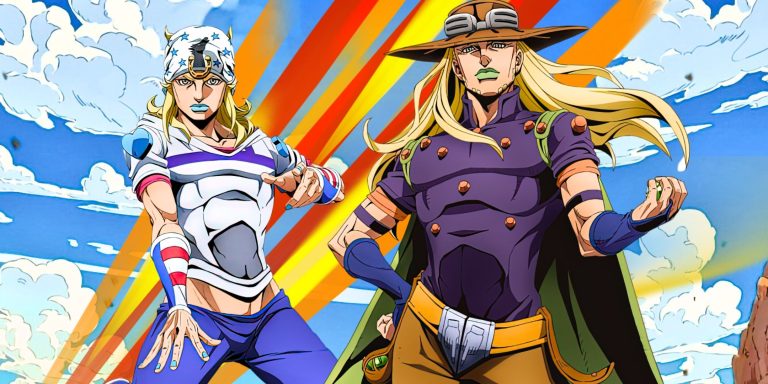
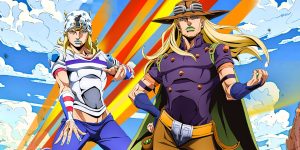
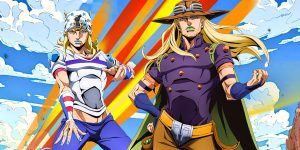
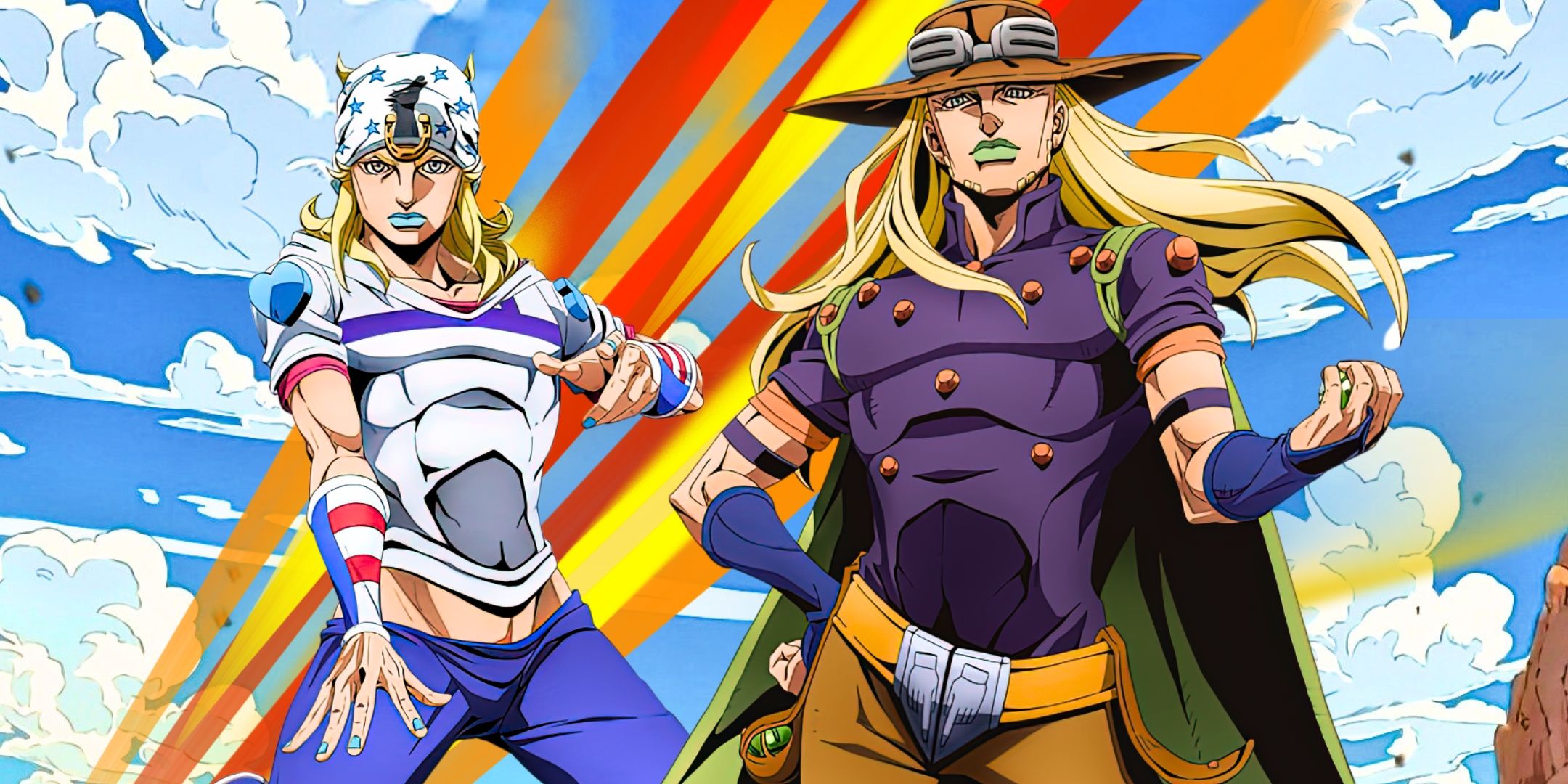
At the beating heart of this sprawling trans-American crucible is arguably the finest dynamic duo in contemporary manga history: Johnny Joestar and Gyro Zeppeli. Their bond forms an emotional architecture far richer and more nuanced than the classic buddy-cop camaraderie seen in previous iterations.
Johnny Joestar: The Dark Determination of a Fallen Star
Unlike the inherently noble Jonathan Joestar or the rakishly heroic Joseph, Johnny begins his journey as an unlikable, tragic figure. A former child equestrian prodigy whose vanity, arrogance, and carelessness led directly to a gunshot wound that paralyzed him from the waist down, Johnny is hollowed out by depression and survivor’s guilt. He is physically broken, emotionally brittle, and entirely uninterested in saving humanity.
Araki frequently illustrates Johnny with literal dark cross-hatching across his eyes—a manifestation of his “dark determination,” a ruthless, animalistic willingness to kill or sacrifice anything to regain what he lost. Johnny is not embarking on the race to reach the mountaintop of heroism; his journey is an agonizing psychological effort to crawl out of the abyss, famously declaring his desire not to reach a positive state, but simply to “get from negative back to zero.”
Gyro Zeppeli: Eccentricity Concealing a Moral Reckoning
Balancing Johnny’s brooding, razor-sharp desperation is Gyro Zeppeli, a disgrace-bound royal executioner from the Kingdom of Naples. Armed with whirling steel spheres, golden teeth bearing the message “GO! GO! ZEPPELI,” and a surreal affinity for nonsensical jokes about pizza mozzarella, Gyro initially projects the illusion of an untouchable, swaggering rogue. Yet underneath his eccentric bravado lies a profoundly tender moral crisis: he entered the lethal race solely to secure royal amnesty for a wrongfully condemned child sentenced to the gallows.
The philosophical friction and subsequent mutual codependency between Johnny and Gyro elevates Steel Ball Run above its predecessors. Gyro functions as mentor, brother, and spiritual anchor, while Johnny acts as the terrifying pragmatist willing to plunge into damnation when Gyro’s conscience hesitates. Their evolving bond provides the emotional ballast necessary to navigate a narrative filled with sheer, unrelenting cruelty.
The Equestrian Bottleneck: David Production’s Technical Gauntlet
If the narrative of Steel Ball Run is a masterpiece waiting to be brought to life, its logistical realization is an animator’s waking nightmare. Within the anime industry, there is an unspoken law etched in blood and budget sheets: animating horses is the quickest route to production collapse.
Equestrian animation demands an excruciating comprehension of quadruped anatomy, complex muscle deformation, dynamic foreshortening, and shifting gait rhythms. In Steel Ball Run, these horses aren’t standing passively in the background; they are engaged in high-velocity combat, charging through raging rivers, dodging dinosaur transformations, navigating canyon shootouts, and kicking up persistent dust particulate across dynamic, ever-changing topography.
David Production cannot approach Part 7 with the same production methodology that carried Phantom Blood or Diamond is Unbreakable. Hand-drawing hundreds of unique, galloping thoroughbreds across a multi-cour television run is functionally impossible under modern Japanese television schedules without catastrophic outsourcing drops. The studio faces a critical crossroads:
- The Hybrid 3D CGI Dilemma: Utilizing high-end 3D models for the horses—akin to Wit Studio’s approach in early Attack on Titan or MAPPA’s Vinland Saga—integrated with hand-drawn riders. However, achieving seamless compositing without plunging into the uncanny valley will demand state-of-the-art non-photorealistic rendering (NPR) shaders to honor Araki’s distinct cross-hatching and ink washes.
- A Strategic Film or Multi-Part Format: The sheer scope may force David Production and Warner Bros. Japan to rethink distribution, potentially splitting the introductory stages into theatrical releases or shorter, prestige-budgeted cours to preserve sakuga fidelity.
Ideological Warfare: The First Napkin and Funny Valentine
An adaptation’s longevity lives and dies by its antagonist, and in President Funny Valentine, Steel Ball Run possesses one of the most intellectually compelling adversaries in modern media. Operating beneath the mantra of absolute American exceptionalism, Valentine seeks the Holy Corpse to construct an impenetrable geopolitical aegis around the United States, utilizing his dimensional-hopping Stand, Dirty Deeds Done Dirt Cheap (D4C).
His infamous “First Napkin” monologue—a masterclass in political philosophy positing that society is governed exclusively by whoever dictates the unspoken terms of engagement—frames the climax of Part 7 not as a battle between light and dark, but as an ideological clash between aggressive, utilitarian nationalism and raw, personal self-actualization. In our modern socio-political landscape, Valentine’s charismatic, unwavering, and chillingly clean-handed fanaticism will undoubtedly spark explosive discourse across the wider pop-culture spectrum.
The Horizon Beckons: Can the Anime Capture Lightning in a Bottle?
The anticipation for Steel Ball Run is a volatile powder keg. After the controversial, momentum-sapping Netflix batch-drop release model of Stone Ocean, the fandom’s collective demand is clear: Part 7 must return to weekly serialized broadcast. It requires the communal ecstasy of weekly theory-crafting, reaction cycles, and musical reference dissections that made the airings of Stardust Crusaders and Golden Wind such appointment-viewing phenomena.
Adapting Steel Ball Run is not just the next logical chapter for David Production; it is an epochal trial. If they can conquer the equestrian logistical mountain and capture the raw, tragic poetry of Johnny and Gyro’s journey, they will not merely deliver another stellar season of television—they will cement one of the crowning triumphs of modern anime history.
The starting pistol hasn’t fired yet, but the horses are at the gate. How do you think David Production should tackle the legendary equestrian animation hurdle? Can a CGI hybrid truly capture Araki’s inkwork? Sound off in the comments below, and let us know your dream voice cast for Johnny and Gyro!