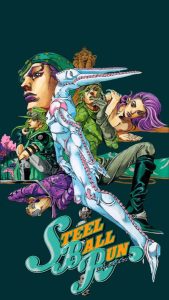
Ever since the crimson strings of destiny tied the Joestar bloodline to an inevitable climax in Stone Ocean, the global anime community has held a singular, collective breath. For over a decade, David Production pulled off one of the greatest adaptation miracles in modern animation history, faithfully translating Hirohiko Araki’s eccentric, hyper-stylized masterpiece into an indelible pop-culture juggernaut. Yet, as the final credits rolled on Jolyne Cujoh’s tragic yet triumphant finale, a new dawn broke over the horizon—one coated in desert dust, gunsmoke, and the thunderous pounding of hooves across the American frontier. We have arrived at the precipice of JoJo’s Bizarre Adventure: Steel Ball Run.
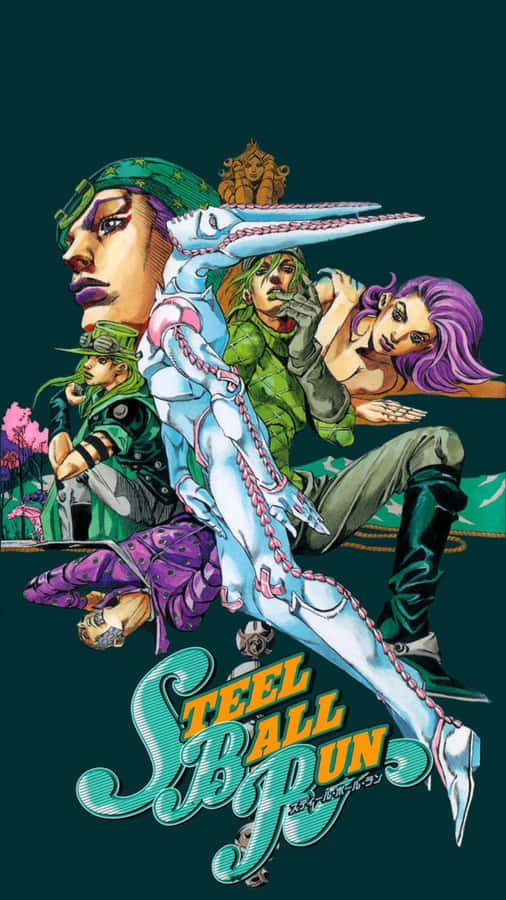
Widely heralded by critics and manga scholars alike as Araki’s undisputed magnum opus, Steel Ball Run represents far more than just Part 7 of an ongoing franchise; it is an audacious artistic rebirth. Transitioning from the weekly shonen grind of Weekly Shonen Jump to the monthly, uninhibited pages of Ultra Jump, Araki untethered himself from commercial conventions to craft an intoxicating cocktail of alternate-history western, cosmic horror, high-stakes sports drama, and existential tragedy. As industry rumors swell and anticipation reaches a fever pitch, the question paralyzing fandom forums from Tokyo to Reddit is no longer if David Production will tackle it, but how the studio can conquer the monumental technical and narrative crucible that lies ahead.
The Golden Ratio: How Araki Reinvented Supernatural Combat
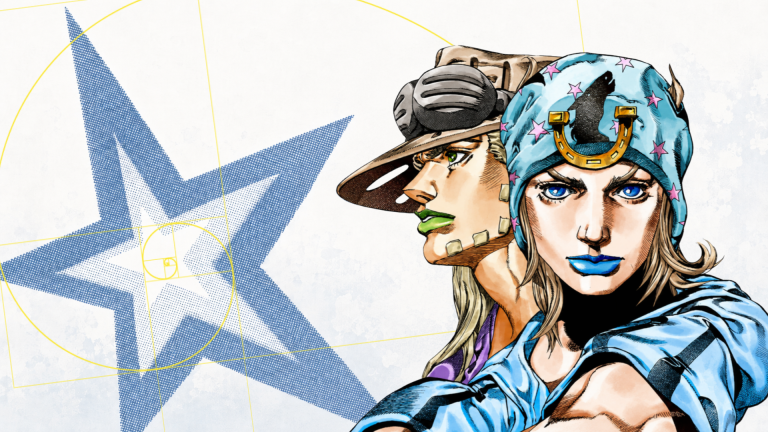
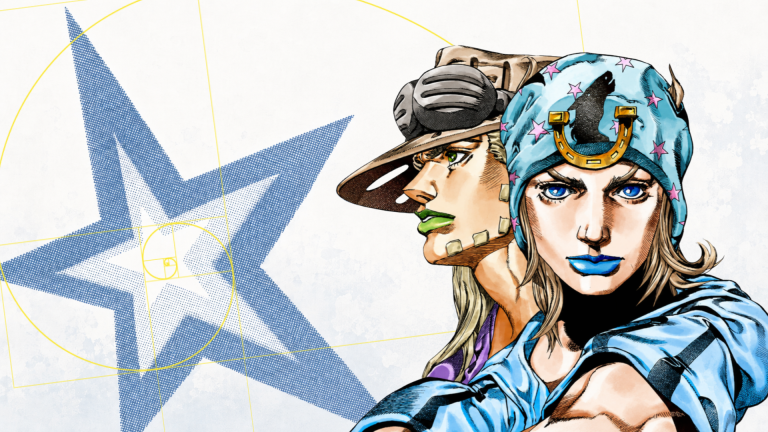
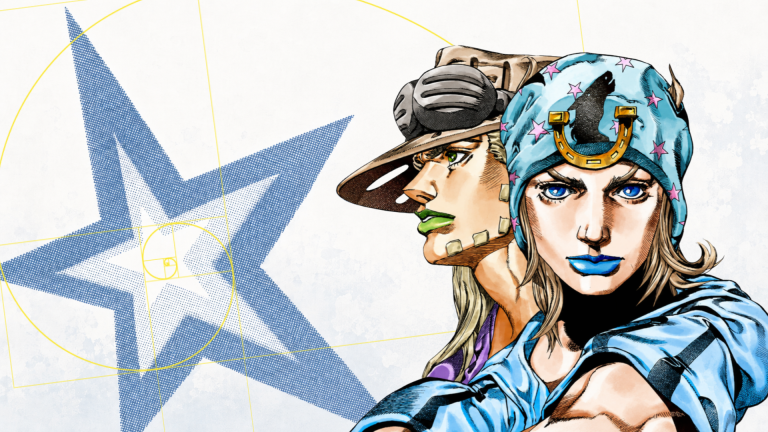
When Araki reset his universe following the reality-collapsing events of Part 6, he didn’t just clear the deck—he fundamentally rebuilt the franchise’s combat philosophy. In Steel Ball Run, the supernatural ceases to be purely about punch-ghost personifications; instead, it synthesizes Renaissance mathematics, sacred geometry, and anatomy into the ancient Neapolitan discipline known as the Spin (Kaiten).
The Spin acts as an evolutionary synthesis, bridging the elemental respiration of Hamon with the psychological complexity of modern Stands. Utilizing spherical projectiles governed by the Golden Ratio—the logarithmic spiral found everywhere from nautilus shells to swirling hurricanes—Araki roots his battles in kinetic visual physics. Through Gyro Zeppeli’s mystical Steel Balls and Johnny Joestar’s evolution of his nail-bullet Stand, Tusk, combat becomes an escalating masterclass in spatial awareness and gravitational manipulation.
From Hamon to Gravitational Singularities
Unlike earlier installments where power scaling occasionally tipped into absurdity, the progression of the Spin feels earned, mathematical, and deeply cosmic. When Johnny realizes that the ultimate application of the Golden Spin can break through interdimensional barriers, Araki is not granting an unearned shonen power-up; he is linking human willpower to the fundamental constants of the universe. For David Production, rendering this aesthetic requires a visual overhaul: shifting from sharp, urban neon palettes to gritty, sun-bleached watercolor washes interspersed with dynamic vector lines that convey rotational kinetic force.
A Paraplegic Jockey and an Executioner: The Psychology of Johnny and Gyro
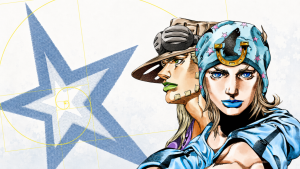
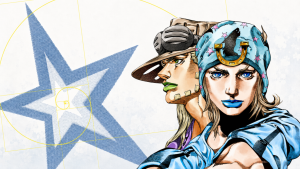
At the beating heart of Steel Ball Run is an unforgettable central partnership that shatters conventional heroic tropes: Johnny Joestar and Gyro Zeppeli. Rather than the righteous valor of Jonathan or the cool-headed stoicism of Jotaro, Johnny begins his trek as a deeply cynical, emotionally broken former horse-racing prodigy. Paralyzed from the waist down following a catastrophic act of youthful vanity, Johnny joins the trans-continental race not out of nobility, but out of a desperate, selfish urge to reclaim his humanity after witnessing Gyro’s Spin miraculously cause his paralyzed legs to twitch.
Johnny is defined by what Araki calls “dark determination”—a cold, unyielding fire in his eyes that reveals an anti-hero completely prepared to kill if it means crawling out of the figurative “negative” and returning to “zero.” He is one of manga’s most complex portrayals of disability and trauma, fighting not to save the world, but to rediscover his personal self-worth.
Serving as both his mentor and existential foil is Gyro Zeppeli, a disgraced royal executioner from Naples racing to secure political amnesty for an innocent child condemned to death. Gyro is a paradoxical marvel: an eccentric, grill-wearing goofball who cracks nonsensical jokes about mozzarella cheese, yet carries the agonizing weight of his family’s grim tradition on his shoulders. Their bond isn’t built on heroic platitudes, but forged over campfire banter, shared failure, and quiet moments of solidarity beneath the starry skies of the American Midwest. Translating their emotional chemistry demands voice actors capable of swinging effortlessly between gut-busting camp and devastating, tear-soaked intimacy.
David Production’s Ultimate Crucible: The “Horse Problem”
While fans clamor for the adaptation’s announcement, industry veterans recognize the elephant in the production room—or rather, the horse. Steel Ball Run centers on an epic 6,000-kilometer race across late-19th-century America, featuring dozens of jockeys galloping at breakneck speeds across dynamic topography. In the world of anime production, four-legged animals are notoriously terrifying to animate.
A galloping horse requires complex anatomical deformation, precise muscular shifting, and consistent perspective foreshortening. Hand-drawing these sequences in traditional 2D across a projected 36-to-48-episode run would obliterate standard production budgets and run even elite animators into the ground. Historically, studios like MAPPA and Wit have leaned heavily on 3D CGI to handle equestrian elements in shows like Attack on Titan and Vinland Saga, often yielding mixed visual cohesion.
For David Production, this is their greatest trial. To do justice to Araki’s detailed ink work, the studio must pioneer an innovative hybrid technique. Utilizing hyper-detailed cell-shaded 3D horse models layered with hand-drawn characters and Araki’s trademark cross-hatching textures may be the only sustainable path forward. Furthermore, fans are unified on one crucial operational front: after the controversial batch-drop model of Stone Ocean on Netflix deflated organic weekly buzz, Steel Ball Run desperately requires a traditional weekly broadcast release to reclaim its status as a communal internet phenomenon.
Manifest Destiny Gone Bizarre: Funny Valentine and the Holy Relic
What elevates Steel Ball Run from a gripping sports epic into high-concept historical fiction is its sprawling political conspiracy. The race itself is a smokescreen engineered by the 23rd President of the United States, Funny Valentine, whose goal is nothing less than the collection of the severed, mummified Corpse Parts of an ancient holy figure—heavily implied to be Jesus Christ.
Valentine is widely regarded as one of anime’s greatest ideological foils. Backed by his dimension-hopping Stand, Dirty Deeds Done Dirt Cheap (D4C), Valentine is not motivated by petty sadism or juvenile villainy; he is propelled by a radically unshakeable patriotism. His doctrine of the “First Napkin”—the philosophical premise that whoever seizes initiative sets the table for global civilization—argues that America must monopolize all worldly fortune, willingly exporting all global misfortune elsewhere.
This grand clash between Valentine’s collectivist, imperialist zeal and Johnny’s raw, personal drive for individual redemption gives Part 7 its monumental thematic resonance. It interrogates the mythology of the American Dream, divine providence, and the price of progress. The choreography of D4C’s multidimensional mechanics alone will require unprecedented storyboarding ingenuity to keep the spatial logic coherent on screen.
The Horizon Ahead: When Will the Starting Gun Fire?
The road to adapting JoJo’s Bizarre Adventure: Steel Ball Run is a marathon, not a sprint. Fandom patience has been tested through long hiatuses, but that restraint has only elevated the source material to sacred status. David Production has consistently demonstrated an unmatched reverence for Hirohiko Araki’s legacy, and they know that mishandling Part 7 is simply not an option.
When the starting gun finally rings out and the opening chords of an inevitable modern-western JoJo score drop, it won’t just be another seasonal anime premiere—it will be an industry-defining event that cements the franchise into the pantheon of animated masterpieces. Steel your resolve, sharpen your Golden Rectangles, and hold your horses. The greatest race in anime history is creeping ever closer to the starting line.
What are your biggest hopes—and fears—for David Production’s adaptation of Steel Ball Run? Which voice actors do you want to see bring Johnny and Gyro to life? Sound off in the comments below, and stay tuned to Wibux.com for all breaking JoJo updates!