
Ever since the cosmic, melancholy reset of Stone Ocean drew to a close in late 2022, a singular, deafening murmur has echoed across the international anime landscape. It is not a question of if, but when and how. The target of this insatiable anticipation is none other than JoJo’s Bizarre Adventure: Steel Ball Run—Hirohiko Araki’s sprawling, genre-defying ninth-century American epic. Consistently ranked alongside Miura’s Berserk at the absolute pinnacle of manga literature, Part 7 is widely revered as Araki’s magnum opus. Yet, as David Production remains tantalizingly tight-lipped about their production schedule, the discourse surrounding this holy grail of adaptations has reached a fever pitch. Adapting Steel Ball Run is not just the next logical phase for a beloved franchise; it is the ultimate creative frontier for modern television animation.
The Trans-Continental Odyssey: Reinventing the JoJo Mythos
To understand the unprecedented fervor surrounding Steel Ball Run, one must first recognize the structural seismic shift it represents in Araki’s creative timeline. When serialized in 2004, the series initially discarded the traditional JoJo moniker, masquerading as an eccentric standalone western before revealing its true lineage. Set in 1890, the narrative chronicles the titular Steel Ball Run race: a brutal, non-regulated 4,000-mile equestrian trek spanning from the beaches of San Diego to the streets of New York City, lured by a life-altering fifty-million-dollar purse.
More crucial than its dusty plains and clockwork revolvers was Araki’s mid-run migration from the grueling confines of Weekly Shōnen Jump to the roomier, creator-centric confines of the monthly Ultra Jump. Unchained from strict page-count limits and shōnen editorial mandates, Araki’s prose blossomed into something profound, morally gray, and unapologetically mature. The sprawling panels traded fast-paced brawling for expansive vistas, devastating psychological warfare, and an almost sacred mystery surrounding the race’s true objective: the unearthing of a scattered, mummified holy relic known as the Saint’s Corpse. It is a story where divine intervention collides head-on with imperialist manifest destiny.
Johnny and Gyro: A Masterclass in Flawed Protagonism
At the beating heart of this cross-country odyssey is the finest character dynamic Araki has ever penned. Rather than the indomitable gentleman Jonathan Joestar or the cool-headed stoicism of Jotaro Kujo, Part 7 presents us with protagonists who are painfully, desperately human.
Johnny Joestar’s “Dark Determination”
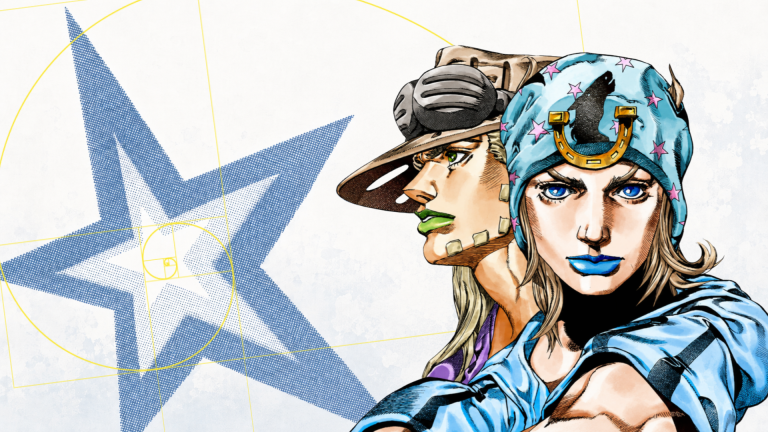
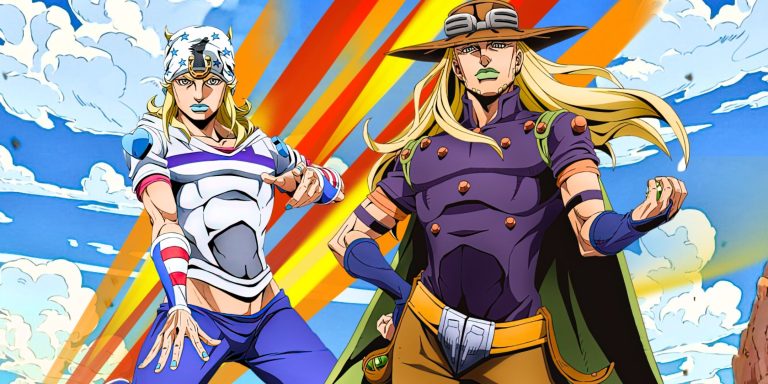
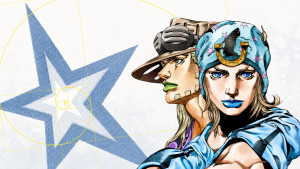
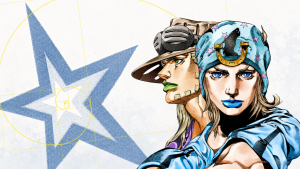
Johnny Joestar is not a traditional hero. A disgraced former horse-racing prodigy who lost his status and the use of his legs due to sheer hubris, Johnny begins his journey not out of a desire to save the world, but out of a raw, selfish yearning to reclaim his footing. When he discovers that the strange spinning weapons used by an eccentric foreigner cause his paralyzed legs to momentarily twitch, his pursuit of redemption turns obsessive.
Araki frequently illustrates Johnny with “shikkoku no ishi”—a dark, terrifying determination visible in his eyes that unnerves his companions as much as his adversaries. Johnny does not strive to ascend from zero to positive; his tragic, gripping arc is an agonizing struggle merely to haul his spirit from negative back to zero. His evolving Stand, Tusk, mirrors this harrowing psychological ascension through distinct Acts, growing from a helpless, fingernail-shooting anomaly into an interdimensional force of absolute consequence.
Gyro Zeppeli and the Sacred Geometry of the Spin
Riding beside Johnny is Gyro Zeppeli, a disgraced Neapolitan executioner’s son armed with twin steel orbs and a vibrant personality lined with gold-plated teeth. Gyro enters the race to win royal amnesty for an innocent child condemned to death, masking his deep familial trauma beneath absurd musical compositions about mozzarella cheese and terrible daily puns.
Gyro acts as both mentor and foil, introducing the lore’s most mathematically intoxicating battle mechanic: The Spin. Transcending the solar breathing of Hamon and refining the metaphysical mechanics of Stands, the Spin is rooted in natural law—harnessing the Fibonacci sequence and the Golden Rectangle found throughout the organic world. Through Gyro, Araki elevates kinetic physics into visual poetry, turning thrown spheres into engines of distorted gravity, cellular destruction, and mystical illumination.
The Galloping Titan: David Production’s Technical Crucible
If Steel Ball Run is universally celebrated as a narrative masterpiece, why the prolonged radio silence from David Production? The answer lies in one word that sends chills down the spine of every animator in Tokyo: horses.
Equestrian animation is notoriously acknowledged within the anime industry as an agonizing technical ordeal. A horse’s complex musculoskeletal framework, the undulating rhythm of its four-legged gait, and the constant shift in perspective required during high-speed chases make hand-drawn 2D sequences extraordinarily cost-prohibitive and time-intensive. Even celebrated industry giants like MAPPA and Wit Studio have heavily relied on rigid 3D models to render mounted cavalry—often with polarizing, visually jarring results that pull viewers out of the immersion.
David Production built its legacy on tactile kineticism, explosive color swaps, and hyper-detailed manga-accurate line-art. For Steel Ball Run, they face a staggering logistical dilemma:
- Rendering dozens of unique thoroughbreds galloping across dynamic topography in continuous, fast-paced tactical battles.
- Blending potential 3D CGI cel-shaded models seamlessly with their iconic, hyper-stylized 2D aesthetic without crossing into the uncanny valley.
- Preserving the hyper-detailed linework and textured, weathered rendering characteristic of Araki’s mature seinen style.
The studio’s recent triumphs with the visual feast of Urusei Yatsura and the gritty atmospheric weight of Fire Force prove their technical prowess is expanding, but Part 7 will necessitate an entirely overhauled digital pipeline. It is not an adaptation that can be rushed; to deliver anything less than perfection would be treated as sacrilege by the global anime community.
The Moral Horizon: Funny Valentine and Cultural Transcendence
Beyond the technical obstacles and dynamic duos lies the thematic ambition of the narrative’s central conflict. Part 7 introduces what many consider anime’s most compelling political antagonist: Funny Valentine, the 23rd President of the United States. Valentine is a patriot devoid of cartoonish malice, seeking the Saint’s Corpse to guarantee an eternity of wealth and geopolitical prosperity for his homeland at the expense of the rest of the globe.
His dimension-hopping Stand, Dirty Deeds Done Dirt Cheap (D4C), challenges traditional spatial logic, while his philosophical thesis—the foundational metaphor of “taking the first napkin”—presents a chilling meditation on collective conformity, power dynamics, and national exceptionalism. It elevates the conflict beyond good and evil into a clash of absolute, incompatible wills.
The Dawn of an Unprecedented Era
We are standing on the precipice of an epochal moment in anime history. JoJo’s Bizarre Adventure: Steel Ball Run is not just another seasonal cour; it is a sprawling, high-concept, supernatural Western opera that possesses the narrative horsepower to redefine the medium on a global stage. The passion of the fanbase is self-evident—fan-made musical concepts, high-budget indie trailers, and endless community debates have kept the embers blazing hot during this prolonged interregnum.
When David Production finally flashes that inaugural teaser trailer, displaying a sun-drenched San Diego coastline and the thunderous rumble of hooves on hard-packed earth, the anime world will stop spinning. Until then, our collective eyes remain fixed on the horizon, waiting for the starting gun to fire.
What are your biggest hopes—or deepest fears—for the Steel Ball Run adaptation? Do you think David Production should use full CGI for the horses, or fight for hand-drawn fidelity? Sound off in the comments below, and keep your browsers locked to Wibux.com for all your breaking anime updates!