Ever since the melancholic, bittersweet chords of Duffy’s “Distant Dreamer” signaled the conclusion of JoJo’s Bizarre Adventure: Stone Ocean in late 2022, the global anime community has found itself locked in a state of suspended animation. The original universe conceived by Hirohiko Araki had run its course, ending an unbroken multi-generational bloodline war that stretched from Victorian England to a maximum-security prison in Florida. Yet, for seasoned manga readers and casual anime enthusiasts alike, the end of Part 6 was never viewed as a farewell—it was merely the prologue to the main event. Now, the collective gaze of the fandom shifts toward the arid, dust-choked trails of late-19th-century North America. The anticipation surrounding an adaptation of Part 7: Steel Ball Run has transcended standard seasonal hype; it has become an obsession.
Widely revered as Araki’s undisputed magnum opus, Steel Ball Run regularly jostles with Kentaro Miura’s Berserk for the highest-rated spot on global manga indices. But bringing this sprawling, supernatural horse race across the American frontier into serialized animation represents an unprecedented mountain for David Production to climb. Between existential thematic reinventions, complex mathematical combat systems, and the notoriously brutal technical logistics of horse animation, the road ahead is as perilous as the race itself.
The Shift to Seinen: Araki’s Reinvention of the Bizarre
To understand the monumental buzz surrounding a potential anime announcement, one must understand how radically Steel Ball Run altered the creative DNA of the entire franchise. Launched in 2004 in the pages of Weekly Shōnen Jump before transitioning to the monthly, older-skewing demographic of Ultra Jump, Part 7 freed Hirohiko Araki from the editorial guardrails that constrained typical youth manga. The resulting work was not just a narrative reset, but a philosophical elevation.
Resetting the Universe and Elevating Stakes
Gone was the lineage of inherently righteous paragons battling theatrical evil. Set in an alternate 1890, the story follows the eponymous Steel Ball Run: a grueling, cross-country horse race spanning from the Pacific coast of San Diego to the bustling metropolis of New York City, lured by a staggering $50 million grand prize. Beneath this capitalist spectacle lies an occult geopolitical conspiracy of biblical proportions—a desperate scramble to assemble the mummified relics of an unnamed Saint, whose supernatural fragments bestow reality-warping blessings upon whoever controls them.
By transplanting the narrative into a hyper-stylized reimagining of the American West, Araki engaged directly with the mythos of Manifest Destiny, colonial expansion, and the brutal moral compromises of progress. The tone shifted from colorful supernatural melodrama to a prestige Western picaresque, steeped in grimy realism, historic verisimilitude, and psychological grit.
Johnny Joestar and Gyro Zeppeli: Dualism in the American Badlands
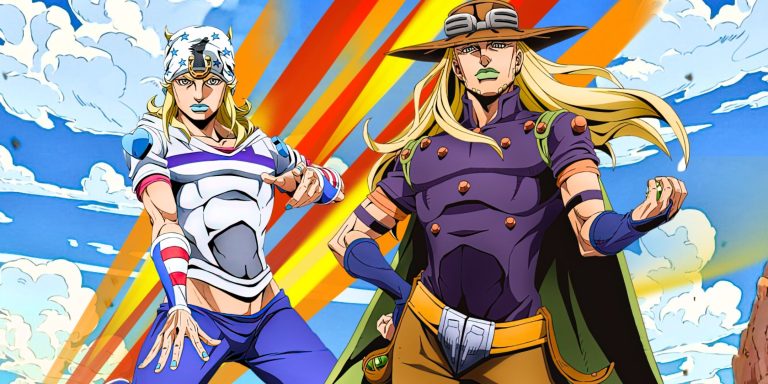
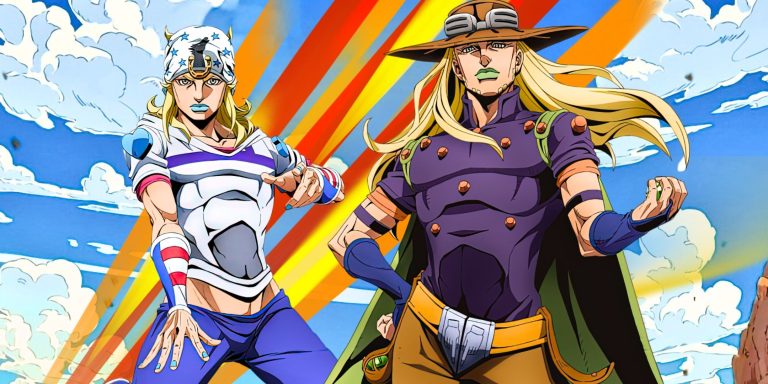
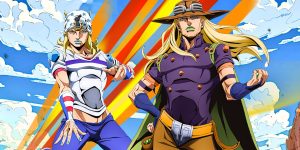
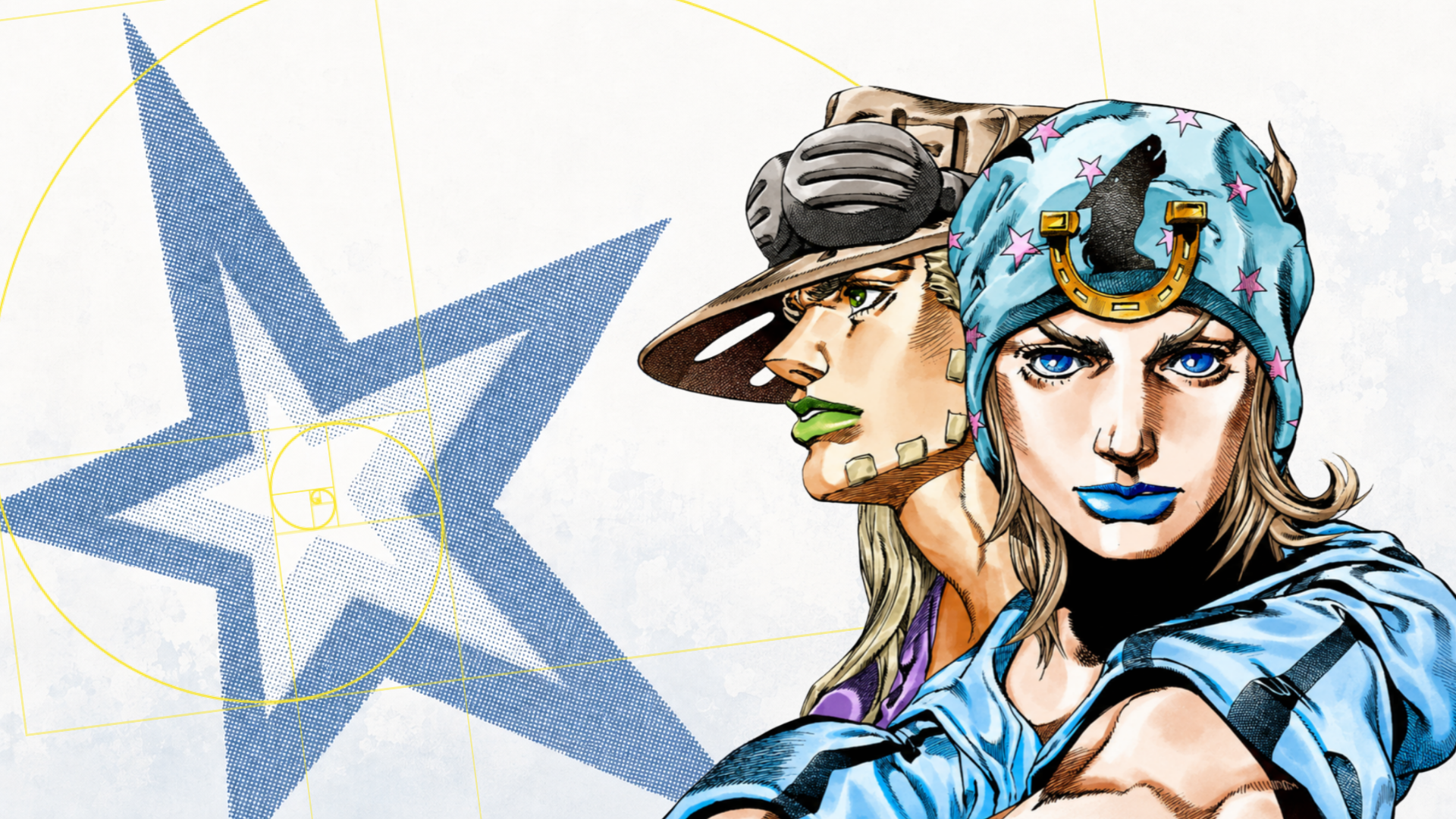
At the beating heart of this grand transcontinental trek is what is widely considered the finest character duo Araki has ever penned: Johnny Joestar and Gyro Zeppeli. Their relationship forms an emotional anchor rarely matched in the medium, shifting the series’ trademark buddy dynamic into something profound, tragic, and profoundly human.
From Paraplegia to Transcendence: Johnny’s “Dark Determination”
Johnny Joestar is deliberately constructed as the polar opposite of the noble, incorruptible Jonathan Joestar from Part 1. A former child-prodigy jockey struck down in his prime by a senseless act of violence that left him paralyzed from the waist down, Johnny begins the story not as a hero, but as a bitter, washed-up cynic. He does not join the race for national pride, glory, or even wealth. His motivation is raw, desperate, and singularly selfish: after an encounter with Gyro Zeppeli’s mystic weapon causes his legs to momentarily twitch with life, Johnny resolves to chase that sensation to the ends of the earth.
Johnny’s journey with his Stand, Tusk, serves as a direct mirror to his psychological reconstruction. As he matures through brutal physical trials and ethical dilemmas, his Stand evolves from a frail, embryonic creature into a devastating, dimension-shattering colossus. Araki does not shy away from Johnny’s flaws; the narrative repeatedly highlights the cold, vacant “dark determination” in Johnny’s eyes—a willingness to commit murder without hesitation if it means getting closer to his goal. He is an anti-hero who strives not to go from zero to positive, but simply to claw his way out of the negative back to zero.
The Steel Balls, Neapolitan Humor, and The Spin
Standing beside him is Gyro Zeppeli, a disgraced executioner’s son from the Kingdom of Naples whose boisterous flamboyance and eccentric humor mask an excruciating burden of conscience. Gyro enters the race to win an amnesty plea for an innocent child sentenced to death back home. Unlike Johnny, Gyro possesses a moral center, yet he operates through an almost operatic layer of swagger, complete with gold-plated teeth and an obsession with composing nonsensical songs about pizza mozzarella.
Gyro is the master of The Spin—a forgotten martial art that weaponizes rotational kinetic energy, bypassing traditional Stand mechanics through the geometry of the Golden Ratio. The intellectual dance between Johnny’s desperate yearning and Gyro’s philosophical stoicism elevates Steel Ball Run into an exquisite character study. Their campfire banter feels organically lived-in, making the inevitable tragedies of the open trail hit with shattering emotional weight.
The Technical Nightmare: Horses, CGI, and David Production’s Next Frontier
If the storytelling of Steel Ball Run is universally lauded, the industrial reality of adapting it is a source of acute anxiety among animators. In the modern anime production pipeline, there is no creature more universally feared by key animators than the quadrupedal horse—let alone dozens of them running simultaneously at high speeds.
The Equestrian Hurdle in Modern Anime
Four-legged galloping anatomy requires a staggering volume of hand-drawn frames to capture weight, muscle deformation, and realistic kinetic momentum. A single equestrian battle, rendered entirely in classic 2D animation, could drain the time, budget, and physical stamina of an entire animation department within weeks. To sustain that level of kinetic fluidity across fifty or sixty episodes of an uninterrupted cross-country race is financially and logistically impossible under standard production schedules.
Industry insiders and technical analysts recognize that David Production will almost certainly be forced to rely on hybrid workflows, integrating bespoke 3D CGI models for the horses alongside hand-drawn riders and Stand effects. The ultimate challenge will be fidelity: blending these CGI models seamlessly into the high-contrast, chiaroscuro aesthetic that has defined the studio’s signature JoJo look since 2012. If the horses appear stiff, weightless, or visibly detached from their desert environments, the visual immersion that makes Part 7 iconic could rapidly evaporate.
Reclaiming the Cultural Momentum Post-Stone Ocean
Beyond the drawing board, David Production and Warner Bros. Japan must also navigate distribution mechanics. The controversial, staggered “batch release” model employed by Netflix for Stone Ocean severely dampened organic week-to-week internet discourse, blunting the cultural ripple effect that once fueled Parts 3 through 5. For a masterwork like Steel Ball Run, fans and critics alike are clamoring for a return to the classic weekly episodic broadcast format, allowing community theory-crafting and sheer narrative momentum to build in real time.
The Ideological Warfare of Funny Valentine
No dissection of Steel Ball Run is complete without acknowledging its centerpiece antagonist: the 23rd President of the United States, Funny Valentine. Far removed from the vampiric sadism of Dio Brando or the sociopathic quietism of Yoshikage Kira, Valentine is an ideological monolith powered by an unyielding, fanatical utilitarianism.
Armed with D4C (Dirty Deeds Done Dirt Cheap), a Stand that manipulates parallel dimensions and the absolute laws of cause and effect, Valentine genuinely believes his pursuit of the Saint’s Corpse is an act of supreme benevolence. In his mind, collecting the relics will construct an untouchable sanctuary of fortune for the United States, banishing all suffering beyond its borders to the rest of the world. The clash between Johnny’s deeply personal pursuit of bodily autonomy and Valentine’s grandiose, self-righteous imperialism turns the climax of Part 7 into an electrifying debate on morality, nationalism, and the cost of greatness.
The Horizon Awaits
The adaptation of JoJo’s Bizarre Adventure: Steel Ball Run is not merely the next project on David Production’s slate; it is the definitive test of the studio’s artistic maturity. It requires balancing the raw, dust-caked brutality of an American epic with the psychedelic, hyper-vibrant artistic flourishes that define Hirohiko Araki’s visual lexicon. The stakes are immense, but so is the potential reward: a faithful, meticulously crafted adaptation could easily claim a spot among the greatest anime series ever produced.
What do you think is the biggest hurdle facing David Production with Steel Ball Run? Can CGI horses truly capture Araki’s artistic brilliance, or are you hoping for an extended pre-production to ensure hand-drawn perfection? Drop your thoughts, dream voice casts, and stand predictions in the comments below!