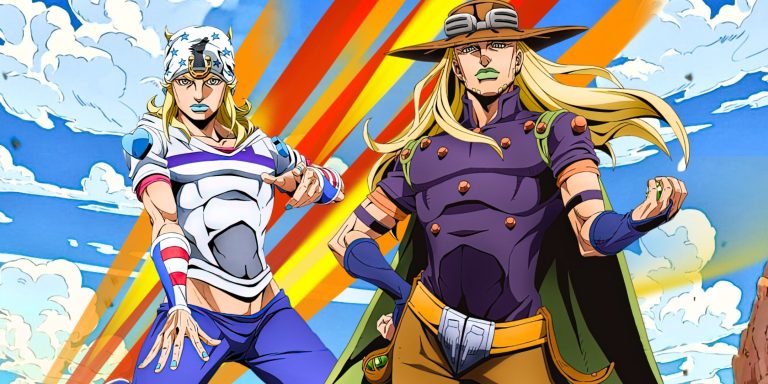
Ever since the bittersweet, melancholic strings of the Stone Ocean finale echoed into the ether in late 2022, an unspoken, collective tension has gripped the anime landscape. For over a decade, David Production pulled off what was once deemed an insurmountable task: adapting Hirohiko Araki’s multi-generational, dimension-spanning tapestry into a coherent, hyper-stylized modern animation juggernaut. Yet, throughout that entire journey—from the Victorian hallways of Phantom Blood to the humid confinement of Green Dolphin Street—every veteran fan knew that the road was ultimately leading toward a singular, legendary summit. That summit is JoJo’s Bizarre Adventure: Steel Ball Run.
Universally lauded and permanently entrenched near the pinnacle of global manga rankings, Steel Ball Run is not just the seventh installment of a celebrated franchise; it is Araki’s sprawling magnum opus. The ongoing industry buzz surrounding its inevitable anime adaptation is neither standard seasonal hype nor fleeting social media speculation. It represents a watershed moment for modern anime production—a convergence of prestige storytelling, radical thematic reinvention, and what is shaping up to be David Production’s most terrifying technical trial to date.
A Trans-Continental Renaissance: Araki’s Leap into the Seinen Stratosphere
To understand the sheer magnitude of the hype around Steel Ball Run, one must first understand its historical weight within Araki’s creative journey. Serialized initially in Weekly Shonen Jump in 2004 before transitioning to the monthly seinen pages of Ultra Jump, Part 7 freed Araki from the grueling, youth-oriented shackles of weekly shonen deadlines. The result was an explosive creative renaissance. Araki wiped the slate clean, resetting the timeline to 1890 and staging a grueling, coast-to-coast horseback race across the rugged expanse of North America with a staggering fifty-million-dollar purse.
This was no longer just an eccentric martial-arts mystery or a flamboyant urban skirmish. Steel Ball Run morphed into an epic American Western steeped in dusty grit, cosmic body horror, and geopolitical intrigue. By pivoting to a monthly format, Araki’s artwork transcended comic conventions, evolving into hyper-detailed, neoclassical illustrations reminiscent of Renaissance anatomy studies fused with high-fashion couture. Bringing this evolved aesthetic to the screen requires more than just David Production’s trademark neon color-flips and kinetic sound effects; it demands an entirely elevated visual grammar.
A Study in Gravity and Grace: The Psychology of Johnny and Gyro
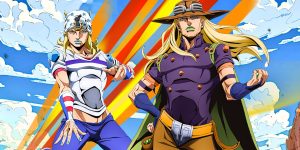
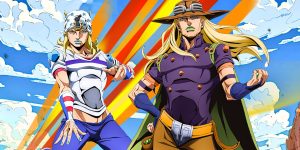
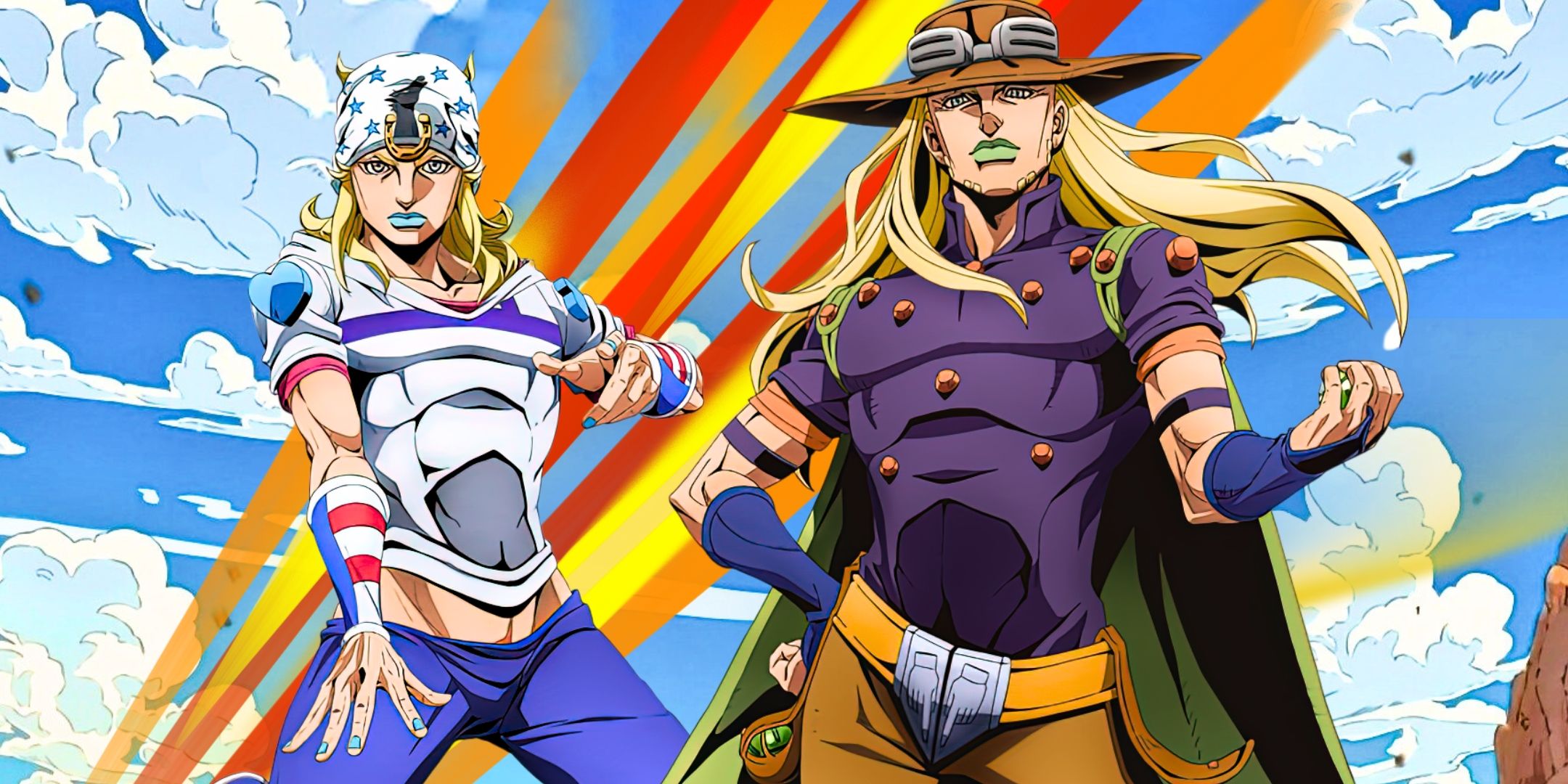
At the beating heart of Part 7’s enduring reverence is the central duo of Johnny Joestar and Gyro Zeppeli. Unlike the chivalrous paragons or delinquent saviors of prior generations, Johnny and Gyro exist entirely within a moral grey zone, defined far more by their shared trauma, lingering guilt, and desperate quests for personal redemption than by heroic altruism.
From Ego to Evolution: Johnny Joestar’s Dark Ambition
Johnny Joestar is arguably Araki’s most daring protagonist. A former child prodigy jockey whose runaway narcissism cost him his family, his fame, and the use of his legs, Johnny begins the race as a bitter, cynical shell of a man. His primary motivation isn’t to save the world; it is the raw, burning desire to find “negative zero”—to simply claw his way back to being an ordinary human. Throughout the race, Araki imbues Johnny with what characters explicitly describe as “the eyes of a killer.” Watching this desperate, paraplegic anti-hero evolve through his Stand, Tusk, as it progresses across multiple destructive Acts, will offer anime audiences one of the most psychologically complex character arcs in contemporary shonen or seinen history.
The Golden Spin: Metaphysics Beyond the Stand Meta
Counterbalancing Johnny’s brooding desperation is Gyro Zeppeli, a disgraced Neapolitan executioner’s son armed with steel spheres and a buoyant, theatrical exterior that conceals an unyielding personal code of honor. Gyro reintroduces a classic franchise mechanic through a brand-new lens: The Spin. Unlike the biological ripples of Hamon or the psychic projections of Stands, the Spin is a metaphysical discipline grounded in mathematics, the Golden Ratio, and the natural geometry of the universe. The dynamic between Johnny’s cold calculation and Gyro’s philosophical bravado forms the finest emotional double-helix Araki has ever penned, elevated by bizarre campfire banter, existential musings, and unforgettable emotional payoffs.
The Equine Bottleneck: David Production’s Ultimate Technical Gauntlet
If the narrative pedigree of Steel Ball Run is universally celebrated, the question of its actual realization in moving pictures remains a point of intense industry fascination. The elephant—or rather, the stallion—in the room is straightforward: animating horses is notoriously one of the most punishing, labor-intensive challenges in all of hand-drawn animation.
A horse’s anatomy is a labyrinth of complex skeletal mechanics, shifting muscular bulk, and intricate four-beat rhythmic cadences. In Steel Ball Run, horses are not incidental background props; they are principal characters. The narrative lives and dies on the visceral kineticism of galloping hooves churning through Arizona sands, desperate tactical maneuvers at seventy miles per hour, and dynamic camera angles that swoop underneath charging steeds mid-stand battle. To draw dozens of unique horses frame-by-frame with high consistency across twenty-plus episodes would drain the budget and break the wrist of virtually any modern studio.
Industry insiders and fans alike know that David Production must lean into hybrid animation pipelines. We have seen glimpses of how modern studios tackle this dilemma—from Wit Studio and MAPPA’s stylized 3DCG mounts in Attack on Titan to specialized vehicle rigs in modern mecha productions. The real test for David Production will be integrating seamless, cell-shaded 3DCG horse rigs with Araki’s razor-sharp, textural 2D character art without shattering the audience’s immersion. Getting this delicate visual marriage right is the single greatest production barrier separating an ambitious announcement from a legendary release.
The Sacred Frontier: Navigating Funny Valentine’s Ideological Crucible
A masterpiece race requires an unforgettable finish line, and Steel Ball Run achieves this through one of the most compelling antagonists in modern fiction: the 23rd President of the United States, Funny Valentine. Behind the veneer of patriotic rhetoric and an obsession with obtaining the scattered, miraculous relics of the “Holy Corpse,” Valentine presents an unsettling ideological dilemma. His Stand, Dirty Deeds Done Dirt Cheap (D4C), introduces multiverse-hopping spatial paradoxes that will test the creative staging and sound design limits of David Production’s best directorial talent.
Valentine is not a mustache-twirling megalomaniac; he is an imperialist zealot whose worldview directly clashes with Johnny’s hyper-individualist drive. The socio-political themes running through the latter half of the manga elevate the race from a thrill-seeking sports drama into a staggering metaphysical thriller about destiny, national exceptionalism, and the spiritual cost of ambition.
The Horizon Beckons: What Steel Ball Run Means for Modern Anime
Rumors continue to swirl through production pipelines, leaker communities, and convention halls regarding when the first official key visual will drop. Whether David Production takes a prolonged pre-production window to fortify its 3D pipeline or partners with an external powerhouse to co-produce the high-speed race sequences, expectations couldn’t be higher. Steel Ball Run is more than just another sequel—it is the definitive milestone that can cement the JoJo saga alongside legendary adaptations like Vinland Saga, Berserk (1997), and Monster.
When the starting gun finally fires and the dust clears over San Diego beach, anime will be met with an uncompromising, visually daring spectacle unlike anything seen on television screens before. The golden spiral has begun to turn, and the journey across Araki’s frontier is poised to redefine the medium all over again.
What are your biggest hopes and fears for the Steel Ball Run anime adaptation? Are you confident in a hybrid 3DCG approach for the horses, and who is on your dream voice-cast list for Gyro and Johnny? Let your voice be heard in the comments below!