Ever since the melancholic, bittersweet chords of Stone Ocean brought Hirohiko Araki’s original generational saga to a definitive close, the anime ecosystem has been gripped by a collective, breathless anticipation. For over a decade, David Production pulled off what critics once considered impossible: adapting the flamboyant, eccentric, and anatomically defying panels of JoJo’s Bizarre Adventure with kinetic fidelity and stylistic reverence. Yet, all six animated parts feel like mere preludes to the monumental mountain looming on the horizon. We have arrived at the precipice of Part 7. Steel Ball Run is not merely the next canonical milestone; it is widely heralded as Araki’s magnum opus, a cultural titan that redefined sequential storytelling and established a golden standard for modern seinen fiction.
Whispers of pre-production murmurs, trademark renewals, and studio schedules have transformed routine anime discourse into an electrified vigil. But adapting Steel Ball Run is a trial unlike anything David Production has previously weathered. From the existential reset of its narrative canvas to the terrifying logistical realities of animating continuous equestrian warfare, the trans-American race is set to be the defining frontier of modern anime production.
The Seinen Metamorphosis: Why Steel Ball Run Transcends the JoJo Canon
To understand the immense buzz enveloping Part 7, one must contextualize the seismic shift that occurred during its serialized run. Beginning in Weekly Shonen Jump before migrating to the monthly, boundary-pushing pages of Ultra Jump in 2005, Steel Ball Run freed Araki from the grueling weekly deadlines and thematic constraints of traditional shonen. The result was a radical aesthetic and narrative reinvention—a rebooted continuity set in an alternate 1890s America, where historical fiction, cosmic mysticism, and gritty survivalism coalesced.
The scale of the narrative expanded exponentially. The Steel Ball Run race—a grueling 6,000-kilometer cross-country trek from San Diego to New York boasting a fifty-million-dollar purse—serves as the grand stage. Yet beneath the dust and gunpowder lies an unsettling narrative concerning geopolitical manifest destiny, miraculous religious relics, and moral ruin. Araki traded urban brawls and episodic monster-of-the-week formats for a sweeping, cinematic Western epic that reads more like Cormac McCarthy collided with Sergio Leone, painted through the psychedelic lens of high-fashion surrealism.
Johnny Joestar and Gyro Zeppeli: A Study in Broken Humanity and Brotherhood
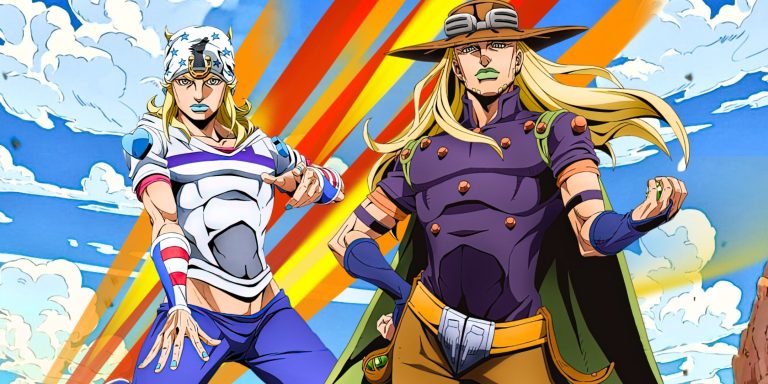
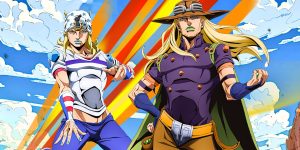
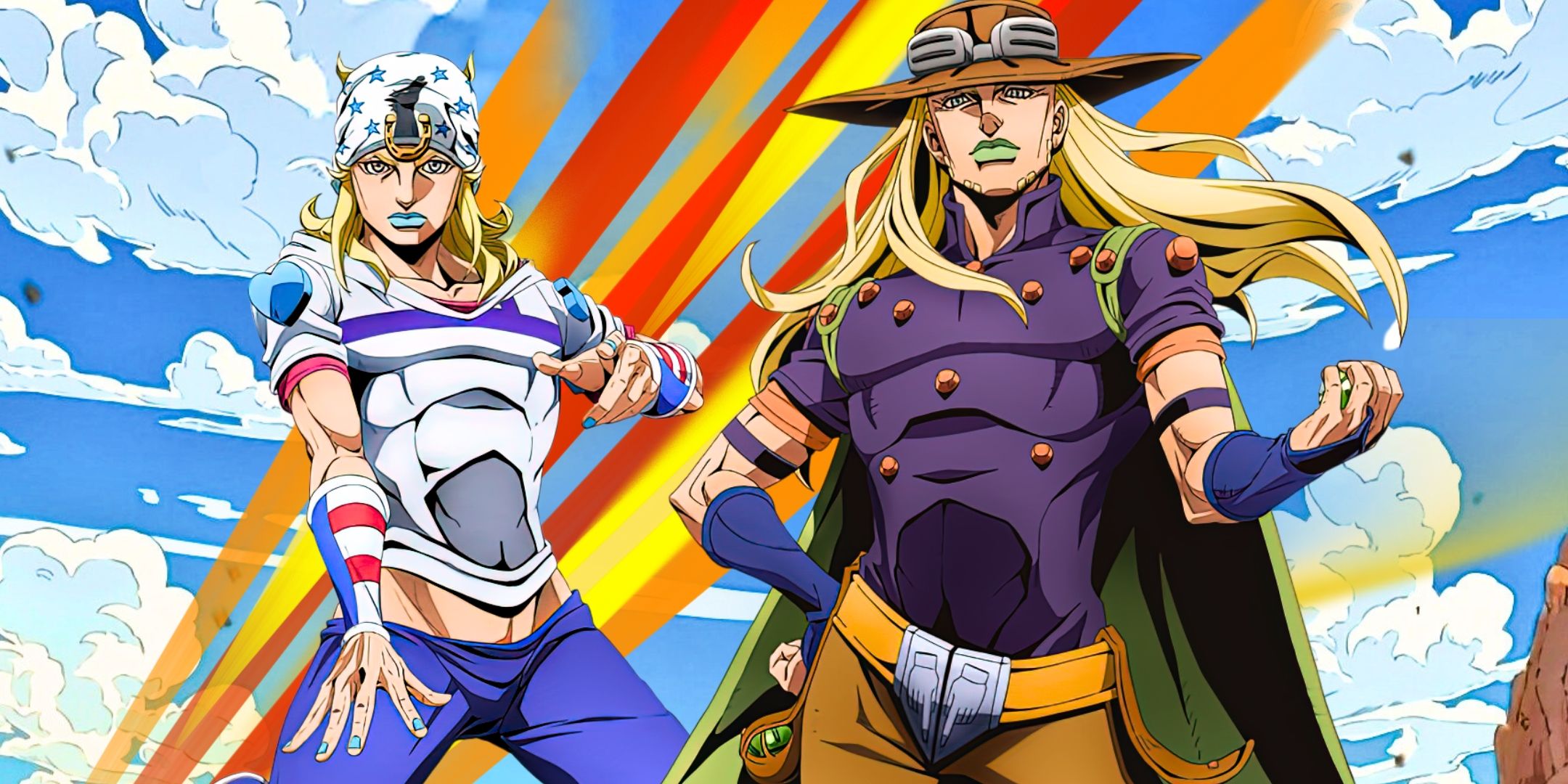
At the beating heart of this sprawling transcontinental odyssey is the most meticulously developed dynamic in manga history: Johnny Joestar and Gyro Zeppeli. Previous JoJo protagonists operated under varying shades of moral heroism or righteous delinquent charisma. Johnny, conversely, is an inversion of the archetype. Paralyzed from the waist down following an act of hubris that shattered his prodigal equestrian career, Johnny begins the race stripped of glory, dignity, and purpose. He is cynical, cold, and operates with what Araki famously terms “dark determination”—an unblinking willingness to kill if it brings his own soul back from the negative ledger.
From Negative to Zero
Johnny Joestar is not racing to become a hero, save the world, or claim the prize money. His motivation is painfully, beautifully selfish: he simply wants to get back to “zero.” When he witnesses Gyro Zeppeli wield the enigmatic, rotating steel balls that momentarily allow his paralyzed legs to twitch, Johnny finds an obsession that evolves into spiritual resurrection. His stand, Tusk, evolves across four distinct acts, physically reflecting Johnny’s psychological rehabilitation from a crawling, self-pitying wretch into an indomitable force of nature.
The Eccentric Executioner
Balancing Johnny’s brooding desperation is Gyro Zeppeli, a disgraced Neapolitan executioner competing in the race to secure amnesty for an innocent child condemned to death. Gyro is quintessential Araki: a man sporting grillz engraved with “GO! GO! ZEPPELI,” who punctuates high-stakes firefights with terrible operatic puns and bizarre pedagogical lectures on cheese. Beneath his bombast lies heavy ancestral guilt. Gyro acts not just as Johnny’s ally, but as his mentor, philosopher, and moral compass. Their bond lacks the performative bravado of typical battle anime duos; it is a slow-burn, deeply emotional brotherhood forged through shared campfires, freezing blizzards, and brushes with death.
The Golden Rotation and the Holy Corpse: Metaphysical Combat
Where earlier parts relied on traditional Stand battles, Steel Ball Run complicates the power ceiling by introducing The Spin. Grounded in the mathematical beauty of the Fibonacci sequence and the Golden Ratio, the Spin represents an ancient Neapolitan martial art that weaponizes infinite rotational energy. It is an intellectual, tactile system that bridges the gap between the natural sciences and Araki’s signature supernatural absurdity.
As the race traverses the American heartland, the plot morphs into a macabre geopolitical thriller centered on the pursuit of the Saint’s Corpse—the mummified remains of an implied Jesus Christ that grant miraculous luck and spatial distortion to whoever gathers them. Standing between our protagonists and these divine artifacts is President Funny Valentine, a charismatic, hyper-patriotic zealot equipped with the dimension-hopping Stand Dirty Deeds Done Dirt Cheap (D4C). Valentine’s brand of ruthless, utilitarian righteousness poses philosophical queries that invert traditional villainy, forcing the audience to grapple with whether the pursuit of peace justifies absolute imperialistic sacrifice.
The Equestrian Nightmare: David Production’s Technical Rubik’s Cube
If the narrative pedigree of Part 7 is undisputed, why has it taken so long to reach the screen? The answer lies within the brutal realities of the animation pipeline. Animating quadrupeds—specifically horses in sustained, dynamic gallop—is universally acknowledged as the supreme nightmare of 2D animators. A single horse possesses intricate muscular articulation, four independently moving joints, shifting weight distribution, and flowing manes. Steel Ball Run features dozens of horses running simultaneously through varied terrains: scorching deserts, river crossings, violent rainstorms, and rocky canyons.
David Production stands at a monumental technological crossroads:
1. The 3DCG Hybrid Imperative: Relying exclusively on hand-drawn 2D frames for hundreds of racing scenes would bankrupt the studio’s schedule and physically break its animation staff. The inevitable path forward mirrors the approach seen in Wit Studio’s Attack on Titan or MAPPA’s dense battle sequences: crafting high-end 3D CGI models for the horses, seamlessly cell-shaded to match bespoke 2D hand-drawn character models.
2. Preserving the Araki Aesthetic: Araki’s linework reached its absolute zenith during Part 7. The heavy cross-hatching, hyper-detailed musculature, and Western-inspired dust-caked grit require an artistic direction more aligned with prestige cinematic films than weekly broadcast television. Fans will not tolerate plastic, floaty CGI steeds that disrupt Johnny and Gyro’s grounded intimacy.
3. Format and Pacing: Spanning 24 dense volumes, Steel Ball Run cannot be rushed into a compressed 24-episode order. Speculation within production circles suggests David Production may divide the magnum opus into multiple prestige cours or an overarching multi-season epic, affording the animators the necessary runway to deliver uncompromising visual fidelity.
The Next Frontier: Fan Speculation and Cultural Horizon
The anticipation surrounding Part 7 is not confined to Japanese animation forums; it is a global pop-culture phenomenon. Voice actor speculation runs wild—will the production tap Yuki Kaji or Kensho Ono, who portrayed Johnny in the All Star Battle video game iterations, or will the studio wipe the slate clean for fresh auditions? Fan artists, indie animators, and digital communities have spent years producing breathtaking proof-of-concept animations, musical themes, and mock-up trailers to satisfy an insatiable appetite.
When David Production finally flashes the green light on Steel Ball Run, it will signify far more than just another seasonal release. It will mark the transition of anime’s most idiosyncratic franchise into the upper echelon of cinematic seinen storytelling. The path across the 1890 American continent is paved with blood, steel, and divine intervention. Steel your nerves, sharpen your rotation, and prepare your saddles: the greatest race in animation history is only a matter of time.
What are your personal hopes for the Steel Ball Run adaptation? Do you think David Production should utilize hybrid CGI for the horses, or wait until hand-drawn sakuga can deliver the ultimate spectacle? Sound off in the comments below!