The crescendo of Stone Ocean’s universe-shattering finale did more than wrap up the multi-generational blood feud between the Joestar lineage and DIO; it quietly closed the ledger on one of the most remarkable production runs in contemporary anime history. Since 2012, David Production achieved what mid-2000s anime pundits long deemed an exercise in futility: faithfully, stylistically, and unapologetically adapting Hirohiko Araki’s labyrinthine manga opus. Yet, the moment the dust settled on Cape Canaveral, an inescapable, fever-pitch murmur began rippling through the global anime sphere. Every thread, forum, and industry roundtable pointed toward a singular horizon: JoJo’s Bizarre Adventure: Steel Ball Run.
Widely regarded by critics, scholars, and longtime readers as Araki’s undisputed magnum opus, Steel Ball Run (Part 7) is not simply the next chronological adaptation—it is a monumental paradigm shift. Moving away from the late-twentieth-century urban locales of its predecessors, Steel Ball Run reboots the mythos into an alternate-universe, late-1800s transcontinental horse race across the unforgiving expanse of North America. The buzz surrounding its potential anime adaptation is intoxicating, but behind the excitement lies an equal measure of trepidation. Bringing this masterwork to the screen presents an artistic, technical, and thematic gauntlet unlike anything David Production has previously navigated.
Araki’s Seinen Evolution: The American Frontier as a Mythic Canvas
To understand the religious reverence surrounding Steel Ball Run, one must first recognize its unique editorial genesis. Part 7 began its serialization in Weekly Shōnen Jump in 2004 under the unadorned title Steel Ball Run, initially obscuring its direct narrative ties to the JoJo franchise. However, its 2005 transition to the monthly seinen imprint Ultra Jump marked the pivotal creative renaissance of Araki’s career.
Freed from the frantic deadlines, demographic guardrails, and sanitized violence of the shōnen machine, Araki elevated his craft to breathtaking heights. The pacing expanded, the panel layouts acquired the sweeping grandeur of John Ford and Sergio Leone westerns, and the illustrative draftsmanship evolved into hyper-detailed cross-hatching and neoclassical anatomical precision. Steel Ball Run discarded the familiar “monster-of-the-week” cadence in favor of an uninterrupted, 6,000-kilometer survival gauntlet. It married the gritty grit of the American frontier with cosmic surrealism, turning the dust plains, badlands, and blizzards of the United States into a sprawling cathedral of psychological attrition.
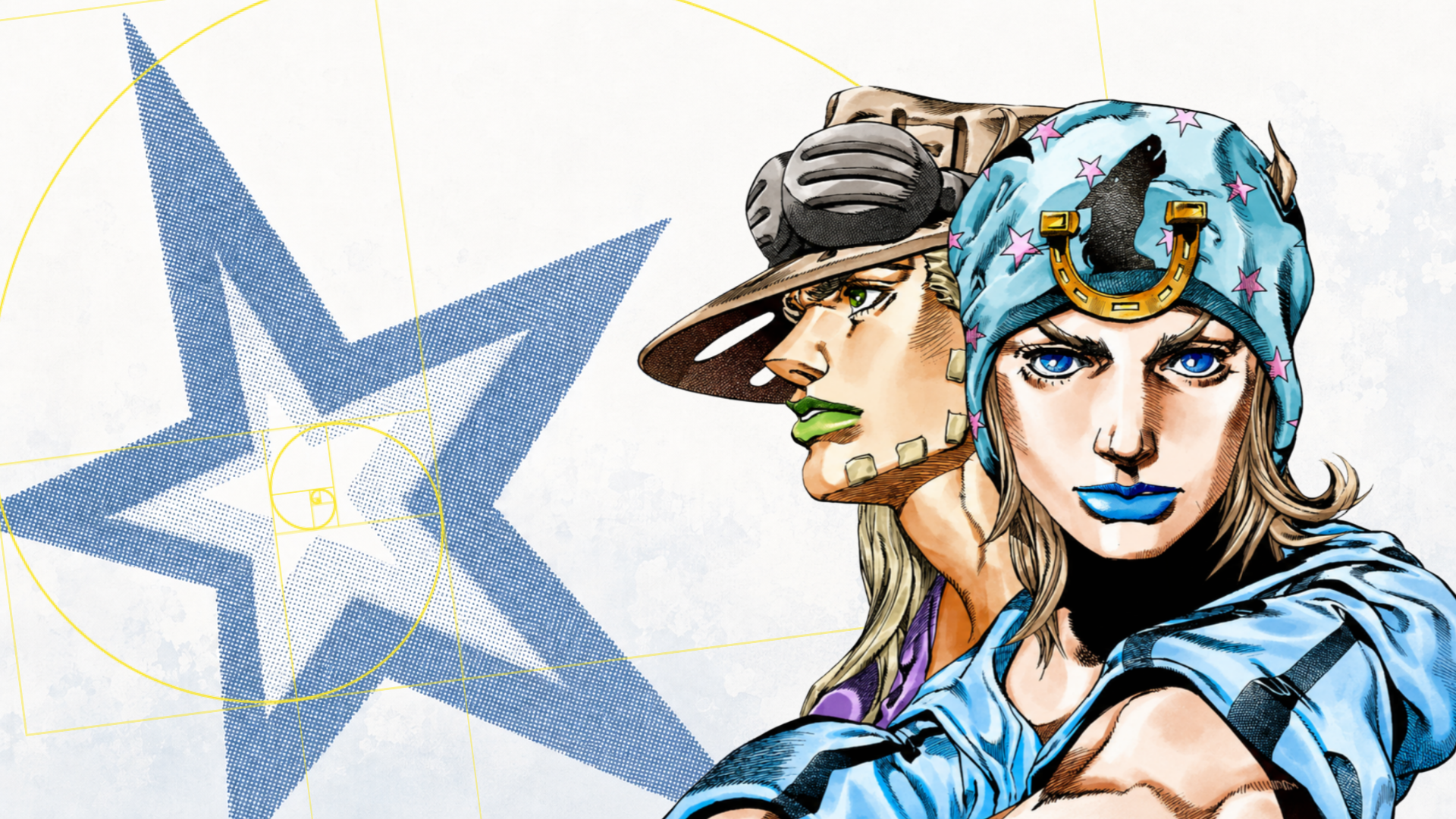
The Golden Spiral: Johnny, Gyro, and the Anatomy of Ambition
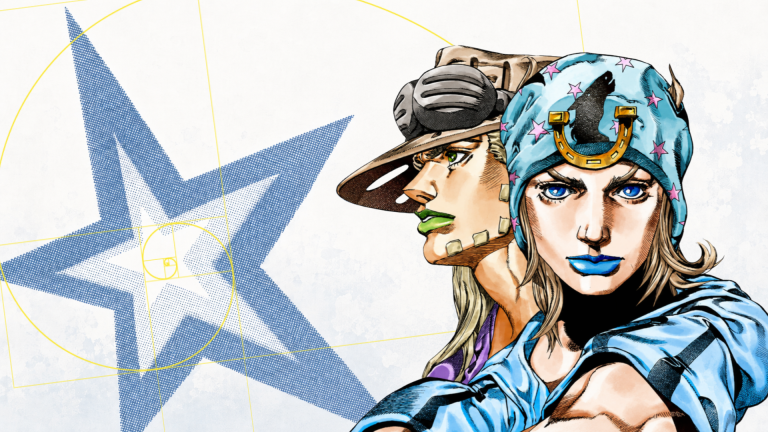
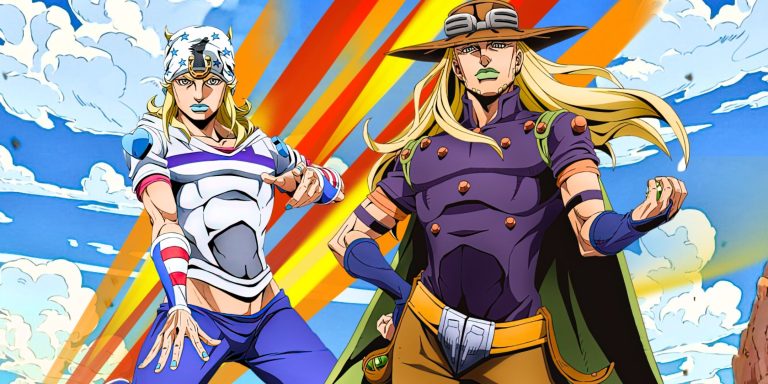
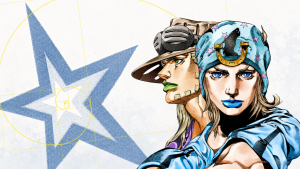
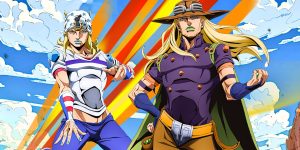
At the beating heart of this sprawling race is what stands as Araki’s most psychologically complex duo: Johnny Joestar and Gyro Zeppeli. Their dynamic moves far beyond the archetypal battle-shōnen camaraderie found in earlier parts.
Johnny Joestar: The Dark Determination of a Paraplegic Wanderer
Unlike his upright, morally luminous ancestor Jonathan Joestar, Johnny enters the narrative as an abrasive, broken figure. A former child-prodigy jockey struck down by hubris and paralyzed from the waist down following an act of senseless arrogance, Johnny is neither heroic nor altruistic. He enters the grueling trans-American race driven by a solitary, desperate spark: the possibility of reclaiming the use of his legs. Johnny’s morality is defined by what the narrative candidly terms “dark determination”—a ruthless, bottomless hunger to survive and advance, even if it demands stepping across ethical abysses. His evolution from a melancholic wreck into a terrifyingly focused Stand user (commanding the evolving abilities of Tusk) offers one of the most nuanced portrayals of physical disability and psychological resurrection in modern manga history.
Gyro Zeppeli and the Mastery of the Spin
Serving as Johnny’s foil and mentor is Gyro Zeppeli, a disgraced Neapolitan executioner who carries the emotional core of the narrative. Flamboyant, eccentric, and quick to crack absurd jokes, Gyro conceals a crushing existential burden: he races to win amnesty for an innocent child condemned to death by the state. Through Gyro, Araki introduced the Spin (Kaiten)—a kinetic, mathematical martial art based on the Fibonacci Sequence and the Golden Rectangle. The Spin completely revitalized the series’ combat logic. Where traditional Stands operated on supernatural idiosyncrasies, the Spin functions as a hyper-stylized pseudo-science of universal geometry and spatial rotation. An anime adaptation must capture the tactile weight, sonic reverberation, and mind-bending physics of Gyro’s spinning steel spheres as they manipulate human anatomy and distort space-time itself.
The Technical Everest: Animating the Equestrian Nightmare
While narrative hype runs high, industry realists understand why an anime adaptation has not been rushed into immediate production. Steel Ball Run represents an absolute production nightmare for any animation studio, primarily due to one terrifying element: horses.
In traditional 2D hand-drawn animation, the horse is notorious for being the most grueling subject to execute convincingly. The complex skeletal articulation, weight distribution, constant muscle flexing, and rhythmic cadence of quadruped locomotion demand virtuoso-level draftsmanship. Now multiply that baseline challenge by several hundred horses galloping simultaneously through dynamic terrain, rotating camera angles, and high-speed Stand battles. In an era where production pipelines are perpetually strained, an all-2D approach across a proposed 40-to-50-episode run borders on suicidal.
David Production stands at a crossroads that will inevitably define the visual standard of the project:
- The CGI Dilemma: Integrating 3D computer graphics for equestrian sequences is practically unavoidable. However, as witnessed across several modern productions, poorly integrated 3D models can shatter immersion, creating a disjointed “uncanny valley” effect against hand-drawn characters.
- The Hybrid Methodology: David Production demonstrated technical mastery with their iconic 3D opening sequences created by Kamikaze Douga, as well as their sophisticated lighting and composite shading in recent seasons. To pull off Part 7, the studio will require a meticulously engineered hybrid pipeline—combining cell-shaded, high-frame-rate CGI horse rigs with bespoke, hand-drawn keyframe animation for close-ups, impacts, and dramatic shifts in emotional intensity.
The Corpse, The Patriot, and The Geopolitical Crucible
Any examination of Steel Ball Run is incomplete without addressing its grand thematic centerpiece: the contest for the Saint’s Corpse and the presence of Funny Valentine, the 23rd President of the United States. Valentine stands as arguably the most compelling antagonist Araki has ever conceived. Far from the cartoonish villainy of early adversaries, Valentine is fueled by an incorruptible, terrifying brand of imperialist patriotism. His ultimate Stand, Dirty Deeds Done Dirt Cheap (D4C), allows him to traverse parallel dimensions, turning ontological displacement into an unprecedented combat tool.
The philosophical clash between Valentine’s collectivist national destiny (“taking the first napkin”) and Johnny Joestar’s deeply personal, individualized quest for self-actualization elevates the second half of Part 7 into high-concept political drama. Translating this tension into moving image requires a directorial touch capable of balancing intense visceral action with quiet, dialogue-heavy philosophical dialectics—demanding the same directorial finesse that elevated Vinland Saga and Monster.
The Verdict: An Adaptation Destined to Define an Era
The anticipation for Steel Ball Run is not standard franchise nostalgia; it is the demand for a definitive monument in anime history. Hirohiko Araki’s masterpiece deserves an adaptation that refuses to cut corners, compromise its challenging adult tones, or flinch before its staggering technical hurdles. If David Production can conquer the equestrian tempest and harness the aesthetic grandeur of Araki’s Golden Spiral, Part 7 will not merely honor its source material—it will cement itself as an era-defining achievement in Japanese animation.
Now over to you, Wibux readers: How do you want David Production to handle the animation of the race? Are you holding out hope for hand-drawn sakuga, or do you trust a modernized CGI-hybrid pipeline to deliver the goods? Drop your thoughts, theories, and dream voice casts in the comments below!