For more than a decade, David Production has pulled off one of the most audacious, technically demanding translation acts in modern anime history: turning Hirohiko Araki’s idiosyncratic, fashion-forward, pose-striking manga legacy into a generational pop-culture juggernaut. When the oceanic prison walls of Green Dolphin Street collapsed in the bittersweet finale of Stone Ocean, a chapter closed not just on Jolyne Cujoh, but on the entire original continuity that began at the Victorian estate of Phantom Blood. Now, the collective anime hive mind is hyper-fixated on one singular, mythic horizon: the greenlit dawn of JoJo’s Bizarre Adventure: Steel Ball Run.
Widely regarded by critics and readers alike as Araki’s absolute magnum opus—regularly trading punches with Berserk at the absolute apex of manga ranking leaderboards—Steel Ball Run represents a colossal artistic shift. It is a grand, panoramic, supernatural Western that tears through nineteenth-century America on horseback. Yet as rumors swirl and anticipation reaches fever pitch, the prospect of an anime adaptation raises an intoxicating mix of breathless excitement and palpable anxiety. Adapting Part 7 is not merely a matter of greenlighting another cour; it is David Production’s ultimate trial by fire.
A Transcontinental Metamorphosis: Araki’s Seinen Rebirth
To understand the religious reverence surrounding Steel Ball Run, one must grasp its unorthodox inception. Launched in 2004 under the simple moniker Steel Ball Run in Weekly Shonen Jump, the series initially distanced itself from the mainline *JoJo* branding. It wasn’t until its relocation to the monthly seinen imprint Ultra Jump in 2005 that Araki unleashed the full scope of his creative autonomy. Liberated from the grueling weekly deadlines and demographic guardrails of traditional shonen, Araki shifted his storytelling into a mature, morally grey register.
Manifest Destiny and Cosmic Dread
Set in 1890, the narrative frames a trans-American race stretching from San Diego to New York City, boasting a staggering fifty-million-dollar purse. However, this marathon of endurance is quickly unveiled as a geopolitical smokescreen. Behind the dust, grease, and gunfire lies an international covert war orchestrated by United States President Funny Valentine to assemble the mummified, supernatural Corpse Parts of an unspoken messianic figure. Araki infuses American mythos, frontier grit, and cosmic horror with his signature flamboyant surrealism. The stakes feel immediate, bloody, and genuinely historic, transforming a sporting spectacle into a philosophical inquiry on patriotic zeal, holy relics, and human desperation.
Johnny Joestar and Gyro Zeppeli: Flawed Symbiosis in the Dust
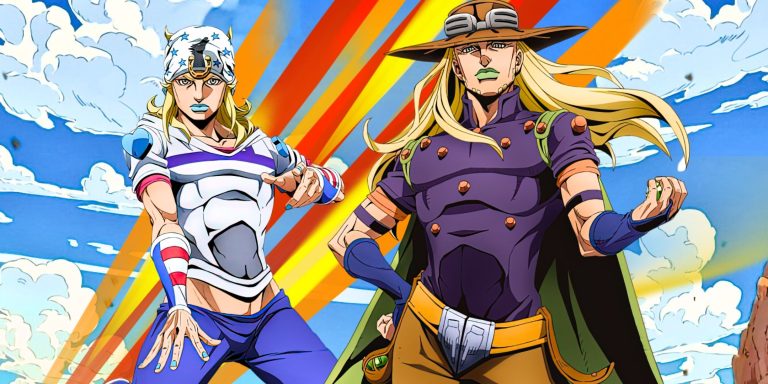
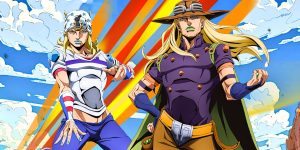
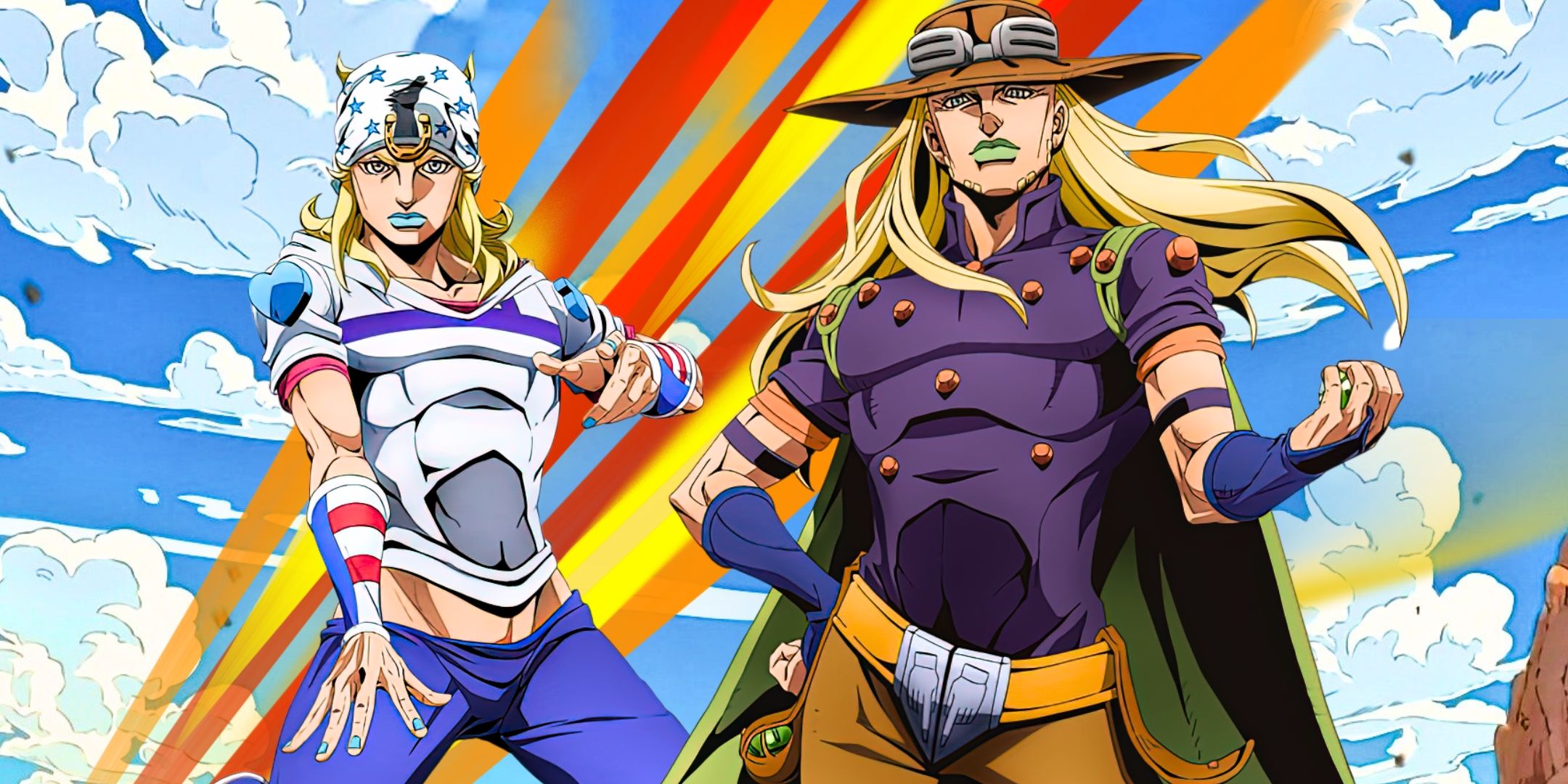
At the center of this sun-scorched epic is arguably the finest dual protagonist dynamic ever drafted in graphic fiction: Johnny Joestar and Gyro Zeppeli. Their partnership moves far beyond the mentor-pupil arrangements of Jonathan and Baron Zeppeli, or the tempestuous camaraderie of Joseph and Caesar. It is a messy, beautifully earned emotional journey between two broken wanderers seeking salvation.
The Paraplegic Seeking “Zero”
Johnny Joestar is not a virtuous hero. Paralyzed from the waist down following a self-absorbed altercation at the peak of his career as an elite jockey, Johnny is embittered, cynical, and driven by what Araki frequently terms “dark determination”—an unrelenting, feral willingness to kill or sacrifice anything to reclaim his agency. Johnny does not race to save the world; he races because touching one of Gyro’s spinning spheres caused his paralyzed legs to momentarily twitch. In Johnny’s own words, he doesn’t care about reaching “positive” territory—he just wants to drag his broken life back from “negative” to “zero.”
The Executioner’s Noble Burden
Counterbalancing Johnny’s brooding desperation is Gyro Zeppeli, a disgraced Neapolitan royal executioner equipped with weaponized steel spheres and grill-toothed swagger. Gyro enters the race to win imperial amnesty for an innocent child condemned to death back home. Despite his eccentric operatic outbursts and absurd running gags (the immortal “Pizza Mozzarella” ballad being prime voice-acting bait), Gyro is deeply introspective. Their bond develops through campfire banters, calculated gunfights, and brutal losses, forging an existential brotherhood that elevates Steel Ball Run from an action-adventure into a haunting character drama.
The Mechanics of Miracles: The Spin and the Golden Ratio
Longtime fans yearning for the anime adaptation are equally eager to see how David Production visualizes the radical evolution of combat mechanics in Part 7. While Stands remain integral to the narrative tapestry, they are radically recalibrated alongside The Spin—an ancient Neapolitan martial craft rooted in the mathematical perfection of the Golden Ratio (Fibonacci sequence).
Rather than manifesting punch-ghosts out of sheer willpower from chapter one, Stands in Steel Ball Run evolve symbiotically with spiritual alignment and anatomical mastery. Johnny’s Stand, Tusk, mirrors his psychological trauma and rebirth, progressively mutating from a pathetic fingernail-shooting cherub (ACT 1) to a dimension-shattering, gravity-defying colossus (ACT 4). The visual iconography of the golden spiral—drawn through the curvature of sea waves, the muscle fibers of sprinting horses, and swirling steel spheres—demands an avant-garde visual grammar that will test the aesthetic elasticity of David Production’s directorial team to its absolute limit.
The Equestrian Gauntlet: David Production’s Monumental Obstacle
Why has the adaptation taken so long to manifest? The elephant in the room is undeniably four-legged. In the animation industry, horses are notorious animators’ graveyards. Hand-drawing a running equine form requires complex anatomical foreshortening, rhythmic gait physics, and muscular articulation that can rapidly bleed a studio’s budget dry. Steel Ball Run does not merely feature occasional cavalry; it is an uninterrupted, nine-stage race involving thousands of mounts galloping across varied biomes for dozens of volumes.
CGI vs. Hand-Drawn Craftsmanship
Modern anime productions often circumvent this dilemma by employing cel-shaded 3D CGI models. However, poorly integrated CGI risks flattening Araki’s distinct cross-hatched, Caravaggio-inspired line art into generic, weightless assets—a misstep that nearly unraveled adaptations like Berserk (2016). For David Production to honor the kinetic fury of the manga, they must pioneer a sophisticated hybrid pipeline: utilizing fluid 3D base rigs for equestrian motion tracking overlaid with expressive, hand-drawn character flourishes and signature dynamic color palette swaps.
The studio has proven its technical mettle before. The kaleidoscopic time-skips of Golden Wind and the sheer scale of the Fire Force ignition sequences prove they possess world-class talent. Yet, capturing the thunderous, earth-shaking momentum of the Diego Brando and Johnny stampedes through the Rocky Mountains will demand unprecedented pre-production time, multi-studio collaborations, and likely a prestige seasonal distribution model rather than an exhaustive weekly run.
The Dawn of the Great Western Anime Odyssey
As the international anime landscape becomes increasingly saturated with assembly-line isekai and repetitive battle shonen, the arrival of JoJo’s Bizarre Adventure: Steel Ball Run promises a breath of radical, dust-choked air. It is a period piece, an American tragedy, an occult conspiracy, and an electrifying sports thriller rolled into one unrelenting tour de force. If David Production can conquer the monumental logistical hurdles facing its production pipeline, Part 7 will not merely reignite the JoJo renaissance—it could reset the benchmark for high-prestige anime adaptations this decade.
Which moment from the transcontinental race are you most desperate to see animated—Gyro’s comedic serenades, Diego’s reptilian awakening, or the catastrophic roar of Tusk ACT 4? Sound off in the comments below, and stay locked to Wibux.com for all your frontline anime breakdowns!