


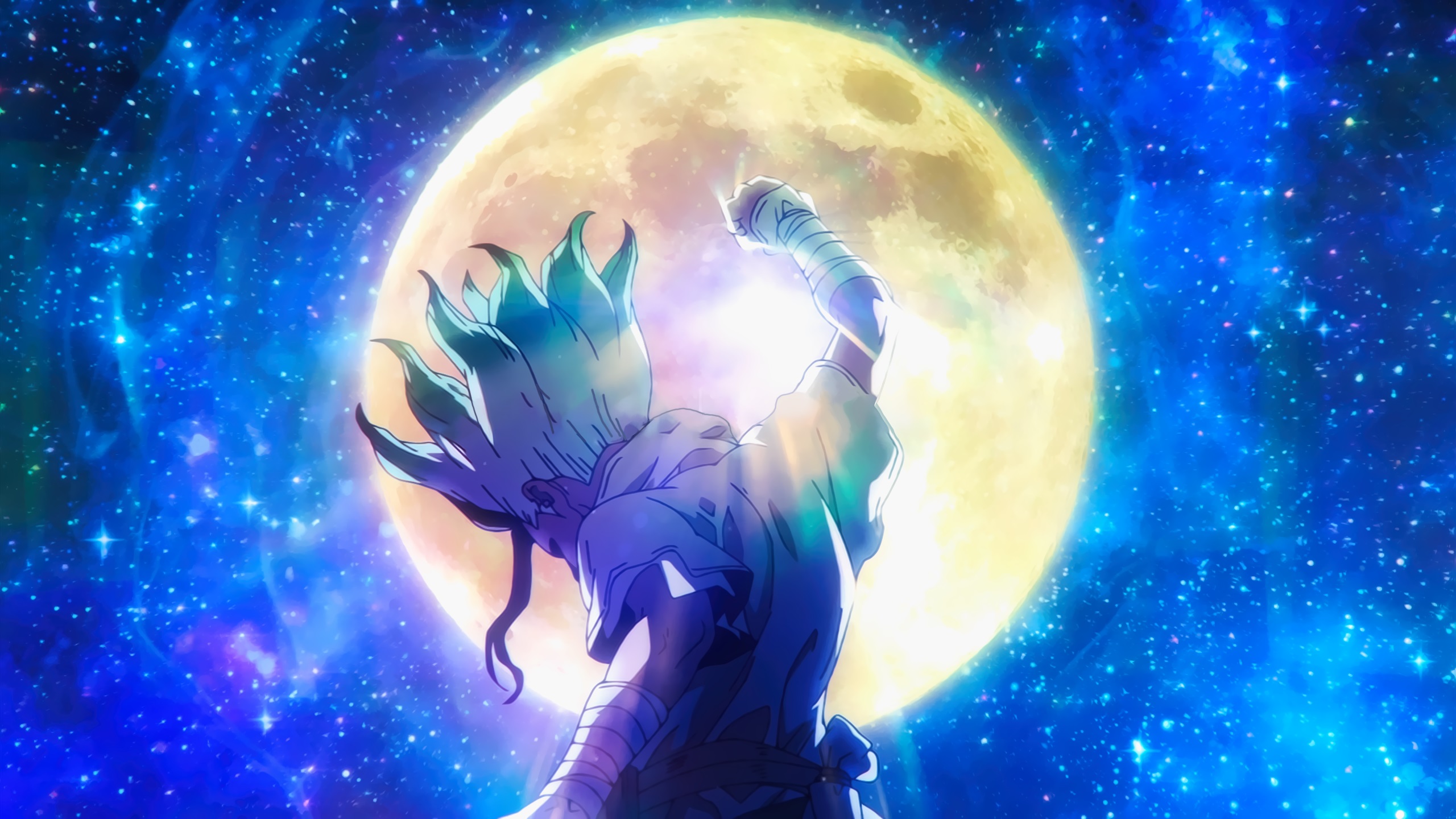
When Senku Ishigami first awoke in a petrified world 3,700 years after a blinding green light stripped humanity of its civilization, his initial ambition seemed delightfully preposterous: rebuild society from scratch using the fundamental laws of nature. We watched him brew nitric acid, forge iron, distill sulfa drugs, and stitch together a primitive cell phone out of gold wire and vacuum tubes. Yet, what began as an eccentric survivalist experiment has steadily escalated into one of the most audacious narrative trajectories in modern shonen history. With the official announcement and anticipation surrounding Dr. STONE: Science Future—the fourth and final television anime season from TMS Entertainment—the Kingdom of Science is preparing for its ultimate, impossible gamble: leaving Earth altogether to challenge their cosmic tormentor on the surface of the Moon.
For long-time fans who have tracked writer Riichiro Inagaki and artist Boichi’s masterwork since its manga debut in 2017, this final season represents more than just a seasonal checkpoint. It is the narrative culmination of human ingenuity pushed to its theoretical limits. The upcoming confrontation with the elusive, chilling entity known only as Why-Man transforms what was once a post-apocalyptic pastoral into a gripping hard-sci-fi thriller, poised to cement Dr. STONE as an enduring titan of modern anime.
Launching Humanity: The Audacity of the Lunar Landing Arc
The road to space in Dr. STONE is not paved with narrative shortcuts or mystical power-ups. Unlike contemporary battle shonen where protagonists unlock genetic potential or spiritual awakenings to confront godlike threats, Senku’s path to the stratosphere demands literal metric tons of raw aluminum, refined rocket fuel, and unprecedented computing power. Science Future tackles the monumental Moon Mission arc, an odyssey that forces humanity’s survivors to bridge thousands of years of technological evolution in a matter of months.
From Clay Pots to Rocket Staging: Senku’s Industrial Revolution
The scale of this logistical mountain cannot be overstated. Before Senku and his comrades can even dream of escaping Earth’s gravitational well, the Kingdom of Science must establish a global supply chain. This requires venturing far beyond Japan to secure vital regional resources across continents—an effort that turns the narrative into an epic globe-trotting industrial race. Constructing a viable multistage rocket, designing pressurized EVA suits from scratch, and fabricating precision telemetry guidance systems without modern industrial machinery is a staggering storytelling feat. Inagaki’s genius lies in making the formulation of liquid propellant and the hand-wiring of early core-rope memory feel just as heart-pounding as any high-stakes duel from Jujutsu Kaisen or Demon Slayer.
Unmasking Why-Man: An Existential Threat Broadcast from the Moon
At the center of this cosmic mission lies anime’s most uncanny and unsettling antagonist. Ever since Senku activated his first rudimentary radio and was met not with friendly survivors, but with an unrelenting, synthetic voice broadcasting a single word in Morse code—“WHY”—the mystery of the global petrification event has hung over the series like a radioactive fog. Why-Man is not an ordinary villain driven by conqueror’s vanity or political ideology. They are a haunting, omnipresent question mark situated squarely on the lunar surface.
The Morse Code Ghost and the Petrification Paradox
What makes Why-Man so uniquely terrifying is the utter dispassion behind their actions. The petrification beam, weaponized via the crystalline Medusa devices, is an impossible technology that circumvents the known laws of biology. It induces absolute suspended animation, preserving cellular integrity across millennia while halting biological decay. In a macabre irony, this catastrophic weapon was also the very mechanism that allowed Senku and humanity to survive the passage of geological time.
As the Kingdom of Science deciphered the entity’s radio waves, the realization set in that Why-Man was not merely observing; they were actively reacting to technological resurgence. The chilling radio transmissions mimic Senku’s own synthesized voice, demanding to know why humanity refuses to remain silent, static, and petrified. Decoding the identity, motivation, and true origin of Why-Man is not just the ultimate plot resolution; it is an ideological debate on whether human curiosity is an evolutionary virtue or a cosmic liability.
The Chosen Triumvirate: Courage, Science, and Combat
A mission to the Moon under sub-optimal, reconstructed conditions is effectively a suicide mission. The technological constraints of Senku’s spacecraft dictate an unforgiving reality: mass limits restrict the crew to a minuscule strike team of three individuals. This narrative crucible forces the Kingdom of Science to select a triumvirate capable of balancing intellect, execution, and raw survival.
The dynamic between these chosen astronauts forms the emotional core of Science Future. Senku provides the unyielding scientific brainpower necessary to troubleshoot atmospheric re-entry and erratic telemetry on the fly. Ryusui Nanami brings the unparalleled spatial intuition, nautical arrogance, and greed for life required to pilot a prototype vessel through the vacuum of space. Meanwhile, the inclusion of peak physical combatants—whether the primal martial prowess of Tsukasa Shishio or the feral agility and heightened senses of Kohaku—ensures that whatever physical or synthetic nightmare awaits them on the lunar regolith can be met with decisive force. The tension of leaving behind their earthbound comrades, knowing there is no safety net, injects the series with an agonizing, deeply human pathos.
TMS Entertainment’s Production: Elevating the Grand Finale
Adapting the final stretch of Dr. STONE presents an immense visual and directorial challenge, but TMS Entertainment has continually proven itself the ideal steward of Inagaki and Boichi’s universe. Boichi’s original manga illustrations during the space race are widely regarded as some of the most intricate, visually staggering double-page spreads in recent Weekly Shonen Jump history. Translating the mechanical density of Apollo-inspired rocketry, the zero-gravity fluid dynamics, and the terrifying desolation of deep space into smooth animation requires an exceptional level of artistic fidelity.
Director Shuhei Matsushita and the production team are tasked with a crucial tonal balance: honoring the series’ trademark comedic chibi expressions and infectious edutainment energy while pivoting gracefully into the sweeping, cinematic grandeur of space exploration. If early promotional materials and past seasonal execution are any indication, TMS Entertainment is pulling no punches, ensuring that the visual spectacle of the Saturn-style launch sequence will stand alongside the most memorable anime set-pieces of the decade.
Science as Pure Optimism: Dr. STONE’s Lasting Shonen Legacy
In an era often dominated by grimdark fantasy, deconstructive cynicism, and existential despair, Dr. STONE has quietly operated as a beacon of unadulterated human optimism. The series has never framed humanity’s downfall as a cosmic punishment for hubris; instead, it frames our survival as a testament to our collective intellect and capacity for collaboration. Senku Ishigami is a protagonist who explicitly refuses to leave a single human being behind, viewing scientific progress not as a weapon of domination, but as an egalitarian equalizer.
As we brace for Dr. STONE: Science Future, the anticipation across the global anime community is electric. The transition from scraping mica flakes off stone caves to executing an Apollo-style translunar injection trajectory is the ultimate validation of humanity’s stubborn refusal to go gently into the night. When Senku finally plants his foot on the lunar dust and stares down the mystery of Why-Man, he won’t be standing alone—he will carry the accumulated weight, grief, and brilliance of two million years of human evolution on his shoulders.
What are your boldest theories regarding the true nature of Why-Man? Do you think the anime adaptation will feature expanded original scenes for the lunar showdown? Sound off in the comments below, and keep your dials locked to Wibux.com for breaking Dr. STONE news, episode recaps, and deep-dive analyses!