When the final credits rolled on Stone Ocean, wrapping Hirohiko Araki’s original lineage in a bittersweet, universe-resetting cadence, a collective hush swept through the anime community. It was not a silence of conclusion, but of breathless anticipation. For over a decade, David Production has pulled off one of the most audacious feats in modern television: translating Araki’s hyper-stylized, genre-defying manga into an indelible cultural juggernaut. Yet, throughout every neon-soaked clash in Morioh and every operatic mafia standoff in Rome, seasoned fans have cast their eyes toward a distant, mythic horizon. That horizon is 1890s America, painted in prairie dust, dried blood, and spinning iron. JoJo’s Bizarre Adventure: Steel Ball Run is no longer just the next logical milestone on the adaptation roadmap—it is David Production’s ultimate frontier.
The Seinen Rebirth: Why Steel Ball Run Transcends the JoJo Canon
To understand the near-religious reverence surrounding Steel Ball Run, one must understand the seismic creative leap Hirohiko Araki took in 2004. Originally serialized in Weekly Shonen Jump before migrating to the monthly, mature-leaning pages of Ultra Jump, Part 7 severed ties with the rigid pacing demands of mainstream shonen. The move granted Araki unprecedented narrative oxygen. The storytelling matured overnight, trading juvenile power-escalation for meditative philosophical depth, moral ambiguity, and an unsparing historical realism juxtaposed against surrealist horror.
Set against the backdrop of a grueling, cross-country horse race spanning six thousand kilometers from San Diego Beach to New York City, Steel Ball Run operates simultaneously as a gritty historical sports drama, a supernatural political thriller, and a profound character study. It represents the pinnacle of Araki’s creative renaissance, where his legendary obsession with high fashion, Western cinema, and baroque anatomical illustration crystallized into something transcendent. It isn’t merely a great JoJo arc; it consistently sits within the upper echelon of the greatest manga ever conceived.
Johnny, Gyro, and the Geometry of Fate: A Masterclass in Character Psychology
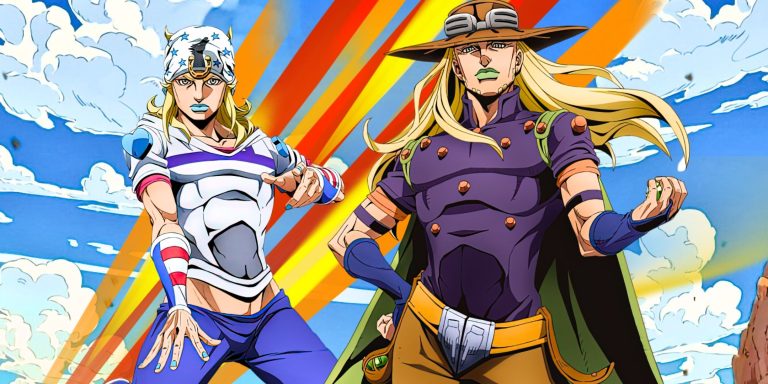
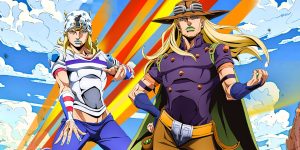
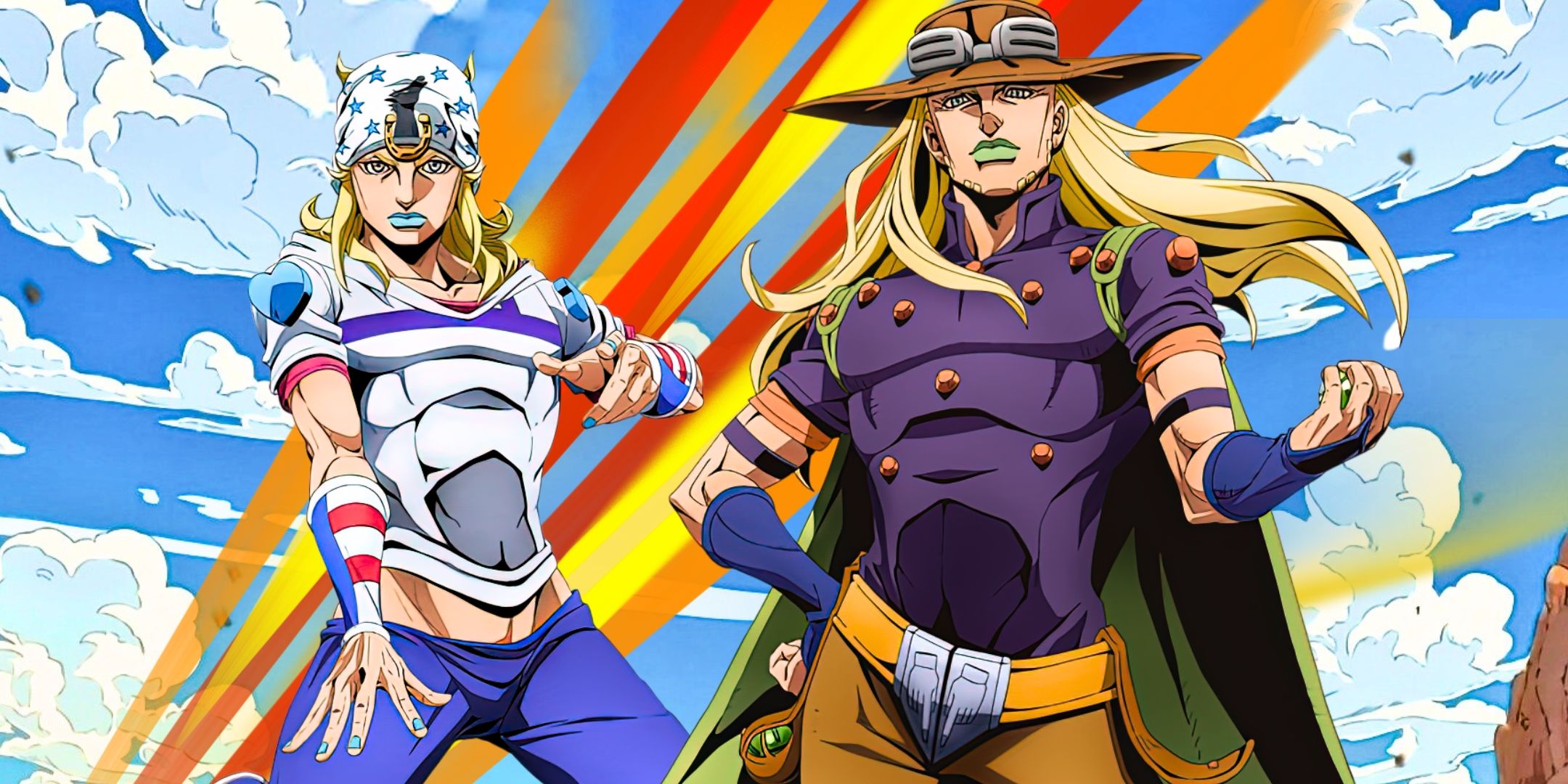
At the beating heart of this cross-continental odyssey is the relationship between Johnny Joestar and Gyro Zeppeli—unquestionably the most nuanced, emotionally resonant duo Araki has ever penned. In stark contrast to the noble, archetype-driven heroes of earlier parts, Johnny begins his journey not as a savior, but as a deeply flawed, paraplegic ex-jockey hollowed out by arrogance and tragedy. He is an anti-hero defined by profound bitterness and an obsessive desire to return his life from “negative” to “zero.”
Enter Gyro Zeppeli: a Neapolitan executioner’s son armed with twin steel spheres, bizarre eccentricities, and a hidden burden of conscience that threatens to crush him. The chemistry between them is electric, oscillating seamlessly between pitch-perfect slapstick comedy—such as Gyro’s unforgettable musical improvisations—and devastating emotional intimacy. They are two broken men running toward self-redemption, forging a brotherhood born of mutual desperation and unspoken reverence.
The Spin: Expanding Supernatural Physics Beyond the Stand
While Stands remain a fundamental pillar of combat, Steel Ball Run fundamentally revitalizes the battle system through the introduction of the Spin. Drawing spiritual lineage from the Hamon of Parts 1 and 2, the Spin is rooted in the natural laws of the Golden Ratio—a sacred, infinite mathematical spiral found throughout nature. Araki elevates this concept into an art form: Gyro’s manipulation of rotational kinetic energy feels visceral, tactile, and grounded, offering a stark visual contrast to the ethereal Stand manifestations of previous eras.
Johnny’s progressive awakening to the Spin mirrors his own painful psychological resurrection. His Stand, Tusk, does not arrive as an omnipotent guardian, but as an evolving manifestation that directly correlates with Johnny’s willingness to confront his own trauma. The narrative threads the mechanics of combat with psychological metamorphosis so seamlessly that every nail shot fired carries genuine thematic weight.
The Equestrian Crucible: David Production’s Greatest Technical Challenge
If fans are desperate for an adaptation, the industry animators tasked with realizing it are likely losing sleep. The primary reason Steel Ball Run has not yet galloped onto our screens is not a lack of enthusiasm, but the staggering technical nightmare of animating horses. In the animation industry, quadrupeds—particularly horses running in constant kinetic motion, perspective changes, and competitive clusters—are widely regarded as the most labor-intensive subjects to draw by hand.
A faithful adaptation demands thousands of cuts featuring dynamic horse anatomy shifting across shifting terrains: arid desert plains, frozen rivers, and dense woodland tracks. To survive this production gauntlet, David Production faces a monumental technical hurdle that will define the visual trajectory of the project:
The studio must navigate the razor-thin line between hand-drawn sakuga and 3DCG integration. While modern cell-shaded CG (seen in masterpieces like Studio Orange’s Trigun Stampede) has achieved unprecedented fluid sophistication, JoJo fans demand Araki’s hyper-detailed, hand-inked line work, cross-hatching, and dramatic posture. If David Production leans too heavily on unpolished CGI models for the horses, the production risks breaking immersion. If they commit purely to traditional 2D animation, production cycles could stretch into half-a-decade delays. Striking this stylistic harmony is the crucible David Production must overcome to bring the race to life without sacrificing the franchise’s celebrated aesthetic DNA.
Manifest Destiny Meets Cosmic Horror: Funny Valentine and the Saint’s Corpse
Every legendary JoJo entry requires a villain of equal philosophical magnitude, and in the 23rd President of the United States, Funny Valentine, Araki delivered his most complex antagonist to date. Valentine is not motivated by the vampiric megalomania of Dio Brando or the quiet psychopathy of Yoshikage Kira. Instead, he is a manifestation of radical, unyielding nationalism, driven by a twisted vision of Manifest Destiny.
The race itself serves as a smokescreen for Valentine’s true objective: assembling the scattered, mummified relics of the Saint’s Corpse, an artifact that grants reality-altering fortune to its possessor. Valentine’s Stand, Dirty Deeds Done Dirt Cheap (D4C), introduces mind-bending multidimensional mechanics that elevate the conflict into an existential chess match. The clash between Valentine’s utilitarian patriotism—believing that the suffering of the world is justified if his country prospers—and Johnny’s raw, individualistic will to survive elevates the final act of Steel Ball Run into high-stakes psychological warfare.
The Long Ride Toward Inevitability
The buzz surrounding Steel Ball Run is not the fleeting hype of a standard seasonal anime cycle; it is the culmination of decades of artistic evolution. For David Production, greenlighting Part 7 is the ultimate gamble—a production challenge of unprecedented scale that, if executed with the stylistic brilliance the studio is known for, could reshape the landscape of prestige anime adaptations for the modern era.
As we await official confirmation from the production committee, the cultural appetite has never been ravenous. The saddle is readied, the stirrups are adjusted, and the winds across the San Diego coastline are beginning to churn. When the starting gun finally sounds, it won’t just be Johnny and Gyro crossing the starting line; it will be an entire generation of anime fans bearing witness to a masterpiece reborn.
What are your biggest hopes and fears for David Production’s adaptation of Part 7? Do you think CGI horses can preserve the soul of Araki’s art, or should the studio take all the time it needs for hand-drawn spectacle? Sound off in the comments below!