
Ever since the melancholic, bittersweet ocean breeze rolled over the final moments of Stone Ocean, the international anime community has kept its collective gaze locked onto a singular, distant horizon: the sun-scorched, blood-soaked plains of late-19th-century North America. For over a decade, Hirohiko Araki’s JoJo’s Bizarre Adventure: Steel Ball Run has occupied an almost mythical status in manga culture. Consistently trading blows with Kentaro Miura’s Berserk for the top spot on critically acclaimed manga registries, Part 7 is widely regarded as Araki’s undisputed masterpiece. It is an electrifying collision of revisionist Western grit, supernatural cosmic mystery, and astonishingly human drama. Yet, as the murmurs surrounding an eventual David Production adaptation grow deafening, the immense anticipation is shadowed by a daunting realization: bringing this particular odyssey to the screen is an animation gauntlet unlike anything the studio has ever faced.
A Trans-American Rebirth: How SBR Rewrote the JoJo Rulebook
To understand the sheer magnitude of the hype, one must recognize that Steel Ball Run is not just the seventh lap of an ongoing marathon; it is a profound metamorphosis. When Araki commenced serialization in 2004, the series initially discarded the traditional “JoJo” branding on promotional covers, masquerading as a standalone frontier epic. Soon after, Part 7 moved from the grueling, youth-targeted confines of Weekly Shōnen Jump to the monthly seinen pages of Ultra Jump. That shift liberated Araki’s artistic and thematic sensibilities, turning a kinetic punch-out series into an expansive, auteur-driven prestige graphic novel.
Set across a grueling 6,000-kilometer horseback race from San Diego Beach to New York City, the narrative orchestrates an irresistible hook. The promise of a $50 million grand prize draws eccentric gunslingers, foreign dignitaries, and ruthless mercenaries into an open-air colosseum. But behind the dust and gunpowder lies an unsettling geopolitical conspiracy orchestrating the discovery of sacred, petrified Corpse Parts imbued with reality-warping miracles. Free from shōnen editorial constraints, Araki saturated the canvas with moral ambiguity, intricate historical flourishes, and panoramic landscapes that dwarf the claustrophobic corridors of previous installments.
Johnny Joestar and Gyro Zeppeli: Flawed Humanity and the Golden Ratio
The Subversion of the Joestar Archetype
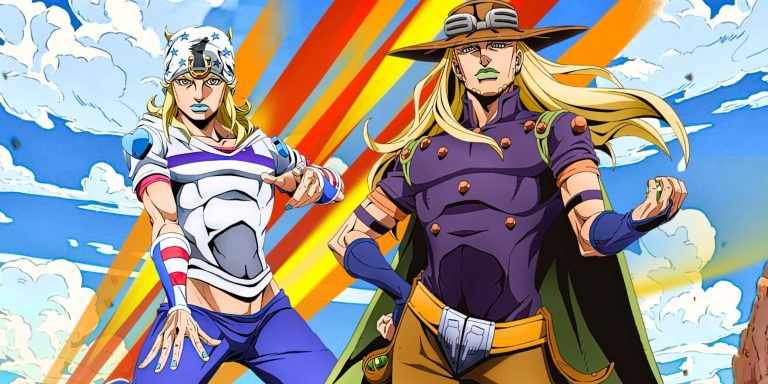
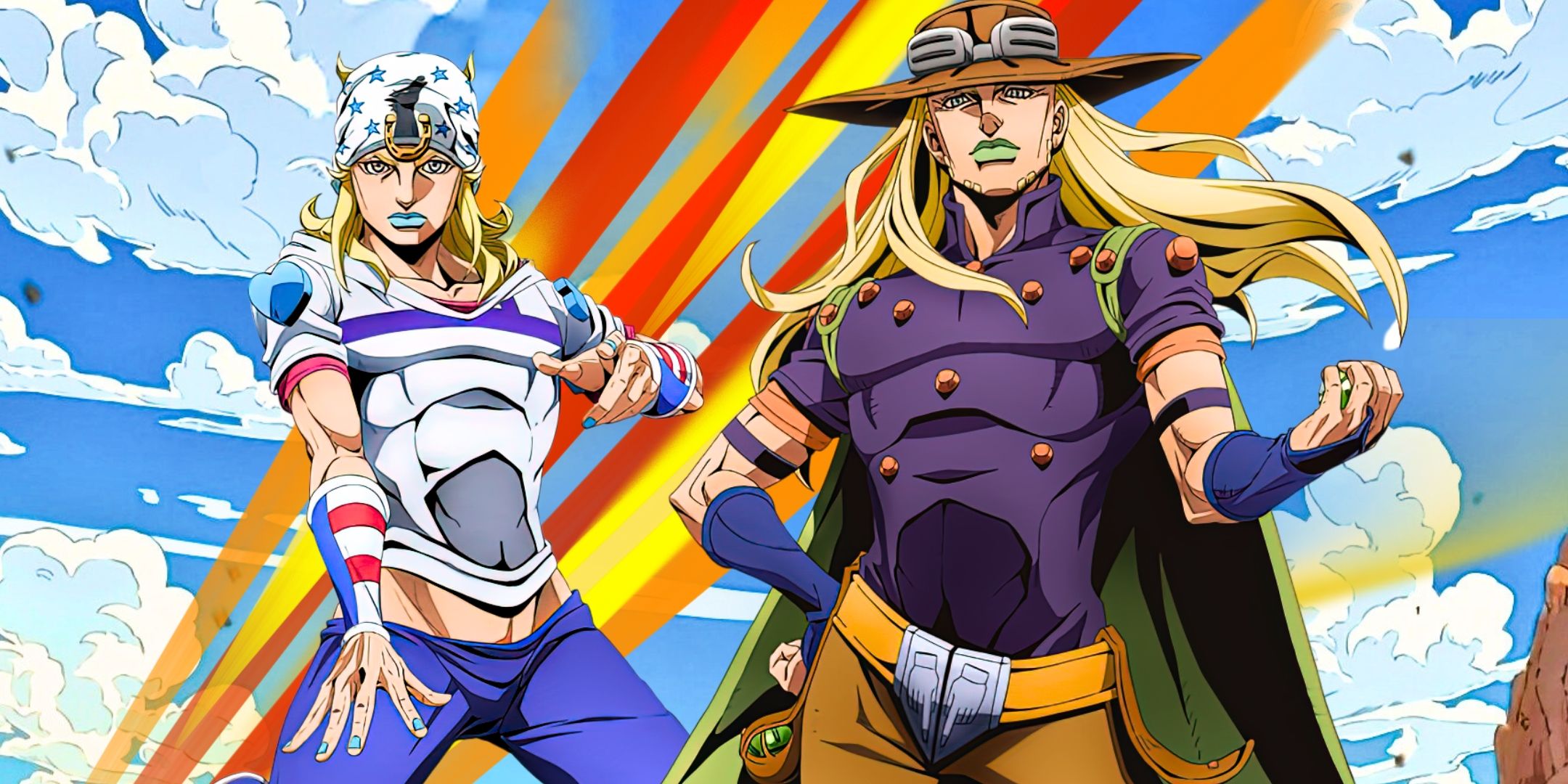
At the beating heart of this cross-country sprint is the relationship between Johnny Joestar and Gyro Zeppeli—unquestionably the most nuanced duo Araki has ever penned. Johnny departs radically from the heroic nobility of Jonathan or the effortless swagger of Jotaro. A former equestrian prodigy reduced to paraplegia by his own arrogant recklessness, Johnny begins the story not as a savior, but as a cynical, spiritually bankrupt shell. His determination is not born of righteousness; it is what the narrative repeatedly refers to as a terrifying, pitch-black resolve. Johnny is fighting solely to reclaim a life from “below zero”—a desperate, raw pursuit of bodily and mental redemption that makes his gradual transformation poignant, unpredictable, and haunting.
The Neapolitan Executioner and the Secrets of the Spin
Balancing Johnny’s brooding gravity is Gyro Zeppeli, a disgraced Neapolitan executioner armed with mystical steel spheres and an absurd, scene-stealing charisma. Gyro is the philosophical anchor of the race. Through his teachings, Araki phases out the straightforward kinetic power of traditional Hamon in favor of the Spin—a devastating martial application of the Golden Rectangle and the Fibonacci sequence. The Spin treats nature itself as a conduit for perpetual rotational energy, demanding spatial awareness, mathematical reverence, and supreme physical precision. The dynamic between Johnny’s desperate vulnerability and Gyro’s eccentric, honorable mentorship elevates Steel Ball Run from an action-adventure into a deeply affecting study of grief, fraternal bonds, and self-forgiveness.
The Equestrian Wall: David Production’s Next Frontier
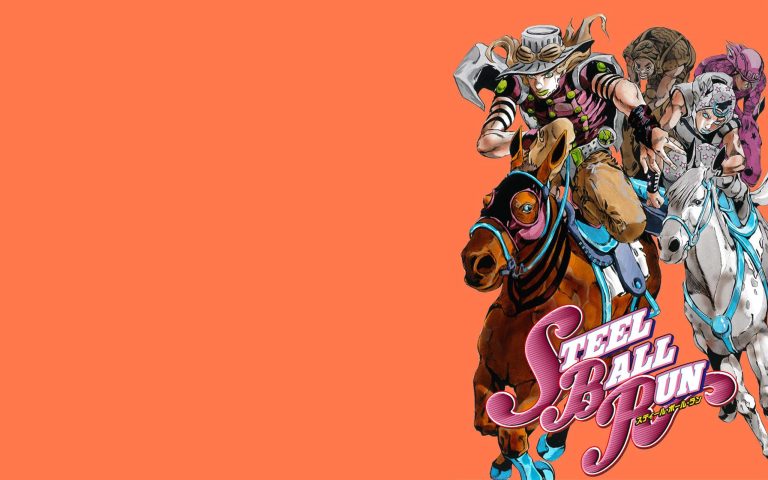
While fans ravenously dissect character designs and voice-cast possibilities, industry insiders are fixated on the elephant—or rather, the horse—in the room. In the lexicon of traditional 2D animation, quadrupedal movement is universally acknowledged as a logistical nightmare. Animating a single, anatomically correct horse in motion requires an exceptional level of keyframe precision, accounting for shifting muscle tension, shifting skeletal weight, and rhythmic gait cycles. Steel Ball Run doesn’t feature just one horse; it demands hundreds of them thundering across dynamic, shifting terrain amidst Stand-infused gunfights.
David Production has rightfully earned its crown as one of the most stylistically audacious studios in the medium. Their historic handling of JoJo—from the iconic shifting color palettes to typographic onomatopoeia bursting onto screen—proves their unyielding love for Araki’s visual grammar. However, a prolonged, high-octane race poses a monumental production crisis. Traditional 2D keyframing for whole cavalry sequences across a serialized television schedule is financially and physically untenable. The studio will almost certainly be forced to pioneer a hybrid workflow, integrating state-of-the-art 3D CGI cel-shaded models for the mounts alongside meticulously hand-drawn riders.
The danger, as seen across various modern anime endeavors, lies in the uncanny valley. If the mechanical weight of the horses feels disconnected from the hand-drawn expressive energy of Johnny and Gyro, the cinematic immersion will fracture. For David Production, conquering Part 7 isn’t simply a matter of drawing manga panels faithfully; it is an epochal technical hurdle that could redefine how large-scale, mobile environments are realized in high-tier Japanese animation.
Patriotism, Divinity, and the Corpse of Destiny
Beyond the logistical puzzle, an anime adaptation must also reckon with the narrative’s deeply complex thematic engine. The conflict of Steel Ball Run is distinguished by its lack of clear-cut villains. Enter Funny Valentine, the 23rd President of the United States and one of pop fiction’s most compelling antagonists. Valentine’s dimension-hopping Stand, Dirty Deeds Done Dirt Cheap (D4C), is fearsome, but his ideology is what truly disarms the viewer. Valentine does not seek world conquest or personal indulgence; his actions are driven by an unyielding, utilitarian patriotism. His philosophy of the “first napkin”—the idea that power belongs to whoever establishes the status quo that society blindly follows—provokes real existential contemplation.
Pitted against alternative counterparts like Diego Brando—whose prehistoric Scary Monsters ability provides visceral, ground-level terror—the quest for the Saint’s Corpse becomes a multi-sided ideological collision. Araki uses this backdrop to interrogate the cost of destiny, asking whether absolute faith can justify unforgivable ruin. Bringing these philosophical deliberations to the screen alongside the series’ escalating surrealism will require a director with a profound thematic grasp and pacing discipline.
The Long Road to the Starting Line
The anticipation for the Steel Ball Run anime is more than standard franchise buzz; it is a cultural checkpoint for modern anime production. As streaming platforms and global audiences demand increasingly sophisticated narratives, Araki’s magnum opus stands as the ultimate convergence of literary ambition and visual madness. It challenges the standard television format, demands unprecedented visual engineering from David Production, and provides an emotional payoff that rivals anything currently airing in the medium.
The horses are pacing restlessly in their gates, and the starting pistol is inevitably going to fire. The only question that remains is whether the industry is truly prepared for the sheer scale of the race ahead.
What part of the Steel Ball Run race are you most desperate to see David Production animate? Do you want to see a hybrid CGI approach for the equestrian sequences, or should they take extra years to hand-craft the journey? Let your voice be heard in the comments below at Wibux.com!