

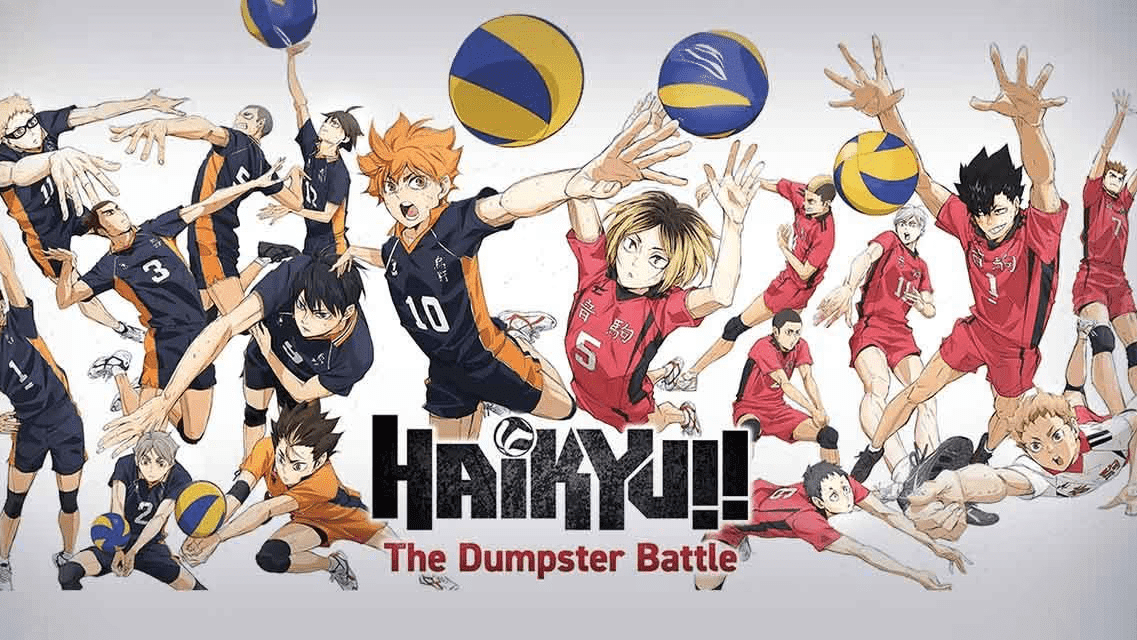
There is an unspoken sacredness to the squeak of rubber against polished hardwood—a sensory trigger that sports anime enthusiasts know signals imminent heartbreak or transcendental glory. When Haikyu!! The Dumpster Battle (Gomi Suteba no Kessen) tore through international box offices earlier this year, hauling in over $70 million worldwide, it proved that the appetite for Haruichi Furudate’s volleyball odyssey had only mutated into something fiercer during its hiatus. Now, as the cinematic juggernaut officially crashes onto global streaming platforms, couch-bound viewers are finally experiencing what theatergoers sobbed through: an 85-minute masterclass in athletic kineticism, narrative distillation, and pure emotional alchemy.
This is not merely the continuation of the National Tournament arc; it is the ultimate fulfillment of a promise made over generations of players. Karasuno versus Nekoma—the Crows versus the Cats—has always existed as the ideological heartbeat of Haikyu!!. Stripped of melodramatic villains or malicious grudges, the Dumpster Battle stands as the absolute zenith of modern sports anime, proving that rivalry is at its most devastating when built entirely on mutual love and philosophical warfare.
A Match Decades in the Making: The Architecture of Karasuno vs. Nekoma
Most shonen sports epics rely on an existential threat to elevate their stakes. Think of Kuroko’s Basketball with the borderline supernatural tyranny of the Generation of Miracles, or Blue Lock transforming association football into a battle royale engineered by egoist madmen. Haikyu!! has always walked a different path, but nowhere is its commitment to humanism more apparent than in the Dumpster Battle.
The rivalry between Karasuno and Nekoma is historic yet quiet. Initiated in the Showa era by old-school tacticians Ikkei Ukai and Yasufumi Nekomata, the matchup was forever doomed to exist solely on practice courts—a phantom clash whispered about but never realized on the national stage. By the time Karasuno’s current generation enters the Tokyo Metropolitan Gymnasium, the game carries the collective weight of retired jerseys, rusted outdoor nets, and half-a-century of unfulfilled ambitions.
Crucially, neither team wants the other to fail. Throughout multiple summer training camps, Nekoma’s captain Tetsuro Kuroo mentored Karasuno’s Kei Tsukishima, while Nekoma’s enigmatic setter Kenma Kozume developed an unspoken, symbiotic bond with Karasuno’s pint-sized middle blocker, Shoyo Hinata. The tension doesn’t stem from animosity; it stems from the agonizing finality of the bracket. In a single-elimination tournament, one team must pack their bags. For the first and last time in their high school careers, it is a game where, quite literally, losing means Game Over.
Kenma Kozume’s Claustrophobic Trap: Psychological Chess at the Net
At the mechanical and emotional center of this battle is the psychological duel between Shoyo Hinata and Kenma Kozume. Where Hinata is an explosive kinetic force powered by raw instinct, boundless stamina, and a borderline feral joy, Kenma is the anti-shonen athlete: physically unmotivated, perpetually exhausted, and prone to viewing life through the detached lens of a video game developer analyzing game design loops.
De-Oxygenating the Crow
The film’s second set delivers one of the most terrifying tactical deconstructions ever committed to animation. Kenma doesn’t just analyze Hinata; he systematically suffocates him. By utilizing float serves to pin Hinata deep into the backcourt, directing floor traffic to clog his approach lanes, and baiting Karasuno’s offensive tempo into rigid predictability, Kenma robs Hinata of his primary weapon: the open run-up.
The visual metaphor deployed by director Susumu Mitsunaka is chillingly effective. Hinata isn’t simply being blocked; he is being placed inside a birdcage. The visual language shifts from sprawling wide shots of the vibrant stadium to hyper-focused, claustrophobic close-ups where the court suddenly feels as suffocating as an elevator shaft. For a protagonist whose entire identity rests on flight, grounding him isn’t just a strategy—it’s an existential horror. It transforms a volleyball match into a gripping psychological thriller where Karasuno is forced to innovate or die.
Production I.G’s Kinetic Masterclass: Directing Sweat, Gravity, and Suffocation
When it was announced that the climactic Nekoma showdown would be adapted as a feature film rather than a full television season, purists were skeptical. Squeezing dozens of manga chapters into an 85-minute runtime seemed like an impossible gambit. Yet, director Susumu Mitsunaka’s return to the franchise proved that cinema is the exact canvas this sequence demanded.
By eliminating episodic pacing, commercial cuts, and long-winded recap segments, the film achieves a relentless, unbroken rhythm that mirrors the physical exhaustion of an elite rally. The sound design is stripped back to its raw essentials: the reverberation of palms slamming into leather, the breathless wheezing of teenagers running on fumes, and the sickeningly loud silence of a ball hovering at the net.
The crown jewel of this production—and a sequence that will undoubtedly be studied in animation colleges for years to come—is the climactic third-set point of view (POV) sequence. Without warning, the camera lunges into the physical perspective of Kenma Kozume. The lens warps. Kenma’s vision blurs with salt and sweat. Stray locks of dyed blonde hair cling to his face, obstructing our view. The camera violently whips left and right, mimicking the frantic eye tracking of an exhausted setter trying to locate the ball amidst blinding gymnasium lights.
This isn’t just dynamic animation; it is an empathetic triumph. We feel the weight of Kenma’s leaden limbs, the sheer friction of the floor burns, and the terror of gravity. When the ball slips from his sweat-slicked fingers on the match-ending error, the audience feels the exact visceral sting of physical failure—an unglamorous, heartbreakingly real conclusion to an epic clash.
The Subversion of the Shonen Climax
Traditional narrative rules dictate that the climax of a sports film should culminate in an explosive, earth-shattering spike—a heroic triumph of willpower over technique. The Dumpster Battle subverts this expectation entirely, opting for an ending that feels profound precisely because it is anti-climactic. The ball does not crash down via a monstrous kill; it simply slips. A sweaty, fumbled set ends the dream.
In that deflation comes the film’s thematic thesis. Across three sets of punishing rallies, Kenma—the boy who hated effort, who only played volleyball to pass the time—collapses onto the court, looks at Kuroo with wide, alive eyes, and breathes four words that shatter the emotional dam:
“Kuroo… thank you for teaching me volleyball. It’s fun.”
In an instant, the scoreline evaporates. The generational rivalry of Ukai and Nekomata resolves not with a trophy, but with an apathetic gamer finally discovering the ecstatic, painful beauty of giving everything to a singular pursuit. The phantom handshake between the old coaches across the decades materializes not on the podium, but through two sweat-drenched teenagers smiling at each other across a lowered net.
The Verdict: An Unrepeatable High-Water Mark
Now that Haikyu!! The Dumpster Battle is readily available for repeat viewings worldwide, its architectural brilliance is even more apparent. While some manga readers will rightfully mourn the loss of select side-character interactions cut for time, Mitsunaka and Production I.G constructed a sleek, laser-focused monument to the series’ thematic core. It captures the fleeting, cruel nature of high school athletics—where years of agony, preparation, and brotherhood can culminate in an 85-minute blur that disappears as quickly as a whistle blows.
With Karasuno now advancing to face Kamomedai and the indomitable Korai Hoshiumi in the upcoming final theatrical chapter, the emotional peak of the series has already been conquered. The Dumpster Battle isn’t just peak Haikyu!!—it is the definitive argument that sports anime, when executed with this level of visual poetry and character honesty, can stand toe-to-toe with any cinematic medium in the world.
Have you streamed Haikyu!! The Dumpster Battle yet? Did Kenma’s first-person POV shot leave you as breathless as it left us? Hit the comments below and let us know your favorite rally!