Ever since the cosmic, reality-resetting finale of Stone Ocean drew the curtain on the multi-generational Joestar blood feud against DIO, anime fans have existed in a state of suspended animation. The conclusion of Part 6 was not merely the end of a narrative lineage; it signaled the threshold of an entirely new paradigm. For manga purists and casual streaming audiences alike, all roads, discussions, and breathless speculation lead inexorably toward one definitive milestone: the anime adaptation of JoJo’s Bizarre Adventure: Steel Ball Run.
Widely revered as Hirohiko Araki’s undisputed magnum opus, Part 7 consistently tussles at the very pinnacle of global manga rankings, standing shoulder-to-shoulder with titans like Berserk and Chainsaw Man. But transforming this 1890 trans-American, hyper-detailed equestrian odyssey into a seasonal television anime represents David Production’s most treacherous trial yet. As murmurs of an imminent announcement echo across production hubs and online forums, the gaming and anime sphere stands on the edge of its collective seat. What makes this adaptation so profoundly anticipated, and why does it represent both a creative goldmine and a logistical nightmare for its animators?
A Masterwork Born of Reinvention: The Trans-American Crucible
To understand the monumental buzz surrounding Steel Ball Run, one must first recognize its unique place in Hirohiko Araki’s creative journey. Originally serialized in Weekly Shonen Jump before migrating to the monthly publication Ultra Jump in 2005, Part 7 broke free from the frantic weekly deadlines that govern mainstream manga. The shift into the seinen demographic granted Araki the breathing room to construct sweeping two-page spreads of the American frontier, layered with atmospheric shading, anatomical nuance, and a gritty, philosophical density previously unseen in the franchise.
The premise alone is a masterclass in high-concept pulp: a six-thousand-kilometer, coast-to-coast horseback race across the United States, carrying an astronomical prize purse of fifty million dollars. From the sun-baked sands of San Diego Beach to the sprawling industrial hub of New York City, thousands of eccentrics, outlaws, and supernatural operatives compete across unforgiving biomes. Yet, beneath the veneer of historical sports fiction lies an escalating, dimension-shattering pursuit for sacred relics that holds the fate of the modern world in the balance.
From Shonen Tropes to Seinen Grit
Unlike the brightly saturated, pop-punk aesthetics of Diamond is Unbreakable or the sleek Italian haute-couture gangster operatics of Golden Wind, Steel Ball Run pulls directly from the dusty vistas of Sergio Leone spaghetti westerns and the grounded, psychological dread of Cormac McCarthy. It trades the manic pacing of urban brawls for long, punishing stretches of isolation, survival mechanics, and existential dread under an indifferent American sky.
Johnny Joestar and Gyro Zeppeli: Deconstructing the JoJo Partnership
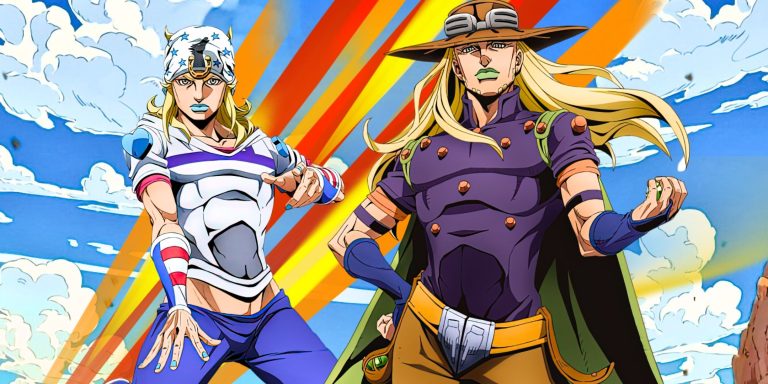
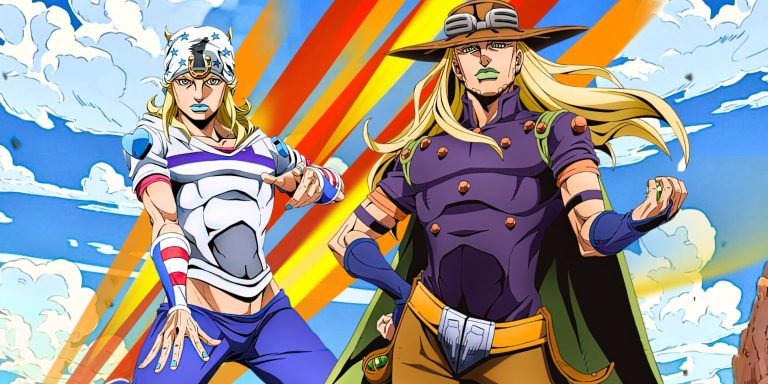
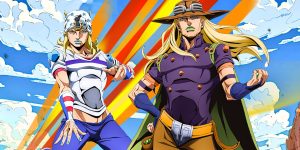
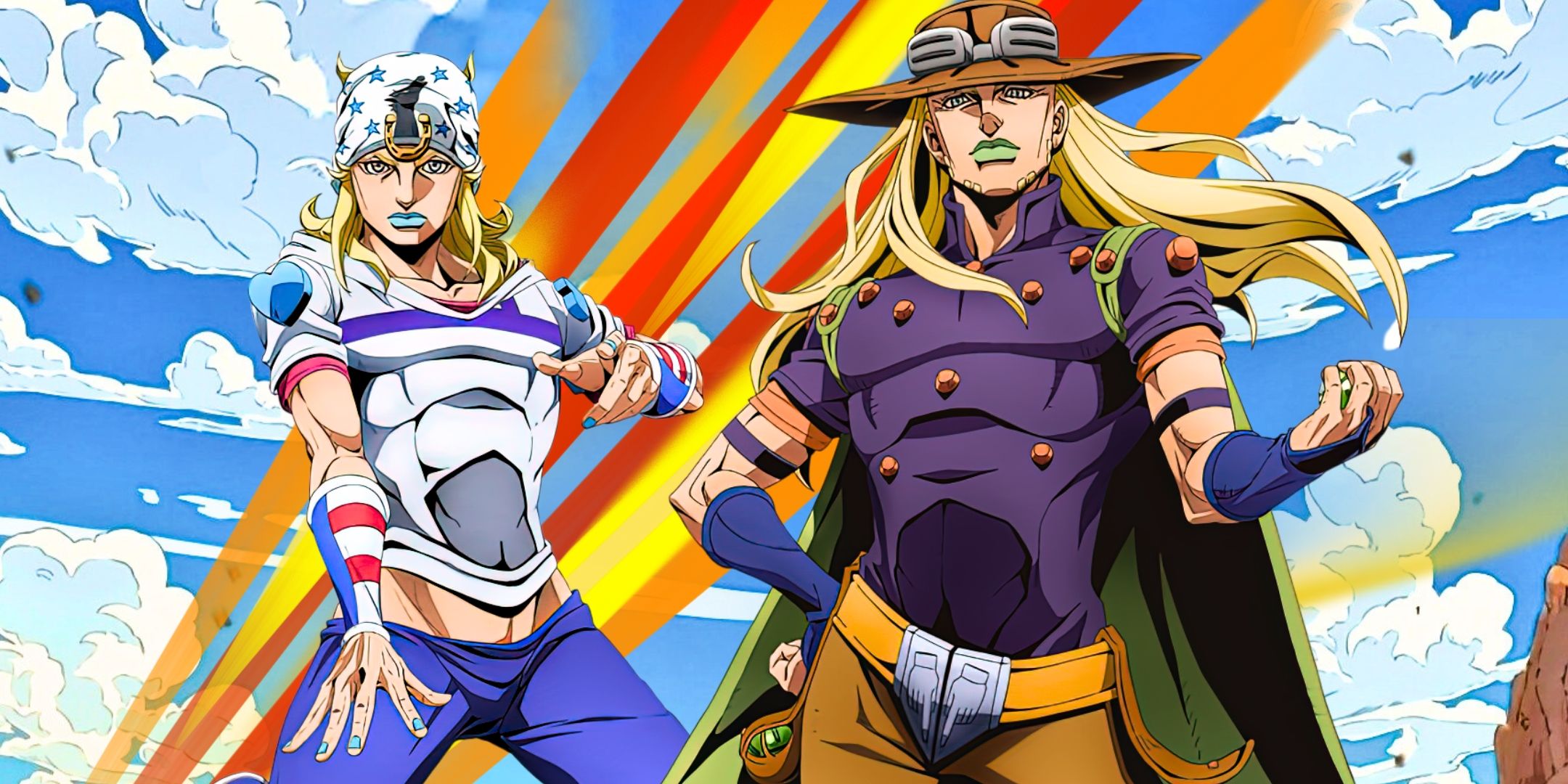
At the beating heart of Steel Ball Run is the most intricately realized partnership Araki has ever penned: Johnny Joestar and Gyro Zeppeli. Their dynamic elevates the narrative above its spectacle, casting aside the traditional archetype of the virtuous hero in favor of raw human vulnerability.
Johnny Joestar is unlike any JoJo who preceded him. A former prodigy jockey brought low by his own arrogance, Johnny begins the story as a paraplegic stripped of his prestige, family ties, and will to live. He is bitter, calculating, and unapologetically selfish. Johnny’s objective throughout the race is not to save humanity; it is merely to move from “negative to zero”—to reclaim his sense of self-worth through the mysterious kinetic properties of the Spin, which momentarily allow him to stand. His moral compass is notoriously grey, marked by cold, unblinking eyes that Araki famously describes as harboring a “dark determination.”
Complementing Johnny’s introverted darkness is Gyro Zeppeli, a flamboyant royal executioner from the Kingdom of Naples armed with steel spheres, steel teeth engraved with “GO! GO! ZEPPELI,” and an absurd penchant for terrible puns. Beneath his ostentatious swagger, Gyro carries a heavy moral cross: he has entered the race to win an amnesty plea for a wrongfully condemned child back in his homeland. Where Johnny is cold and pragmatically driven, Gyro is guided by traditional chivalry and honor, serving alternately as Johnny’s mentor, brother-in-arms, and moral anchor.
The Spin: The Golden Ratio as Supernatural Warfare
One of Part 7’s most brilliant innovations is the phasing out of traditional Stands as the sole power system in favor of The Spin. Rooted in the Neapolitan medical tradition and governed by the mathematical perfection of the Golden Ratio (Fibonacci sequence), the Spin turns kinetic energy into a devastating art form. Watching Gyro manipulate rotation through his steel spheres, and witnessing Johnny translate that sacred geometry into his fingernail-firing Stand, Tusk, promises to deliver some of the most conceptually visually dazzling combat sequences David Production has ever rendered.
David Production’s Technical Everest: The Equestrian Dilemma
If the thematic brilliance of Steel Ball Run makes it an enticing prospect for adaptation, its physical logistics make it an animator’s waking nightmare. Ask any veteran key animator about the hardest subjects to draw consistently in motion, and the answer is almost universal: horses.
A horse in a full gallop requires an understanding of complex quadrupedal skeletal mechanics, shifting muscle masses, dynamic foreshortening, and fluid gait cycles. In Steel Ball Run, these are not background elements or occasional transit sequences; horses are in almost every single scene, navigating harsh cross-country terrain, taking damage, and clashing with bizarre biological Stands.
The burning question within the anime production sphere is how David Production will overcome this technological hurdle:
Will the studio lean heavily on high-end 3D CGI models for the horses, blending them with traditional 2D hand-drawn riders, or can they achieve a bespoke hybrid pipeline? The anime community has seen how poorly integrated CG can alienate viewers, but modern advancements—evidenced by studios like Orange or the kinetic camera integration in recent high-profile adaptations—prove that a stylized, cel-shaded 3D framework can succeed if treated with artistic intentionality.
David Production has routinely proven its critics wrong. From the sound-effect typography leaping off the screen in Phantom Blood to the bravura, painterly color-palette shifts throughout Jojo‘s run, the studio has treated Araki’s sequential art like scripture. Adapting Steel Ball Run will require them to pioneer a new visual grammar, perhaps combining dynamic rotoscoping, hand-tuned 3D models, and the studio’s legendary signature line-shading to preserve the tactile grittiness of Araki’s cross-hatching.
The Saint’s Corpse and the Shadow of Funny Valentine
No discussion of Steel Ball Run is complete without addressing its overarching antagonist: President Funny Valentine. Armed with the dimensional-hopping Stand Dirty Deeds Done Dirt Cheap (D4C), Valentine is a masterclass in villainous character design. His mission—to secure the scattered, mummified remains of a miraculous holy figure (heavily implied to be Jesus Christ) across North America—is framed not by cartoonish villainy, but by fanatical, utilitarian patriotism.
Valentine believes with absolute fervor that the first person to “take the napkin” dictates the trajectory of civilization. His ideological clashes with Johnny and Gyro transform the race from a desperate sprint into a profound examination of nationalism, self-sacrifice, and human agency. The clash of these competing ideals elevates Steel Ball Run into an intellectual and visual powerhouse that is uniquely poised to captivate modern streaming audiences hungry for complex, multi-layered prestige anime.
The Road Ahead: Waiting for the Starting Gun
As David Production quietly wraps other commitments and keeps its creative cards held close to the chest, anticipation for an official teaser at an upcoming industry expo or franchise anniversary event remains fever-pitch. Adapting Steel Ball Run is not just about extending a commercially lucrative franchise; it is about mounting an assault on the grandest summit of Hirohiko Araki’s legendary career.
The journey across late-nineteenth-century America is long, brutal, and fraught with unimaginable peril. But when the starting gun finally sounds, and the first frame of Johnny and Gyro riding into the Pacific sunset hits the screen, the anime medium may well witness the birth of its next generational landmark.
Are you holding out for purely hand-drawn animation, or do you think a hybrid 3D approach is the only realistic way to bring the Steel Ball Run race to life? Who is your dream voice-casting pick for Gyro Zeppeli? Drop your theories, favorite Stand battles, and predictions in the comments below!