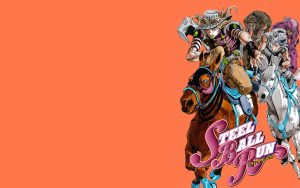
Ever since the bittersweet, universe-resetting melancholy of Stone Ocean faded to black on Netflix, a singular, collective murmur has echoed through the global anime community. It is a chant whispered across forums, immortalized in endless memes, and dissected in video essays running hours long: “Steel Ball Run when?” In an era saturated with seasonal hype cycles, few unannounced projects carry the seismic cultural weight of Hirohiko Araki’s seventh installment of JoJo’s Bizarre Adventure. Frequently heralded as Araki’s magnum opus and ranked consistently alongside Berserk and Chihayafuru near the apex of MyAnimeList’s top manga of all time, Steel Ball Run is not just the next chapter in a generational lineage—it is the holy grail of modern anime adaptations.
Yet, the silence from Warner Bros. Japan and David Production has been deafening. Adapting this trans-continental, supernatural Western horse race is not merely a matter of signing off on production committee budgets; it represents an intimidating technical gauntlet that could redefine the studio’s animation pedigree. As rumors mount and the fandom braces for an inevitable reveal, we must examine the cultural resonance, technical hurdles, and philosophical brilliance that turn Steel Ball Run into David Production’s ultimate frontier.
The Seinen Shift: Araki’s Reinvention of the American Frontier
To grasp why the anticipation for Steel Ball Run burns so fiercely, one must understand its unique place in the overarching JoJo mythos. When the manga debuted in 2004 in Weekly Shonen Jump, it originally shed the “JoJo” moniker, masquerading simply as Steel Ball Run. However, its pivotal move to the monthly Ultra Jump magazine in 2005 marked a profound metamorphosis. Araki was no longer constrained by the rigid moral binaries and pacing demands of the shonen demographic. Liberated by a monthly schedule and an older audience, he delivered an uncompromising masterclass in historical revisionism, psychological depth, and visceral grit.
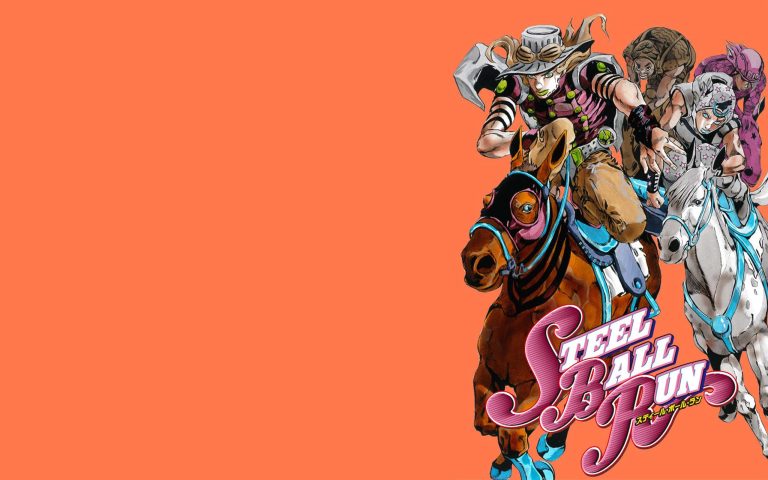
Set in 1890, the narrative chronicles a grueling, 3,800-mile equestrian race across the North American continent, from San Diego Beach to New York City. The prize: an astronomical fifty million dollars. But beneath the dust, gunpowder, and roaring locomotive engines lies a cosmic race for something far more consequential: the scattered mummified fragments of a divine Holy Corpse, sought after by the hyper-nationalistic 23rd President of the United States, Funny Valentine. This pivot away from high-school stomping grounds and urban mob syndicates transformed JoJo from an eccentric action caper into an existential, dust-choked epic about destiny, imperialism, and the cost of ambition.
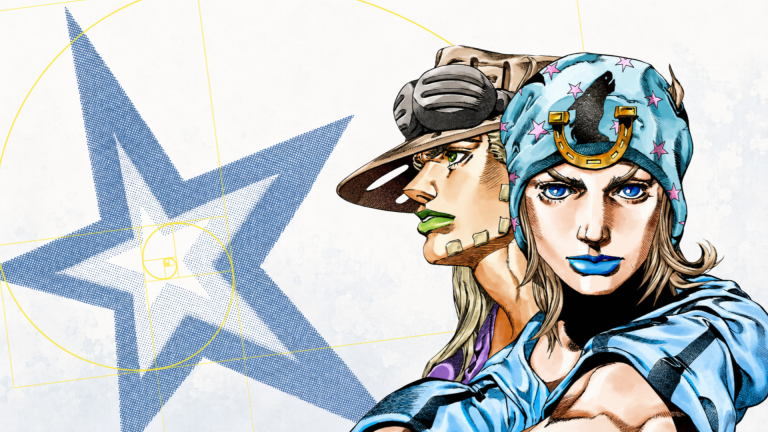
Johnny Joestar and Gyro Zeppeli: A Masterclass in Protagonist Synergy
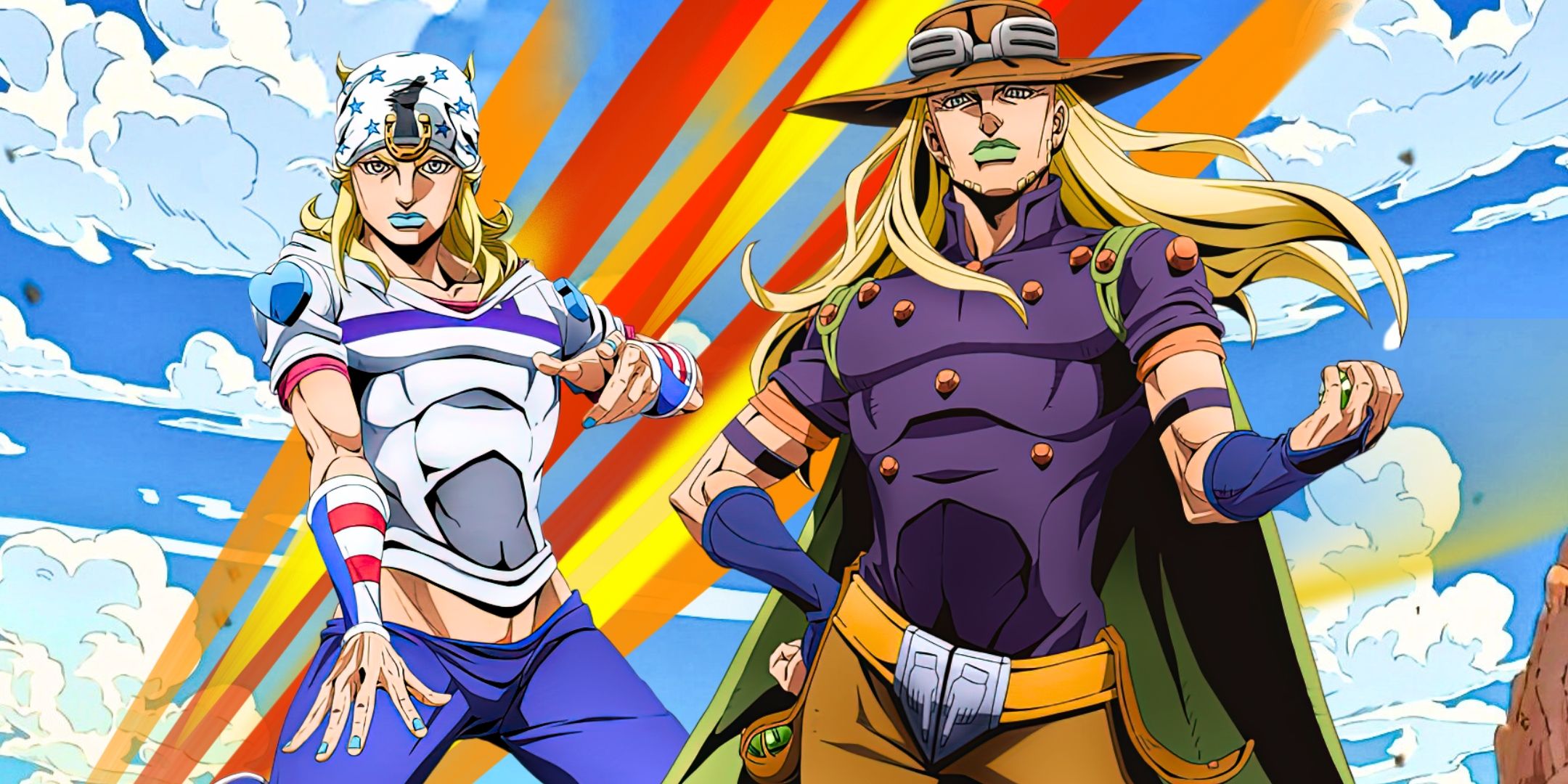
Central to the enduring allure of Part 7 is the relationship between its twin protagonists: Johnny Joestar and Gyro Zeppeli. In earlier iterations, Araki’s heroes were predominantly paragons of righteous fury—archetypes built to smite evil. Steel Ball Run subverts this entirely.
Johnny Joestar is not a virtuous hero; he is a broken, cynical former prodigy jockey left paraplegic by his own vanity. Bitter, introverted, and harboring what Araki famously terms a “dark determination”—an unblinking willingness to kill if it advances his survival—Johnny does not race for glory or virtue. He races for the faintest glimmer of hope: the possibility of returning his body, and his soul, “from negative to zero.”
Contrasting Johnny’s grim introspection is Gyro Zeppeli, a disgraced Neapolitan executioner’s son riding under an eccentric alias. Brimming with theatrical bravado, absurd wordplay (the unforgettable “Mozzarella Song”), and golden teeth engraved with GO! GO! ZEPPELI, Gyro carries his own agonizing burden: the desire to save an innocent boy condemned to execution in his homeland. The chemistry between the two is peerless. Their bond transitions seamlessly from transactional alliance to a profound, brotherly journey of mutual redemption.
From Hamon to the Golden Ratio: Demystifying the Spin
Narratively and mechanically, Steel Ball Run reimagines the series’ combat mechanics by synthesizing classic Stand abilities with a brand-new metaphysical system: The Spin. Rooted in Renaissance mathematics and the Golden Rectangle, the Spin serves as a spiritual successor to Part 1 and 2’s Hamon, yet far more complex.
Through the rotational physics of steel balls, Gyro can manipulate muscle fibers, shatter stone, and deceive gravity itself. Johnny’s Stand, Tusk, evolves through distinct “Acts” as he masters higher tiers of this rotational philosophy, transforming his tragic weakness into an engine of limitless kinetic force. For David Production, rendering the visual geometry of the Spin—with its iridescent spirals, spatial distortions, and intricate mathematical overlays—promises some of the most psychedelic visual set-pieces in franchise history.
The Elephant (or Horse) in the Room: David Production’s Equestrian Challenge
If the narrative is an undisputed masterpiece, why hasn’t an anime adaptation already galloped onto our screens? The answer lies in an age-old industry truism: animating quadrupeds is hell.
Animating horses running at breakneck speeds, displaying anatomically precise musculoskeletal movement, and maintaining that fidelity across hundreds of miles of changing terrain is notoriously difficult in traditional 2D animation. Modern anime studios frequently pivot to 3D CGI models to bypass this resource drain, often with catastrophic visual results that trigger the uncanny valley (as seen in the notorious adaptations of Berserk 2016 or certain background sequences in Attack on Titan).
David Production stands at a crossroads. Part 7 cannot survive relying on jarring, poorly weighted 3D models against painterly desert vistas; the equestrian combat is the heartbeat of the show. Insiders speculate that the extended incubation period since Stone Ocean wrapped in late 2022 is due precisely to pipeline experimentation. Whether through a high-end hybrid technique—utilizing heavily cell-shaded 3D rigs augmented with hand-drawn keyframe flourishes (a technique perfected by studios like Orange)—or a prolonged production schedule that allows dedicated 2D animators to breathe life into the steeds, David Production must ensure the animation matches Araki’s muscular, kinetic line work.
The Holy Corpse and the Shadow of Funny Valentine
A great adventure requires a legendary foil, and in President Funny Valentine, Steel Ball Run delivers arguably the most compelling antagonist in manga history. Armed with his reality-hopping Stand, Dirty Deeds Done Dirt Cheap (D4C), and an unshakeable, zealot-like patriotism, Valentine blurs the lines between villainy and noble statecraft. His worldview—rooted in the concept that whoever “takes the first napkin” dictates the trajectory of civilization—elevates the race beyond a chase for relics into a philosophical clash on free will, power, and sovereignty.
The iconography of the Holy Corpse elevates the tension to mythical proportions. As the racers trek across the Devil’s Palm—a supernatural shifting desert that grants Stands to those who survive its trial—the race becomes an odyssey where spiritual miracles collide with cold, unforgiving black powder. It is bizarre, grotesque, and profoundly moving in equal measure.
The Inevitable Horizon
We are standing on the precipice of a defining moment in modern pop culture. David Production has spent over a decade proving they are the only studio capable of translating Hirohiko Araki’s flamboyant, pose-striking, hyper-stylized universe into motion without losing an ounce of its soul. With Steel Ball Run, they are not simply tackling another sequel; they are setting out to conquer anime’s equivalent of an unscalable mountain.
When the starting gun finally fires—when the first teaser trailer reveals the sweeping sands of San Diego Beach, the metallic clinking of steel spheres, and the opening notes of a gritty, Morricone-inspired score—it will command the attention of the entire anime landscape. Until that day comes, fans wait with bated breath, knowing that true greatness cannot be rushed.
What do you think is the biggest hurdle for the Steel Ball Run anime adaptation? Should David Production lean into hybrid CGI for the horses, or commit to grueling 2D sakuga? Drop your theories and dream voice-cast choices in the comments below!