

When Dr. STONE made its Shonen Jump debut in 2017, it presented an audaciously counter-intuitive pitch: what if the antidote to the hyper-escalating power systems of modern shonen wasn’t raw ki, chakra, or cursed energy, but the periodic table? Across three critically acclaimed seasons and the pulse-pounding Ryusui special, Riichiro Inagaki and Boichi’s prehistoric post-apocalypse transformed the painstaking, millennia-long progression of human innovation into an adrenaline-soaked spectator sport. Now, with the curtain rising on Dr. STONE: Science Future, the fourth and final season helmed by TMS Entertainment, the Kingdom of Science stands at the precipice of its most staggering technological leap yet. Senku Ishigami isn’t just rebuilding civilization anymore; he is aiming directly for the stars.
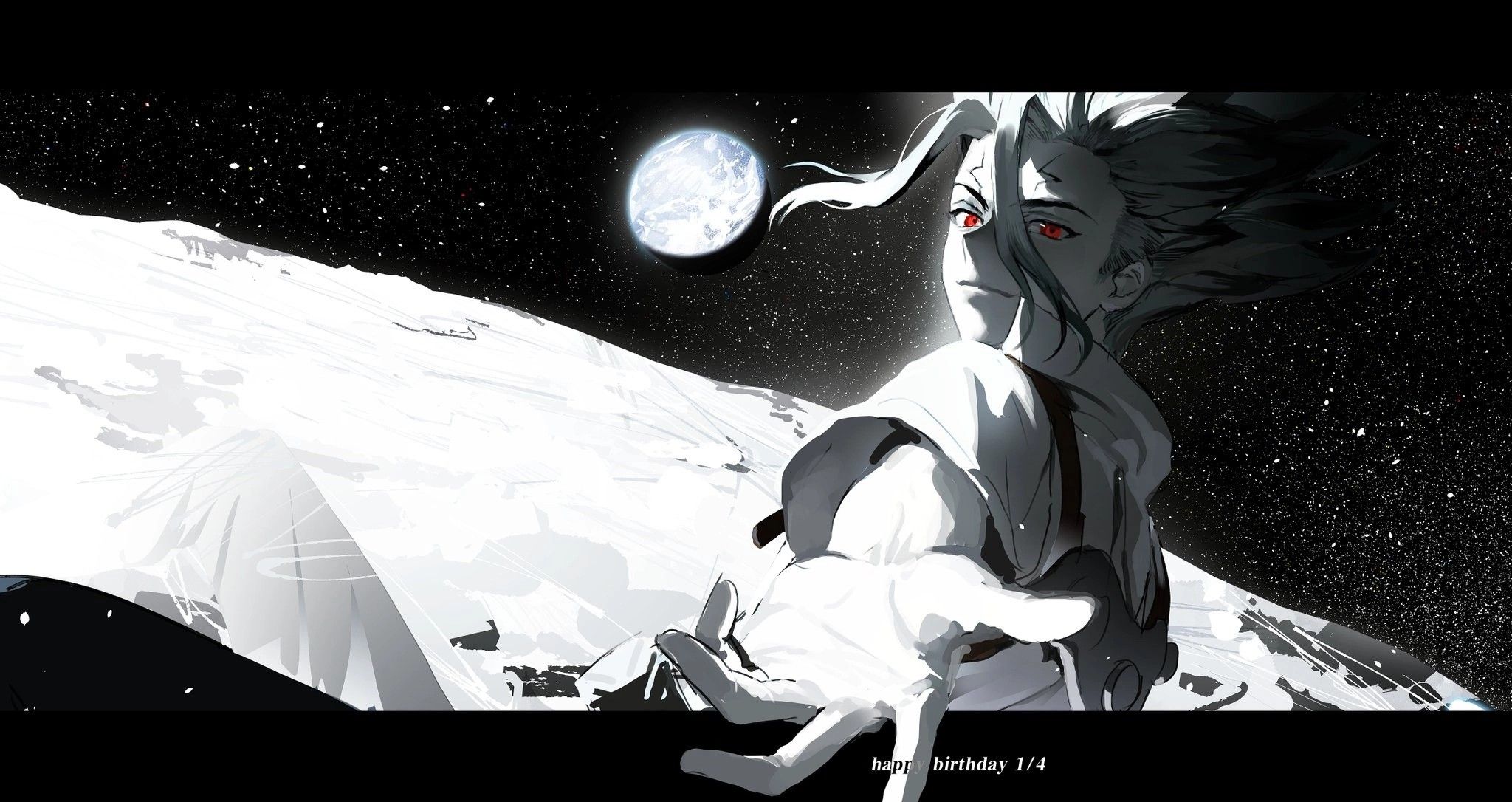
The stakes could not be more existential. What began as a desperate struggle to ignite a campfire without matches has metastasized into an Apollo-scale engineering campaign to construct a functional three-stage rocket, launch human beings across the vacuum of space, and land on the lunar surface. Waiting for them in the silent, cratered dust is the entity responsible for freezing humanity in stone for 3,700 years: the enigmatic voice on the radio known only as Why-Man.
The Apex of the Tech Tree: Engineering the Apollo Program from Scratch
The thematic brilliance of Dr. STONE has always resided in its uncompromising respect for the scientific process. Where lesser narratives rely on narrative shortcuts or divine hand-waving to bridge monumental logistics, Science Future demands that every transistor, heat shield, and drop of liquid propellant be extracted from raw terrestrial matter. The final season chronicles humanity’s greatest industrial undertaking: the construction of global hub-cities designed to feed the supply chain of a twentieth-century space program within a single generation.
To reach lunar orbit, Senku and the former NASA director Dr. Xeno must synthesize their opposing philosophies into pure practical output. Viewers are set to witness an unprecedented expansion of the series’ signature “crafting trees,” ascending from the assembly of analog computers and radar arrays to the synthesis of rocket fuel and telemetry hardware. It is an exhilarating vindication of the series’ core premise: human ingenuity is not an isolated miracle, but a cumulative, unbroken relay race spanning thousands of years.
A Fragile Global Coalition
This lunar ambition transforms the series from an insular wilderness survival story into an international socio-political drama. Establishing outposts across the Americas, Europe, and Asia tests the fragile bonds between the Kingdom of Science and the revived moderns. Navigating the sheer resource intensity of the project exposes the friction between pragmatic survivalism and idealistic humanism—a dynamic that elevates the show’s pacing from standard procedural invention to nail-biting geopolitical orchestration.
The Face on the Radio: Deconstructing the Why-Man Enigma
Ever since the chilling moment in Season 2 when an unnatural radio signal hijacked the Kingdom of Science’s frequencies—endlessly broadcasting the word “WHY” in synthetic Morse code—Why-Man has hung over the narrative like an eldritch shadow. In Science Future, the narrative shifts from terrestrial exploration to hard-SF cosmic mystery. The lunar landing is not merely a scientific exhibition; it is an intercept mission against a potential planetary executioner.
What makes Why-Man such a compelling antagonist is the chilling absence of conventional malice. While previous antagonists like Tsukasa Shishio and Hyoga operated on distinct socio-philosophical dogmas, Why-Man’s broadcasts represent something fundamentally uncalibrated—a threat operating on a cosmic calculus that renders human morality irrelevant. As Senku approaches the source of the petrification light, the series pivots gracefully into speculative biology and transhumanism, asking profound questions about the nature of life, mortality, and whether the petrification beam was an act of omnicidal violence or a perverse gift of biological preservation.
This ideological confrontation promises to be the narrative climax of the entire franchise. Defeating Why-Man cannot be achieved through physical subjugation; it requires Senku to mount a defense of humanity’s chaotic, short-lived, and insatiably curious spirit against a cold cosmic logic that views evolution through the lens of pure preservation.
Astronauts of the New World: Psychology Under Zero Gravity
The technological wonder of the lunar rocket is matched only by the emotional weight carried by its prospective crew. Riichiro Inagaki’s character writing reaches its emotional peak in this final sprint, anchoring colossal technological feats within deeply human character arcs. Senku Ishigami’s impending voyage represents the absolute fulfillment of the dream passed down to him by his adoptive father, Byakuya Ishigami, whose decades of lonely vigil aboard the ISS preserved the seeds of humanity’s resurrection.
The psychological tension within the chosen astronauts forms the beating heart of the final arc:
Senku Ishigami: Stripped of his terrestrial support network, Senku must face the reality that a single calculation error in deep space means instant, inescapable death. His signature stoicism is tested against the vastness of the cosmos.
Ryusui Nanami: The embodiment of human greed redefined as boundless ambition. His evolution from a decadent heir to an indispensable navigator underscores the anime’s thesis that human desire is the ultimate engine of progress.
Chrome: The ultimate surrogate for human wonder. Chrome’s trajectory—from a primitive village “sorcerer” collecting curious rocks to an astronaut stepping onto extraterrestrial soil—is the series’ most resonant emotional thread. He represents the prehistoric human looking up at the night sky and daring to touch it.
TMS Entertainment’s Production Challenge: Visualizing the Void
Adapting the final stretch of Boichi’s manga is no small undertaking for TMS Entertainment. Boichi’s draftsmanship during the manga’s concluding arcs reached an almost maniacal level of fidelity, rendering complex aerospace blueprints, circuit schematics, and atmospheric entries with photorealistic precision. Under the direction of the seasoned series production staff, Dr. STONE: Science Future must successfully reconcile this hyper-detailed visual language with dynamic, fluid animation.
The shift in aesthetic palette will be profound. The warm, lush greens and earthy ochres that characterized the pristine, unindustrialized Stone World will yield to the sterile whites of cleanrooms, the blinding glare of atmospheric ignition, and the suffocating, pitch-black silence of the lunar surface. Sound design will bear an extraordinary burden: the musical scoring by Tatsuya Kato, Hiroaki Tsutsumi, and Yuki Kanesaka must evolve from tribal folk-symphonies into sweeping, atmospheric orchestral pieces that capture both the sheer terror of deep space and the triumphant beauty of human discovery.
Split across multiple cours, this final adaptation affords the production team the structural room required to avoid the rushed pacing that often plagues shonen finales. Every blueprint, failed rocket launch, and breathless re-entry calculation is poised to receive the dramatic breathing room it earned on the page.
The Legacy of Shonen’s Smartest Masterpiece
As Dr. STONE: Science Future prepares to launch its multi-part grand finale, it signals the end of a unique era in Weekly Shonen Jump adaptations. In a genre dominated by generational trauma and demon-slaying blades, Dr. STONE stood apart by declaring that human history, with all its tragic missteps, is fundamentally a love letter to curiosity, cooperation, and the scientific method.
Senku’s mission to the Moon is not merely the climax of a fictional war against an extraterrestrial anomaly; it is an exhilarating testament to what our species can achieve when we replace the impulse to destroy with the relentless desire to understand. When the launchpad clamps finally release and the Kingdom of Science breaks through the stratosphere, it won’t just be Senku sitting in that command module—it will be the entire collected legacy of human civilization, strapping in for the ride of a lifetime.
How do you think TMS Entertainment will handle the monumental Why-Man confrontation? Are you prepared to say goodbye to Senku, Chrome, and the Kingdom of Science? Sound off in the comments below, and stay tuned to Wibux.com for episode recaps, scientific breakdowns, and full coverage of anime’s most ambitious lunar mission!