
Ever since the bittersweet, universe-resetting cadence of Stone Ocean drew to a close in late 2022, a singular, deafening murmur has reverberated through the anime sphere: When does the race begin? For over two decades, Hirohiko Araki’s masterwork has traversed timelines, bloodlines, and genre conventions. Yet, among manga scholars and casual Stand enthusiasts alike, Part 7—JoJo’s Bizarre Adventure: Steel Ball Run—occupies an almost mythic stratosphere. It is widely considered Araki’s undisputed magnum opus, an intoxicating fusion of historical period piece, existential drama, and supernatural grit. But as anticipation swells around David Production’s next chapter, the community finds itself caught between breathless excitement and technical trepidation.
The Reinvention of a Mythos: From Shonen Brawls to Seinen Masterpiece
To understand the monumental buzz surrounding a potential Steel Ball Run anime, one must first recognize its unique publication history. When Steel Ball Run debuted in Weekly Shonen Jump in 2004, it was initially presented without the iconic “JoJo” moniker explicitly tethered to its masthead. However, its subsequent migration to the monthly seinen imprint Ultra Jump in 2005 uncapped Araki’s creative inhibitions. Unshackled from weekly shonen constraints and youth-oriented censorship, Araki’s pen transformed an already audacious action manga into a sprawling, psychologically dense epic.
Set against the vast, unforgiving panorama of late-19th-century North America, Steel Ball Run tracks a grueling, coast-to-coast equestrian race spanning nearly 4,000 miles from San Diego Beach to New York City. The $50 million grand prize acts as narrative bait, drawing out eccentrics, outlaws, and international operatives. Yet, beneath the dust and gunpowder lies an unsettling geopolitical conspiracy centered on the gathering of sacred Corpse Parts. This shift in medium and demographic gave birth to an entirely elevated narrative texture, establishing a standard of visual complexity and thematic maturity that anime-only fans have spent years yearning to see realized on screen.
Broken Men and Golden Spirals: The Tragic Symbiosis of Johnny and Gyro
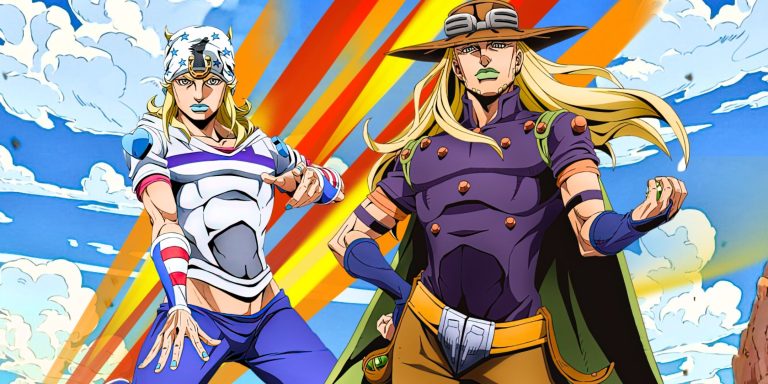
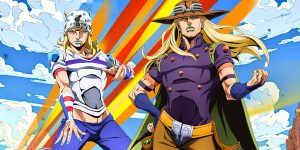
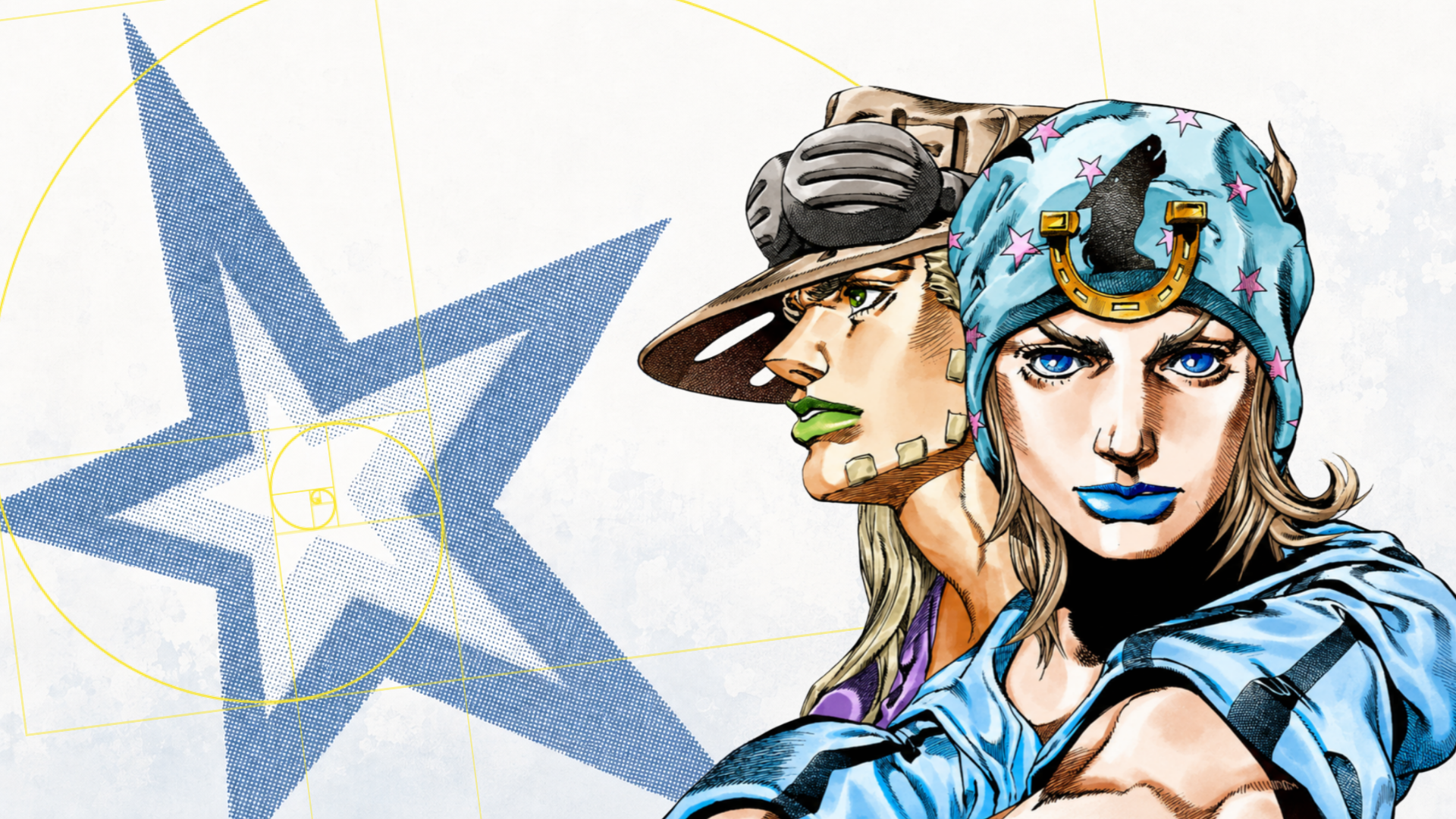
At the beating heart of this monumental narrative lies what is arguably the most exquisitely realized partnership in contemporary manga: Johnny Joestar and Gyro Zeppeli. Unlike the paragons of righteous justice that anchored previous generations, Johnny begins his odyssey not as a noble hero, but as a shattered, deeply flawed former horse-racing prodigy. Paralyzed from the waist down following a senseless ego-driven altercation, Johnny’s arc is not about climbing toward greatness; it is a desperate, agonizing claw back from “negative” to “zero.”
The Psychology of Johnny Joestar
Johnny is notable for carrying a cold, unflinching darkness behind his pale eyes. Araki frequently frames Johnny’s resolve not as heroic altruism, but as an obsession bordering on the villainous. When he witnesses Gyro Zeppeli manipulate a mystical kinetic force capable of briefly stimulating his paralyzed legs, Johnny’s pursuit of Gyro is driven by a visceral, raw desperation for salvation. His Stand, Tusk, reflects this agonizing maturation—evolving through distinct “Acts” that trace his painful physical and psychological metamorphosis.
The Eccentric Dignity of Gyro Zeppeli
Counterbalancing Johnny’s brooding solemnity is Gyro Zeppeli, a disgraced executioner from the Kingdom of Naples whose absurd outward demeanor—complete with customized grillz bearing the words “GO! GO! ZEPPELI”—belies an unbearable burden of generational trauma and civic duty. Gyro is not merely an eccentric co-protagonist; he is Johnny’s mentor, spiritual brother, and moral anchor.
Their interaction shifts the supernatural architecture of the franchise away from traditional Stand mastery and toward the Spin—an ancient physical and metaphysical discipline based on the Golden Ratio. Where earlier parts leaned heavily on supernatural intuition, Steel Ball Run reinvents combat as a game of spatial geometry, kinetic velocity, and sacred mathematical curves. Watching David Production translate the kinetic, vortex-like trajectory of the Steel Balls and the grotesque evolution of Tusk into fluid animation is perhaps the single highest creative expectation currently resting on modern anime studios.
The Animator’s Iron Curtain: The Reality of Equine Production
Despite the ubiquitous fan hunger, there is a very tangible, pragmatic reason David Production has not rushed Steel Ball Run out of the gate: horses. Within the animation industry, quadrupeds—and horses in particular—are notoriously regarded as a death march for production schedules. Their complex muscular articulation, constant shifts in center of gravity, and intricate quadrupedal gallop cycles demand staggering labor when hand-drawn in classical 2D animation.
Steel Ball Run does not merely feature occasional horses; it is an equestrian marathon featuring dozens of distinct mounts operating at peak physiological exhaustion across deserts, blizzards, and canyons. While productions like Attack on Titan and Vinland Saga have negotiated cavalry sequences using a blend of meticulously shaded 3D CGI and hand-drawn hero shots, JoJo carries a hyper-specific, tactile aesthetic identity that risks total collapse if rendered through soulless or poorly integrated CGI models.
David Production made their name through flamboyant, textured hand-drawn line work, bold color shifts, and physically impossible pop-art framing. Replicating the kinetic thunder of stampeding hooves across the Monument Valley without drifting into the uncanny valley of low-budget CGI will require unprecedented planning, an elevated budget, and likely an extended development cycle. Insiders and animation critics broadly agree: if Steel Ball Run is to achieve the legendary heights of its source material, David Production must be given the breathing room to master hybrid 2D/3D integration at a scale rarely seen on episodic television.
Deconstructing Manifest Destiny: The Specter of Funny Valentine
Beyond the technical hurdles lies the franchise’s most compelling, ethically complex antagonist: the 23rd President of the United States, Funny Valentine. Backed by his reality-bending Stand, Dirty Deeds Done Dirt Cheap (D4C), Valentine represents a radical departure from the gleeful sadism of Dio Brando or the psychopathic isolationism of Yoshikage Kira.
Valentine is guided by an absolute, terrifyingly sincere utilitarian nationalism. He views his pursuit of the Corpse Parts through the lens of absolute patriotic stewardship—a cosmic expansion of Manifest Destiny wherein all misfortune is diverted from his nation onto the rest of the world. The clash between Johnny’s micro-scale search for personal autonomy and Valentine’s macro-scale imperialist vision elevates the climax of Steel Ball Run into an ideological debate, challenging audiences on whether the purity of an ambition justifies the collateral ruin left in its wake.
When the Starting Gun Fires
The cultural appetite for JoJo’s Bizarre Adventure: Steel Ball Run has transitioned from hopeful longing into an inevitable creative reckoning. Hirohiko Araki managed to do the impossible with Part 7: he dismantled the foundation of his own multi-decade empire and rebuilt it into a searing, genre-defining masterpiece that stands tall on its own literary merits. The hurdles awaiting David Production are mountainous, from the daunting technicalities of equestrian choreography to the tonal balance required by its seinen grit. Yet, if the studio has proven anything over the past decade of breathing life into the Joestar lineage, it is that they do not shy away from the impossible.
The track is laid, the horses are pacing at the barrier, and the starting gun is closer than ever. How do you envision David Production handling the daunting balance between hand-drawn animation and CGI for the cross-country race? Jump into the comments on Wibux.com and let us know your dream voice casting for Johnny and Gyro!