
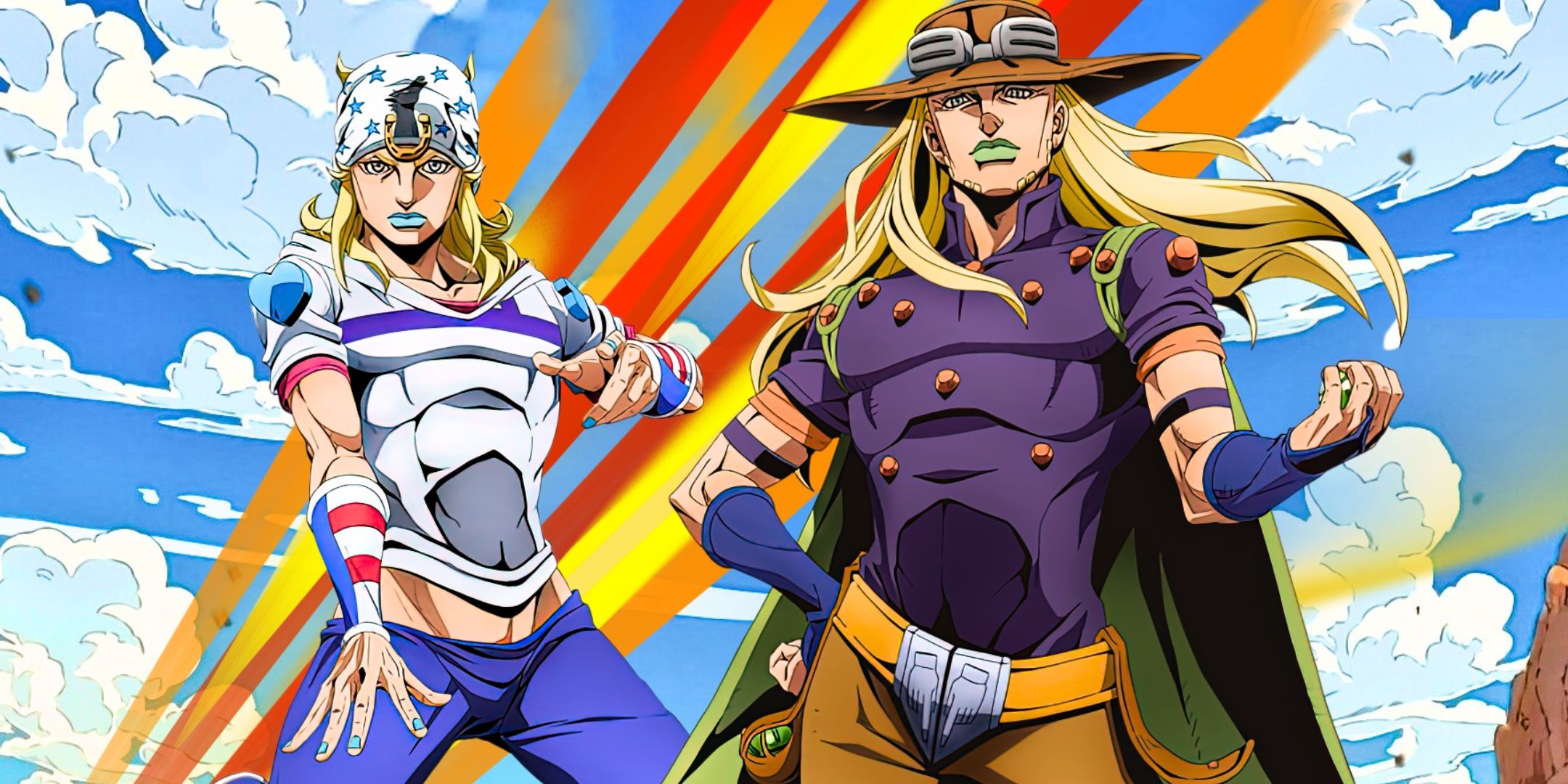
Ever since the bittersweet, reality-shattering finale of Stone Ocean faded to black on Netflix, an electric, almost religious anticipation has gripped the global anime community. For casual viewers, the generational curse of the Joestar bloodline seemed to reach its definitive, cosmic punctuation mark. But for the initiated—those who have spent decades tracking Hirohiko Araki’s bizarre journey through the pages of manga history—the real zenith has not even begun. The whisper that has echoed through message boards, fan expos, and industry panels for years has grown into an undeniable roar: JoJo’s Bizarre Adventure: Steel Ball Run is coming, and it represents the most ambitious, technically terrifying, and narratively transcendent frontier David Production will ever conquer.
Ranked consistently near the absolute summit of MyAnimeList and regarded across critics’ circles as Araki’s undisputed magnum opus, Steel Ball Run (Part 7) is not merely a sequel; it is an ideological rebirth. Transporting the mythos to a gritty, dust-blown, turn-of-the-century America, Part 7 reimagines the franchise through the lens of a grueling 6,000-kilometer cross-country horseback race. With a $50 million grand prize on the line and the hidden, miraculous relics of a holy corpse scattered across the frontier, Steel Ball Run bridges historical fiction, spaghetti westerns, body horror, and cosmic physics. Yet, as the cultural clamor for an anime adaptation hits fever pitch, David Production faces an unprecedented trial: translating the most graphically intricate, horse-heavy seinen epic in modern manga into motion without losing its soul.
The Holy Grail of Seinen Reinvention: Araki’s Alternate-Universe Renaissance
To understand the sheer magnitude of the buzz surrounding Steel Ball Run, one must contextualize its publication history. When Part 7 began serialization in 2004, it was initially detached from the “JoJo” moniker before transitioning from the frantic weekly deadlines of Weekly Shonen Jump to the monthly pages of Ultra Jump in 2005. That editorial shift changed everything. Liberated from the censorship constraints and velocity demands of standard shonen, Araki expanded his storytelling canvas. His panels evolved into astonishing masterclasses of chiaroscuro, physiological precision, and sprawling vistas of the American landscape.
Rather than relying on familiar tropes, Steel Ball Run completely reset the universe following the cataclysmic events of Part 6. The race across the North American continent—stretching from the sun-drenched coast of San Diego to the cobblestone streets of New York City—is not merely an athletic contest. It serves as an allegorical purgatory where desperate souls, outlaws, and politicians collide. By wedding historical touchstones (the dawn of industrialization, mechanized locomotion, and American manifest destiny) with supernatural conspiracy, Araki delivered a high-concept masterwork that transcended standard battle manga archetypes.
Broken Spirits and Golden Rotations: Johnny, Gyro, and the Mechanics of the Spin
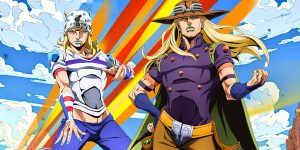
At the beating, bruised heart of Steel Ball Run lies what is arguably the most complex, compelling duo dynamic in manga history: Johnny Joestar and Gyro Zeppeli.
The Paraplegic Prodigy: Johnny’s Dark Resolve
Johnny Joestar is not the chivalrous Jonathan of Victorian England, nor is he the cool-headed, delinquent protector Jotaro Kujo. He is a fallen star. Once a prodigal jockey basking in fame, vanity, and privilege, an act of sheer arrogance resulted in a gunshot wound that paralyzed him from the waist down, stripping away his identity, livelihood, and self-worth. Johnny enters the Steel Ball Run not with dreams of heroic glory, but out of raw, desperate, selfish survival instinct. When he witnesses a mysterious traveler utilize spinning steel spheres that briefly trigger motor nerve responses in his lifeless legs, Johnny clings to that man like a drowning sailor to flotsam. His morality is fractured; Araki frequently paints Johnny with “the dark flame of determination” in his eyes—a ruthless willingness to sacrifice anything, or anyone, to claw his way back to physical and existential wholeness.
The Italian Executioner: Gyro’s Path to Redemption
Acting as Johnny’s mentor, foil, and soulmate in arms is Gyro Zeppeli, a disgraced royal executioner from the Kingdom of Naples. Flamboyant, eccentric, and quick to crack absurd jokes, Gyro’s outwardly theatrical bravado masks a profoundly heavy moral conscience. Gyro rides in the race to win royal clemency for an innocent boy unjustly sentenced to death. While Johnny is desperate to regain what he lost, Gyro is desperate to prevent another’s loss. Their camaraderie feels extraordinarily lived-in, punctuated by campfire philosophizing, campfire musical gags, and life-or-death tactical warfare.
The Spin: Expanding the Metaphysics of JoJo
Lore-wise, Steel Ball Run fundamentally broadens the franchise’s power systems by introducing “The Spin.” Transcending the raw respiratory mechanics of Hamon and refining the metaphysical mechanics of Stands, the Spin is rooted in the Golden Ratio (the Fibonacci sequence). By harnessing the infinite rotational energy found universally in nature, Gyro’s steel balls and Johnny’s evolving Stand, Tusk, manipulate kinetic forces, gravity, and even space-time itself. The visual realization of the Spin—a whirlwind of swirling golden spirals tearing through muscle, earth, and dimensions—demands a level of kinetic choreography that promises to redefine anime combat cinematography if executed properly.
The Galloping Nightmare: David Production’s Equestrian Technical Hurdle
If Steel Ball Run is universally beloved, why has David Production taken so long to officially greenlight it? The answer is simple, technical, and terrifying: horses.
In the animation industry, quadrupeds—and specifically horses—are notoriously regarded as animators’ absolute bane. A galloping horse is a biomechanical nightmare involving complex skeletal articulation, constantly shifting muscular tension, foreshortened perspective, and fluctuating weight dynamics. In Steel Ball Run, horses are not secondary background dressing; they are central, persistent characters that run for thousands of miles across dynamic terrain, clashing at breakneck speeds while their riders deploy metaphysical Stands.
Hand-drawing dozens of galloping thoroughbreds continuously across 30 to 40 episodes would utterly bankrupt a traditional 2D animation pipeline. This leaves David Production with an arduous technical frontier: hybridization. The studio must masterfully weave sophisticated 3D CGI cel-shaded models for horse rigs and wide tracking shots alongside painstakingly illustrated, visceral 2D cuts for close-up combat, rider expressions, and Stand activations. The anime industry has seen both triumphs (such as Studio Orange’s peerless 3D integration in Trigun Stampede) and disastrous failures with CGI integration. Fandom anxiety is justified: if the mounts in the Steel Ball Run look floaty, weightless, or jarringly disconnected from Araki’s lavishly crosshatched line-work, the kinetic immersion collapses instantly.
The Ideological Crucible: Funny Valentine and the Corpse of Destiny
Beyond its logistical hurdles and charismatic protagonists, Steel Ball Run commands reverence due to its secondary cast, headlined by the 23rd President of the United States: Funny Valentine. Valentine represents one of the most philosophically layered, genuinely terrifying antagonists in modern fiction.
Armed with a radical brand of extreme hyper-patriotism and the multi-dimensional abilities of his Stand, Dirty Deeds Done Dirt Cheap (D4C), Valentine seeks to gather the fragmented Corpse Parts of an unnamed holy figure (strongly implied to be Jesus Christ) to secure eternal prosperity for America at the direct expense of the rest of the world. His famous “First Napkin” monologue is a chilling exploration of social dominance, systemic leverage, and geopolitical hegemony. Valentine does not view himself as a villain; in his eyes, he is a righteous statesman whose actions are absolved by absolute purpose. The ideological collision between Valentine’s collectivist manifest destiny and Johnny Joestar’s deeply individualistic, broken-hearted journey transforms Steel Ball Run from a mere race into an epic Greek tragedy framed by blood, sweat, and gunpowder.
The Starting Line Awaits: When Will the Gun Fire?
While David Production and Warner Bros. Japan have kept their cards closely guarded, the cultural ecosystem surrounding JoJo has never been more vibrant. With the ongoing serialization of Part 9, The JOJOLands, public appetite for the franchise’s overarching multiverse lore has reached an all-time high. Furthermore, the lessons learned from Stone Ocean’s controversial batch-release schedule on Netflix have sparked fierce industry debate; purists are loudly campaigning for a return to a weekly broadcast model to allow the generational hype of the Trans-American race to unfold incrementally, building communal tension week after week.
Steel Ball Run is not just the next season of an anime; it is the crowning Everest for one of the most dedicated studios in Japanese animation. If David Production can conquer the equestrian tempest, respect the mature tonal pivot of Araki’s seinen era, and give Johnny and Gyro the acoustic and visual grandeur they deserve, Steel Ball Run won’t just be another hit—it will firmly establish itself as one of the greatest animated epics of the twenty-first century.
The starting pistol is loaded. The golden spiral is turning. Now, the world waits for the call to ride.
Over to you, JoJo fans: How should David Production tackle the massive challenge of animating the horses—full 2D, high-end 3D CGI, or a hybrid model? And who is your dream voice casting for Gyro Zeppeli? Sound off in the comments below!