

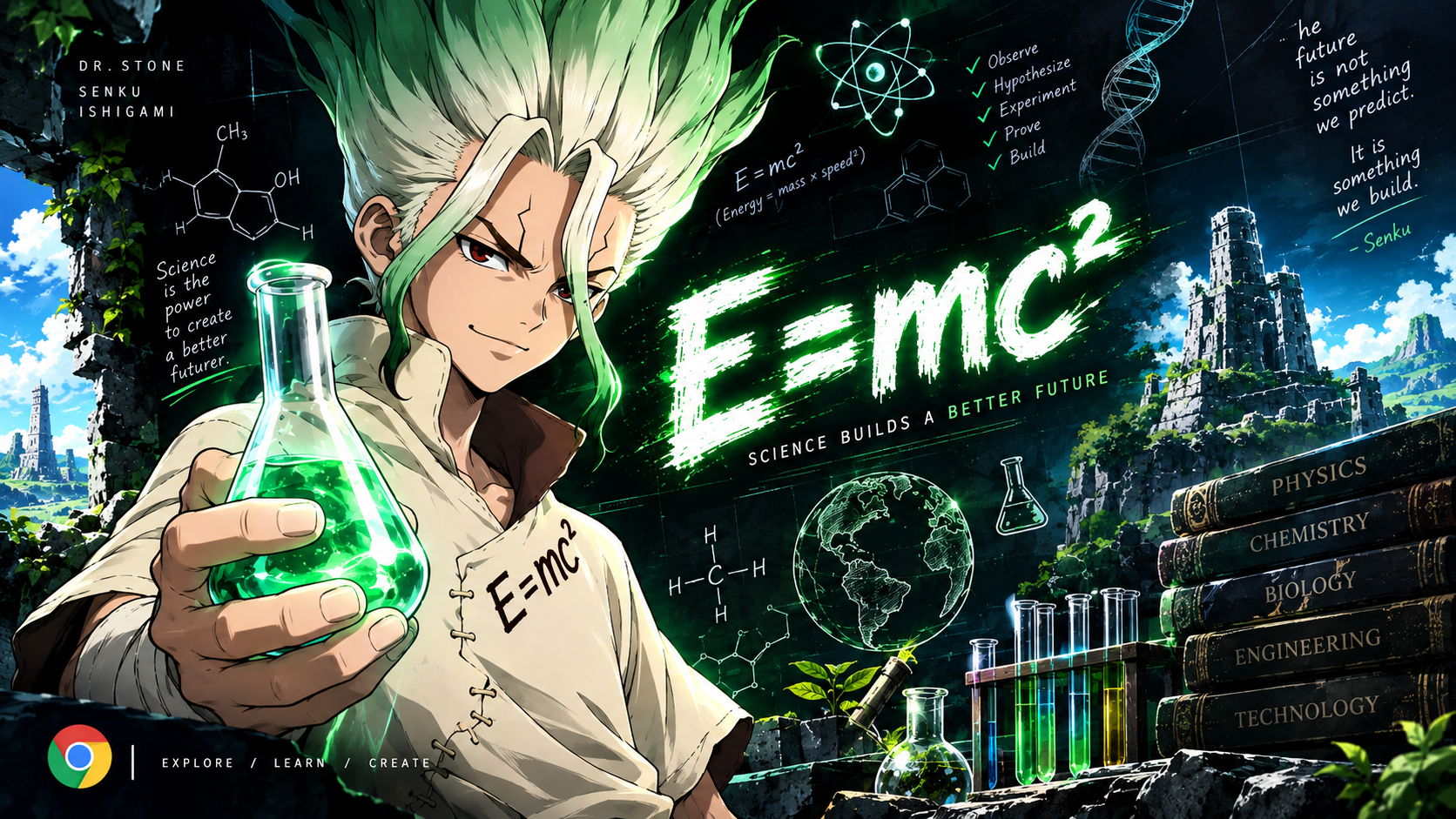
When Senku Ishigami first awoke from petrification in the year 5738, shivering against the primeval wilderness with nothing more than raw cognitive grit and a handful of cracked stone tools, the prospect of an Apollo-style moon mission sounded like psychotic delusion. Yet here we are. With the announcement of Dr. STONE: Science Future, the fourth and final season of TMS Entertainment’s acclaimed adaptation, the Kingdom of Science is preparing to fire its engines toward the ultimate high ground. In an anime landscape saturated with reality-warping power systems, multiversal escalations, and apocalyptic sorcery, Dr. STONE has achieved something arguably more radical: turning the grueling, iterative history of human civilization into the most electrifying shonen narrative of the past decade. Now, the series faces its grandest hurdle yet—a cosmic voyage to unmask humanity’s petrifier and settle the score with the enigmatic entity known only as Why-Man.
From Stone Spears to Saturn V: The Audacious Scope of Science Future
The progression of Dr. STONE has always operated on an exponential curve. Where Season 1 painstakingly detailed the chemical alchemy of calcium carbonate and iron smelting, and subsequent arcs expanded into nautical navigation and telecommunications, Science Future operates on a truly planetary canvas. To reach the Moon, Senku and his allies cannot simply craft a rocket in an afternoon; they must reconstruct global supply chains. Viewers are poised to witness the construction of intercontinental transit, resource outposts spanning across continents, and the synthesis of superalloys capable of withstanding the vacuum of space.
This industrial leap represents the thematic zenith of Riichiro Inagaki and Boichi’s masterpiece. The narrative strips away romanticized notions of instantaneous innovation, exposing the gritty, collaborative bedrock of real-world aerospace engineering. The mission demands thousands of specialized parts, precise mathematical calculations, and life-support architecture developed in a world that, just years prior, lacked indoor plumbing. It is an unapologetic love letter to human infrastructure—an ode to the unglamorous labor behind humanity’s greatest technological leaps.
The Specter in the Static: Confronting Why-Man’s Existential Riddle
At the center of this lunar offensive looms the franchise’s defining enigma: Why-Man. Ever since that harrowing Morse code transmission cracked through Senku’s crude radio receiver—incessantly repeating the word “WHY” in a synthetic imitation of Senku’s own voice—the antagonist has cast an eerie, cosmic-horror shadow over an otherwise optimistic series.
Unlike typical shonen antagonists who covet world domination or ideological supremacy, Why-Man represents a purely clinical terror. The entity does not harbor malicious hatred toward mankind; rather, it functions with cold, algorithmic detachment. Why did it turn billions of conscious minds into calcified statues for nearly four millennia? Is the petrification beam a weapon of extermination, or perversely, a twisted instrument of salvation meant to freeze fragile biological life in indestructible stasis? As the anime readies its final descent onto the lunar dust, this showdown transcends physical combat, shifting into a battle of fundamental worldviews: the dynamic, messy vitality of scientific curiosity versus the sterile, immortal stillness of absolute preservation.
The Chosen Crew: Character Maturation at the Edge of the Atmosphere
Reaching orbit is a suicide run without the correct psychological equilibrium, and the character dynamics steering this lunar expedition reflect the pinnacle of Dr. STONE‘s emotional writing. The casting of the final three-man moon crew is not merely a tactical puzzle; it is the culmination of character arcs years in the making.
Chrome’s Transcendence from Sorcery to Astrodynamics
Perhaps no character embodies the spirit of the series quite like Chrome. Beginning as a self-proclaimed village “sorcerer” collecting curious rocks, Chrome has evolved into an intuitive genius capable of independently discovering fundamental physical laws. In the run-up to the lunar mission, Chrome faces an agonizing cognitive leap: transforming from a terrestrial scrapper into an astronaut tasked with understanding orbital mechanics. His presence proves that genius is not an exclusive birthright of the pre-petrification world, but a universal human spark waiting for kindling.
Senku and Ryusui: The Synergy of Logic and Ambition
The operational backbone of the mission relies on the symbiotic engine between Senku Ishigami and Ryusui Nanami. Senku provides the uncompromising logic, the empirical safety nets, and the operational blueprint. Ryusui, however, supplies the fuel: an insatiable, borderline-arrogant desire to conquer the impossible. Where others see the void of space as an abyss of death, Ryusui sees it as the ultimate luxury commodity, the grandest territory waiting to be acquired. This collision of Senku’s selflessness and Ryusui’s noble greed showcases the multi-faceted engine of human progress.
TMS Entertainment’s Final Hurdle: Animating the Impossible Frontier
From an aesthetic perspective, Dr. STONE: Science Future presents a titanic challenge for TMS Entertainment. Boichi’s original manga illustrations during the final arcs feature staggering, hyper-detailed two-page spreads depicting complex industrial machinery, celestial vistas, and expressive psychological intensity. The production team must balance the hyper-kinetic comedic timing that defines the series’ slice-of-life logistics with the solemn, cinematic weight demanded by spaceflight.
Furthermore, sound design will make or break the climactic encounter. The terrifying acoustic silence of the Moon contrasted with the crackle of localized radio transmissions provides an unprecedented playground for the sound directors. If the production values match the standard set by the New World arc, Science Future could deliver one of the most visually and sonically arresting space travel sequences in modern anime history, effortlessly rivaling prestige science-fiction epics like Planetes and Space Brothers.
A Monument to Human Tenacity: Why Dr. STONE’s Finale Matters
We live in an era of media saturated with climate anxieties, socio-technological cynicism, and apocalyptic fatigue. It is remarkably easy to consume art that suggests humanity is a parasite destined for self-destruction. Dr. STONE has persistently and violently rejected that nihilism. Throughout its run, the narrative has insisted that science is neither inherently good nor inherently evil—it is simply the collective relay race of every human being who ever wondered how the universe works, passed down across generations through blood, sweat, and blackboard equations.
As Senku Ishigami laces up his makeshift EVA suit and preps the thrusters, the stakes could not be clearer. This finale is not just about beating a mysterious villain on the Moon; it is a vindication of two million years of human civilization. It is an argument that our curiosity will always outlast the dark, cold silence of the cosmos.
How do you think TMS Entertainment will handle the monumental revelations of the Why-Man confrontation? Are you emotionally prepared for the Kingdom of Science’s final launch? Let us know your predictions, your favorite scientific innovations, and your final-season hype in the comments below!