Ever since the melancholic strains of Duffy’s “Distant Dreamer” faded over the ocean-soaked finale of Stone Ocean in late 2022, an unspoken, electric tension has gripped the global anime community. The original Joestar bloodline, stretching from Victorian England to the humid swamps of Green Dolphin Street Prison, had reached its definitive, cosmic conclusion. For most franchises, reaching the end of a multi-generational epic signifies a resting period. But for Hirohiko Araki’s genre-defying odyssey, the finale was merely the prologue to something far more mythic: the promised land of Part 7: Steel Ball Run.
Widely regarded by critics and readers alike as Araki’s undisputed magnum opus—perennially locked in a tug-of-war with Kentaro Miura’s Berserk for the highest-rated manga spots on MyAnimeList—Steel Ball Run is not just the next cour of an ongoing franchise. It is an unvarnished artistic rebirth. Moving the narrative to a completely distinct alternate continuity and transposing the action to a 3,700-mile equestrian race across late 19th-century America, Part 7 challenges everything audiences anticipate from the franchise. As anticipation mounts regarding David Production’s eventual adaptation, the question is no longer if it will be adapted, but how the industry can possibly shoulder the sheer weight of Araki’s technical and thematic peak.
A Transcontinental Rebirth: The Seinen Paradigm Shift
To grasp why the hype for Steel Ball Run borders on religious reverence within anime spheres, one must examine its turbulent genesis in 2004. Originally serialized in Weekly Shonen Jump before shifting to the monthly seinen pages of Ultra Jump, the story unshackled Araki from the grueling weekly grind and restrictive editorial confines of teen-oriented manga. The monthly publication schedule allowed the mangaka’s pencil work to metastasize into breathtaking, cross-hatched tableaus reminiscent of European graphic masters like Moebius.
Set in 1890, the plot centers on the titular trans-American marathon: an unprecedented, cross-country horse race organized by eccentric promoter Steven Steel. The prize? Fifty million dollars. The reality? A clandestine, geo-political treasure hunt orchestrating the retrieval of sacred, mummified relics imbued with apocalyptic power. By trading urban alleys and claustrophobic Italian streets for the scorched canyons of Arizona and the treacherous prairies of the Midwest, Araki delivered a neo-Western that melds Sergio Leone’s grit with cosmic body-horror.
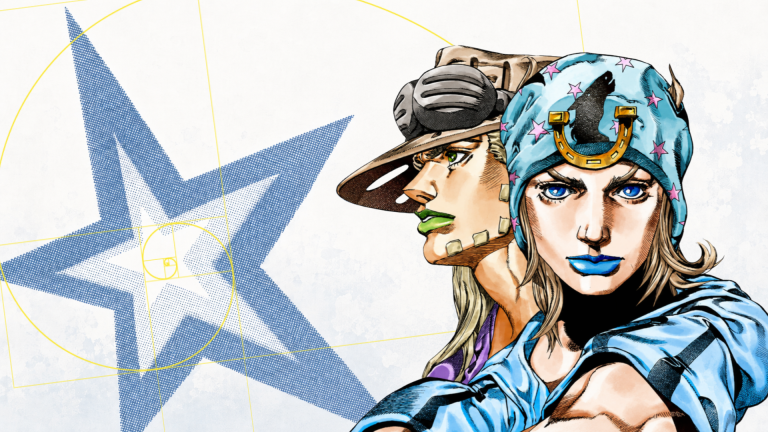
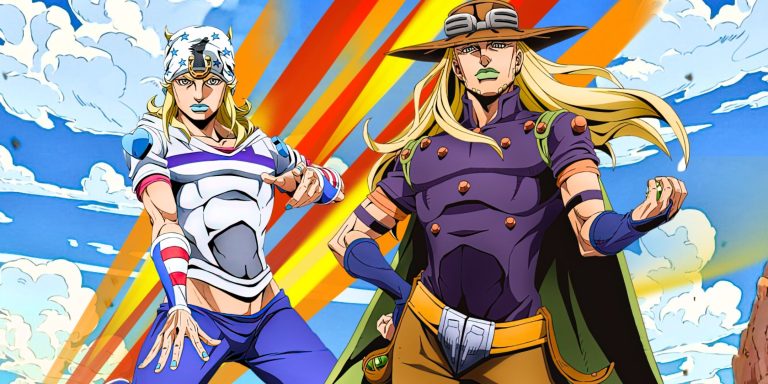
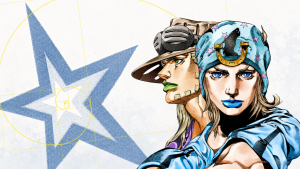
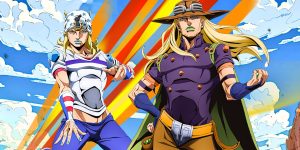
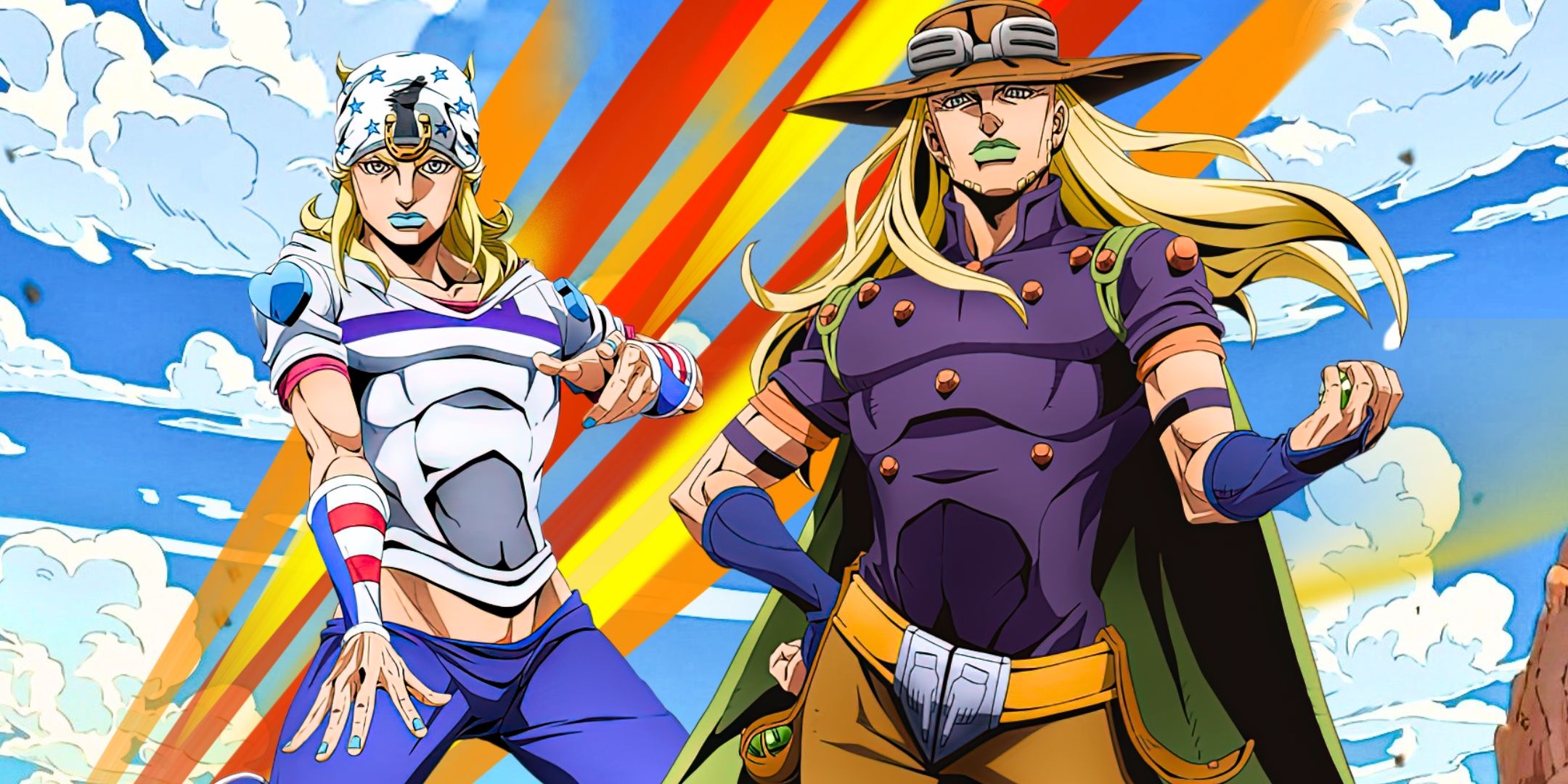
Johnny Joestar and Gyro Zeppeli: Deconstructing the JoJo Duo
At the beating heart of this sprawling dust-and-blood epic is the most psychologically nuanced relationship Araki has ever penned. In contrast to the stalwart nobility of Jonathan Joestar or the swaggering tactical genius of Jotaro Kujo, Part 7 introduces us to an unprecedented lead: a fallen prodigy who is fundamentally, beautifully flawed.
The Paraplegic Gunfighter and the “Dark Determination”
Johnny Joestar is not a hero when the starter pistol fires in San Diego. A former child-prodigy jockey struck down by paraplegia following an act of youthful arrogance, Johnny enters the narrative as an embittered, depressed shell of a man. His journey across America is not fueled by altruism or family duty; it is born of raw, selfish desperation after he witnesses a kinetic phenomenon that momentarily restores sensation to his legs.
Araki treats Johnny’s morality with astonishing complexity, coining the concept of “Dark Determination”—a cold, terrifying flame in Johnny’s eyes that signifies his willingness to murder without hesitation to achieve his goals. Johnny is a deconstruction of the classic JoJo hero, an anti-nihilist forced to drag himself through the dirt, confronting trauma, guilt, and physical limitation in exchange for a shot at redemption.
Gyro Zeppeli: The Virtuoso with a Steel Heart
Contrasting Johnny’s grim intensity is Gyro Zeppeli, a disgraced executioner from the Kingdom of Naples whose sardonic humor, golden grins, and surreal lyrical outbursts mask a tragic burden of honor. Gyro enters the race to win royal amnesty for an innocent child condemned to death. The dynamic between Johnny and Gyro evolves from reluctant tactical alliance to one of the most poignant, deeply grounded brotherhoods in modern sequential art. Gyro serves not merely as Johnny’s mentor, but as the moral compass preventing Johnny from being consumed by his own ruthless resolve.
From Hamon to The Spin: Kinetic Physics and the Golden Ratio
Beyond its character psychology, Steel Ball Run fundamentally reimagines the supernatural combat that defines the medium. While Stands remain present—manifesting with terrifying conceptual abstraction, such as Diego Brando’s Scary Monsters or the dimension-skipping dread of Funny Valentine’s Dirty Deeds Done Dirt Cheap (D4C)—the true structural foundation of Part 7 is The Spin.
The Spin is Araki’s thematic and mechanical evolution of Part 1 and 2’s Hamon (Ripple), elevated through sacred geometry and mathematics. Rooted in the Fibonacci sequence and the Golden Rectangle found across nature, the Spin is a state of rotational energy mastered by the Zeppeli family. By channeling this infinite kinetic force through customized steel orbs, Gyro manipulates human anatomy, deflects projectiles, and distorts the fabric of space itself.
For Johnny, mastering the Spin catalyzes the evolution of his Stand, Tusk. Spanning four distinct “ACTs,” Tusk mirrors Johnny’s psychological rehabilitation: progressing from simple spinning fingernail bullets to a catastrophic, dimensional-piercing force that redefines combat choreography. Animating the visual geometry of the Spin—with its invisible golden spirals and kinetic distortion waves—represents an unprecedented aesthetic challenge that demands a creative director of extraordinary caliber.
The Equestrian Conundrum: Can David Production Conquer the Beast?
The single greatest point of anxiety—and awe—surrounding a potential Steel Ball Run adaptation is not voice casting or musical scoring; it is the physical logistics of animating horses. Within the Japanese animation industry, four-legged equine anatomy is notoriously regarded as a budget-devouring nightmare. Drawing horses in constant, galloping motion from dynamic three-dimensional perspectives is so labor-intensive that many elite studios rely on awkward, jarring CGI assets.
David Production has consistently proven their mettle across six parts, mastering Araki’s distinct color shifts, kinetic sound effects, and flamboyant visual rhythm. However, Steel Ball Run features dozens of racers charging through dust storms, crossing surging rivers, and clashing in mid-gallop skirmishes across hundreds of consecutive miles.
To do justice to Araki’s intricate, scratchy line art, David Production will likely need to employ a cutting-edge hybrid pipeline: utilizing sophisticated 3D modeling for the equine mounts—reminiscent of the groundbreaking integration seen in Orange’s Trigun Stampede—overlaid with meticulous hand-drawn 2D detailing for the jockeys and stands. Rumors have swirled through the sakuga community regarding whether DP might collaborate with dedicated CG powerhouses, or if the production delay since Stone Ocean reflects an extended pre-production cycle designed to build these proprietary technical pipelines from scratch.
The Long Ride Ahead: Anime’s Next High-Water Mark
The anticipation surrounding JoJo’s Bizarre Adventure: Steel Ball Run transcends typical seasonal anime hype. We are standing on the precipice of an adaptation that, if executed with the reverence and visual audacity it deserves, has the latent capacity to redefine what cinematic television anime can achieve. It is an uncompromised convergence of historical fiction, existential horror, mathematical mysticism, and human fragility.
Whether David Production unveils a teaser at the next major Jump Festa or allows the project to simmer behind closed doors for another year, the message across the fan landscape remains resolute: take all the time necessary. The race across the American frontier was never meant to be a sprint; it is an arduous, transformative marathon. And when the starting gun finally echoes, the anime world will bear witness to Hirohiko Araki’s true crowning glory.
How do you think David Production should tackle the legendary horse race—pure 2D sakuga or stylized hybrid CGI? Drop your dream voice cast for Gyro and Johnny in the comments below, and keep your browsers locked to Wibux.com for breaking updates on the JoJo Part 7 front.