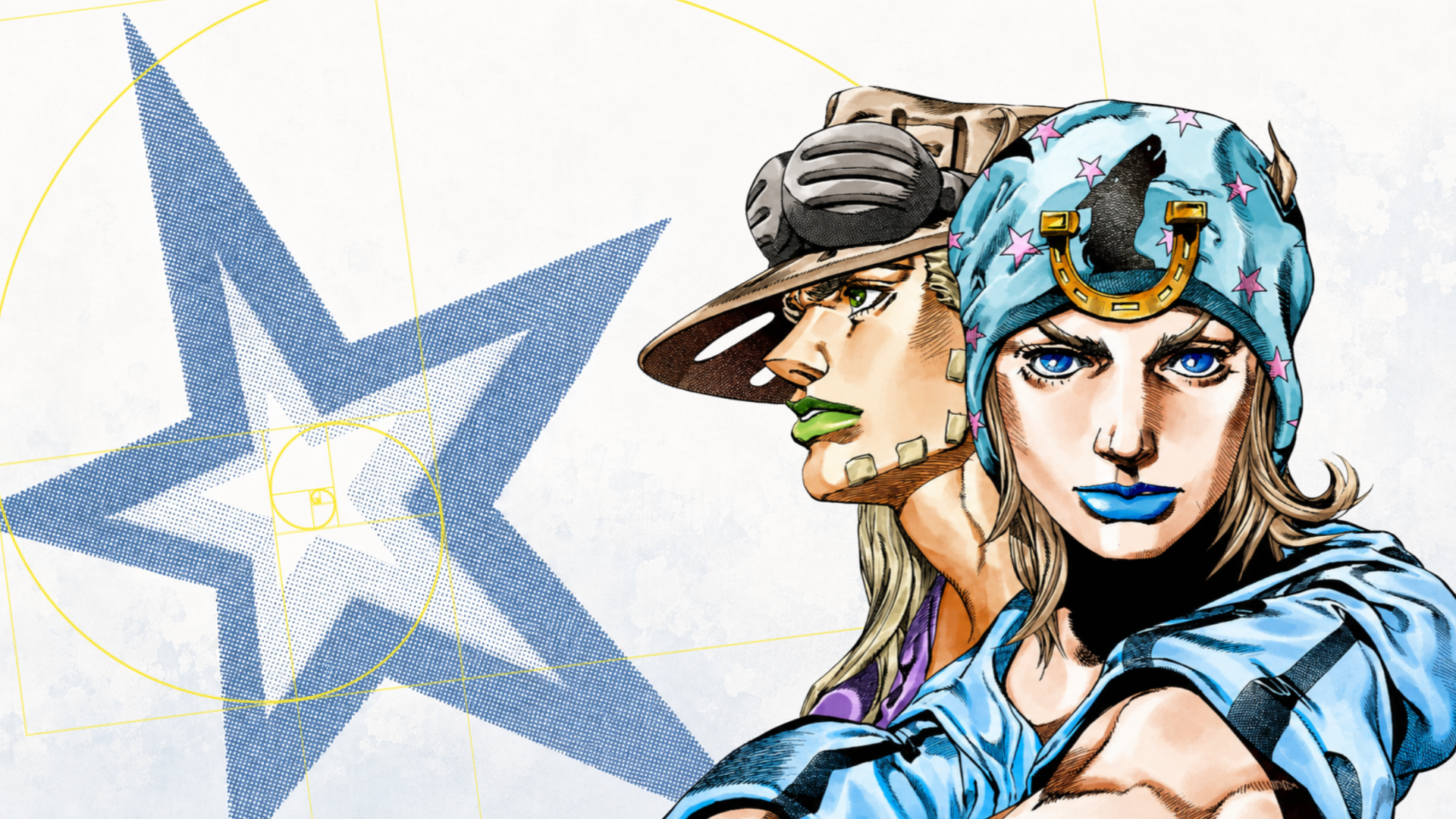
Ever since the cosmic, universe-resetting climax of Stone Ocean drew to a close on Netflix, a singular, thunderous question has echoed through the corridors of anime discourse: When does the race begin? For over a decade, Hirohiko Araki’s JoJo’s Bizarre Adventure: Steel Ball Run has occupied an almost mythical status in the medium. Widely celebrated as Araki’s magnum opus—and consistently sparring with Kentaro Miura’s Berserk for the top spot on global manga rating registries—Part 7 represents a seismic reinvention of what JoJo can be. Rumors, production leaks, and perpetual anticipation have reached a fever pitch, making the eventual adaptation not merely the continuation of a beloved franchise, but David Production’s ultimate trial by fire.
A Monumental Shift: From Shonen Camp to Seinen Western Epic
To understand the ravenous appetite for a Steel Ball Run anime, one must understand how radically it deviates from the generational melodrama of Parts 1 through 6. Serialized between 2004 and 2011, Steel Ball Run began its life in Weekly Shonen Jump before swiftly transitioning to the monthly seinen publication Ultra Jump. That shift in publication demographic was nothing short of transformative for Araki’s creative liberties.
Unshackled from weekly deadlines and standard shonen editorial constraints, Araki slowed his cadence, deepened his thematic resonance, and indulged in panoramic, cinematic storytelling. Part 7 reimagines late 19th-century America as a treacherous, sprawling stage for a 3,800-mile coast-to-coast horseback marathon with a staggering $50 million prize. Beneath the frontier dust and corporate greed lies a metaphysical pilgrimage: the hunt for the scattered mummified relics of a saint (implied to be Jesus Christ himself), backed by none other than the fiercely patriotic, dimension-hopping United States President, Funny Valentine.
The Moral Ambiguity of Manifest Destiny
Unlike previous parts, where the line between heroic justice and irredeemable villainy was drawn in bold, fluorescent strokes, Steel Ball Run operates in a hazy world of historical revisionism, political intrigue, and bruised morality. Valentine’s machinations are driven by an unyielding desire to secure the future of his nation at the expense of the rest of the world. He is a terrifyingly charismatic antagonist whose conviction often mirrors, or even exceeds, that of our protagonists. Adapting this geopolitical and spiritual chess match requires a level of directorial maturity and narrative pacing that David Production has never had to deploy on this scale before.
Johnny Joestar & Gyro Zeppeli: Deconstructing Araki’s Heroes
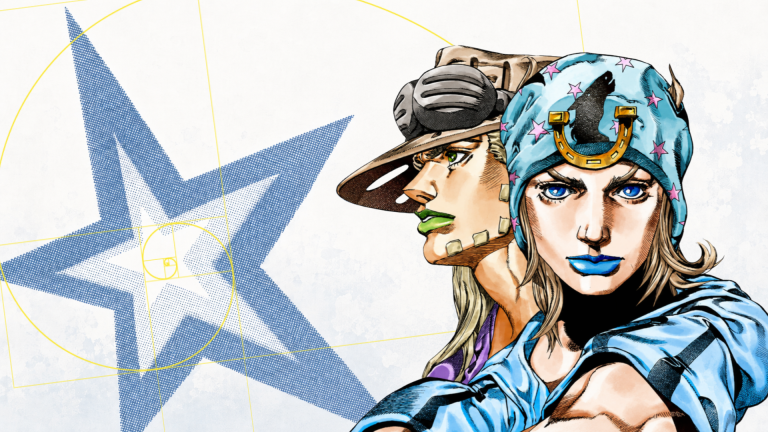
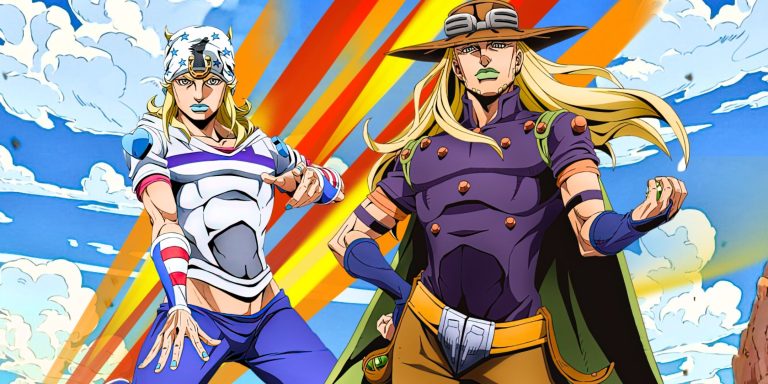
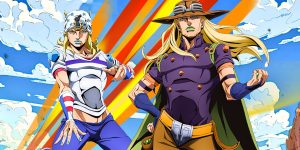
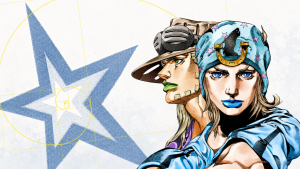
At the beating, bleeding heart of the narrative is the dynamic between Johnny Joestar and Gyro Zeppeli—arguably the most fully realized duo in modern graphic fiction. Johnny represents a profound subversion of the traditional JoJo protagonist. Stripped of the chivalry of Jonathan or the effortless swagger of Jotaro, Johnny is a fallen idol: a former equestrian prodigy whose hubris cost him his family, his career, and the use of his legs. Paralyzed from the waist down, bitter, and carrying an unmistakable “dark determination,” Johnny’s pursuit of the race is not about saving the world; it is about bringing his life from “negative back to zero.”
Enter Gyro Zeppeli, a disgraced executioner from the Kingdom of Naples entering the race to save an innocent boy from execution. Loud, eccentric, intensely guarded, and armed with lethal, twirling steel spheres, Gyro serves as Johnny’s mentor, companion, and foil. Their bond is forged not through melodramatic declarations, but through campfire banter, nonsensical musical compositions (“Pizza Mozzarella”), and shared near-death combat across desolate plains.
The Evolution of the Spin: Beyond the Stand
While Stands naturally return—evolving into bizarre, terrifying forms like Johnny’s multi-act Tusk—the philosophical backbone of Part 7 is the Spin. Rooted in the sacred geometry of the Golden Ratio and Fibonacci sequence, the Spin is a supernatural martial art and scientific marvel passed down through the Zeppeli lineage. Visualizing the Golden Rectangle on screen—translating pure mathematical symmetry into kinetic, screen-shattering power—presents a mesmerizing visual opportunity. For animators, rendering the micro-vibrations, the atmospheric distortions, and the absolute reality-tearing lethality of the “Infinite Spin” will be the benchmark by which the adaptation is judged.
The Studio Dilemma: David Production and the Equestrian Gauntlet
Why has the adaptation of Steel Ball Run taken so long? The answer can be summed up in a single, terrifying word for the Japanese animation industry: horses.
Equine anatomy is universally acknowledged as one of the most complex, grueling challenges a 2D animator can face. Sustaining realistic musculature, four-legged galloping cadences, and dynamic camera angles during high-octane chases requires extraordinary skill and staggering budgets. In an era where even titan studios like MAPPA and Wit have occasionally stumbled or relied heavily on noticeable CGI shortcuts for large beasts, animating a story where dozens of named jockeys race across open plains on horseback for dozens of episodes is an intimidating operational bottleneck.
David Production has proven their technical wizardry across six parts, defining the look of modern JoJo with bold color-palette flips, onomatopoeic kinetic typography, and distinct retro-fashion swagger. However, to bring the Steel Ball Run race to life without sacrificing the gritty texture of Araki’s cross-hatching, the studio will likely need to construct a bespoke hybrid pipeline. Industry observers speculate that a synthesis of advanced cel-shaded 3D horse models combined with hand-drawn 2D rider close-ups and keyframe corrections will be inevitable. If executed with the same finesse seen in high-end projects like Chainsaw Man or Orange’s Trigun Stampede, this hybrid technique could pioneer a new benchmark for kinetic sports animation; if fumbled, the visual dissonance could derail the immersion of Araki’s greatest work.
The Fandom Vigil: Cult Prestige Meets Mainstream Pressure
The fervor surrounding Steel Ball Run is unprecedented. For English-speaking and international fans, Part 7 was the arc that solidified Araki’s reputation from a quirky, cult-favorite mangaka into a masterclass world-builder. It is a work loaded with memetic resonance, existential weight, and unmatched dramatic stakes. The sheer volume of fan-made trailers, animated concept reels, and musical compositions dedicated to Johnny and Gyro on YouTube and TikTok demonstrates that the audience is primed and waiting.
Furthermore, an adaptation must reconcile the shift in serialization format. Adapting an expansive 24-volume seinen manga requires thoughtful pacing—likely spanning a robust, multi-cour seasonal run rather than the binge-model release structure that previously cooled fan enthusiasm during Stone Ocean’s initial rollout. The community’s consensus is clear: David Production must be given the time, budget, and episodic television breathing room this epic deserves.
The Final Stretch: The Horizon of JoJo’s Future
JoJo’s Bizarre Adventure: Steel Ball Run is not merely another season in an ongoing timeline; it is a soft reboot, a masterwork of reinvention, and David Production’s ultimate frontier. It is the story of two broken men galloping through the American wilderness chasing redemption, surrounded by the ghosts of their pasts and the terrifying weight of their ambitions.
When that starting gun inevitably fires, the anime landscape will be compelled to stop and watch. The road from San Diego to New York is paved with technical landmines and sky-high expectations, but if David Production harnesses the same Golden Rotation that guided Araki, we may very well witness the birth of a generational anime masterpiece.
What are your biggest hopes—and fears—for David Production’s adaptation of Steel Ball Run? Will CGI horses compromise the visual fidelity, or are you trusting the studio’s track record? Let your voice be heard in the comments below!