

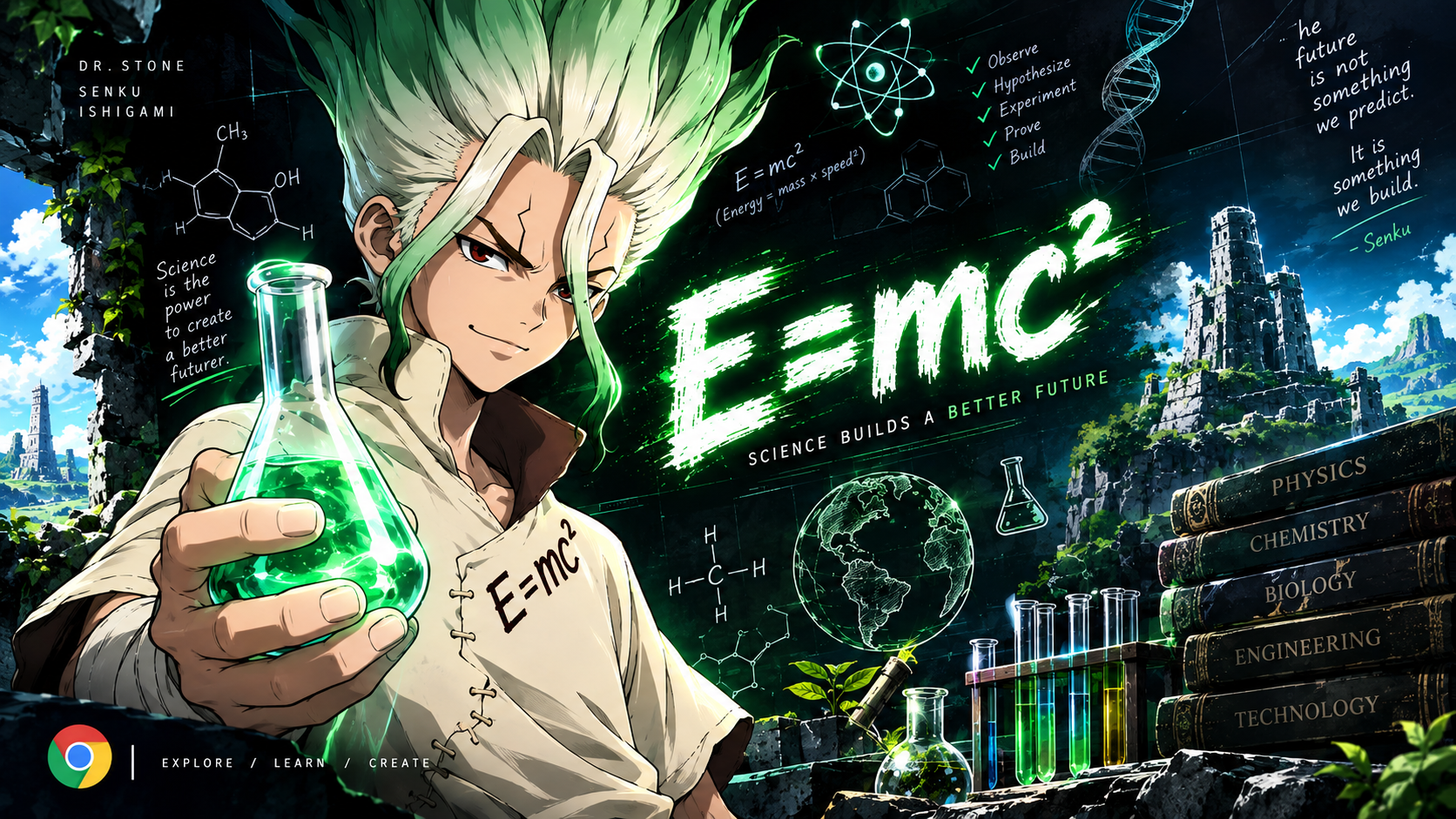
When Senku Ishigami first awoke in the year 5738, peeling petrified crust from his eyes in a world completely swallowed by wild greenery, the Kingdom of Science was nothing more than an audacious dream sketched in the dirt. Seven years after the manga’s debut and following three triumphant anime seasons, the journey of Riichiro Inagaki and Boichi’s flagship masterpiece is hurtling toward its definitive climax. With the announcement and escalating anticipation for Dr. STONE: Science Future—confirmed as the fourth and final season, split across three cours—the stakes have fundamentally severed ties with terrestrial limits. What began as a battle for basic survival against the elements and ideological purists has transformed into an interstellar odyssey. Senku is going to the Moon, and waiting on that desolate, lunar surface is the greatest enigma of the post-apocalyptic era: the petrifying terror known only as Why-Man.
The Industrial Metamorphosis: From Earthen Kilns to Saturn V Ambitions
The narrative brilliance of Dr. STONE has always resided in its stubborn commitment to the scientific method. Where typical shonen series hand-wave progression with supernatural power awakenings or time-skips, Senku’s trajectory adheres to the brutal, beautiful friction of human trial and error. Science Future represents the absolute zenith of this philosophy. To build a moon-landing vehicle without modern infrastructure, the Kingdom of Science must essentially re-enact the entire Industrial Revolution and the space race inside a compressed, breathtaking timeframe.
The logistical scope of this final chapter demands global cooperation. Before Senku can even conceptualize a lunar module, humanity must construct an international supply chain spanning North America, South America, and beyond. Viewers who marveled at the creation of a simple lightbulb or the rudimentary steam engine in earlier seasons are about to witness the assembly of microprocessors, advanced rocketry propulsion systems, and synthetic materials fabricated from sheer grit. It is an audacious narrative flex: validating that when human intellect unites under a shared purpose, even a stone-age civilization can punch a hole straight through the atmosphere.
The Architecture of the Lunar Triumvirate
A mission to the Moon cannot be achieved by Senku alone. The thematic heart of Dr. STONE thrives on division of labor, and the upcoming lunar crew embodies this symbiosis. To survive a one-way shot at cosmic reconnaissance, the narrative assembles a carefully curated strike team balancing intellect, physical mastery, and technical precision. Watching the primitive prodigy Chrome evolve into an intuitive aerospace thinker alongside Dr. Xeno’s high-level physics calculations underscores the franchise’s enduring thesis: science is not a solitary birthright, but a baton passed across generations and rivalries.
Decoding Why-Man: Deconstructing Anime’s Most Chilling Cosmic Riddle
Ever since that spine-chilling, synthesized Morse-code transmission shattered the Kingdom of Science’s airwaves with a single, looping query—“WHY”—the shadow of Why-Man has hung over the narrative like an existential guillotine. In an era where shonen antagonists frequently lean into tragic backstories or bombastic god complexes, Why-Man stands apart as a profoundly unsettling, impersonal force. The entity does not simply threaten physical harm; it threatens to reverse every millimeter of human consciousness back into inert stone.
The confrontation awaiting viewers on the Moon is not a traditional martial showdown. Instead, it serves as an ideological and biological trial. Is Why-Man an extraterrestrial biological intelligence, a rogue synthetic algorithm created by our own forgotten hubris, or something entirely beyond human categorization? The origin of the Medusa devices—the mass-produced petrification mechanisms that turned seven billion people to mineral statues in an instant—lies at the epicenter of this confrontation. Inagaki’s writing in this final stretch subverts typical apocalyptic tropes, pivoting the narrative toward a philosophical examination of life, death, longevity, and the terrifying price of peace.
Generational Ghosts: The Psychological Stakes of the Final Frontier
While the mechanics of rocketry provide the kinetic propulsion for Science Future, the emotional gravity of the season rests squarely on the shoulders of Senku’s late father, Byakuya Ishigami. The foundational tragedy of Dr. STONE has always been the temporal chasm separating father and son. Byakuya and his fellow astronauts on the International Space Station looked down from low Earth orbit as humanity turned to stone, spending their remaining days establishing the Ishigami Village so that Senku might have allies thousands of years later.
Now, Senku is reversing that trajectory. By leaving Earth’s atmosphere, he is effectively entering the celestial sphere that his father once occupied. This inversion lends Science Future a quiet, devastating emotional resonance beneath its rapid-fire scientific exposition. Senku is not driven by revenge, nor does he succumb to weeping nostalgia; his grief is expressed through applied physics. Reaching the Moon is Senku’s ultimate dialogue with the dead—a definitive, roaring statement that his father’s sacrifices on the ISS were not cast into the void in vain.
TMS Entertainment’s Crucible: Adapting Boichi’s Mechanical Masterwork
From an animation standpoint, Science Future poses a monstrous challenge for TMS Entertainment and director Shuhei Matsushita. Manga artist Boichi’s art style reached staggering levels of intricate detail during the lunar arc, illustrating microscopic circuitry, sprawling transcontinental factories, and the haunting, photorealistic desolation of the lunar crust. Replicating that level of technical fidelity without suffering production bottlenecks requires exceptional compositing and strategic art direction.
The decision to split the final season into three separate cours indicates that TMS Entertainment recognized the sheer density of the source material. Compressing the remaining chapters into a single 24-episode sprint would have eviscerated the pacing, robbing the scientific processes of their earned, step-by-step catharsis. Backed by the soaring, symphonic compositions of Tatsuya Kato, Hiroaki Tsutsumi, and Yuki Kanesaka, the anime adaptation has consistently elevated the emotional peaks of the manga. If the production house can maintain its kinetic visual standard across this multi-cour structure, Science Future has the potential to stand alongside the medium’s premier grand finales.
The Antidote to Nihilism: Why This Finale Matters Today
The contemporary pop-culture landscape is undeniably captivated by grimdark deconstructions, cynical anti-heroes, and reality-weary escapism. In stark contrast, Dr. STONE has remained an unapologetic, radical celebration of human ingenuity, intellectual humility, and collective optimism. It posits that humanity’s greatest virtue is not our capacity for conquest, but our insatiable urge to understand the mechanics of the cosmos and lift one another out of the dark.
As Dr. STONE: Science Future readies its engines for the launchpad, fans are not merely gearing up to watch a climactic duel; they are preparing to bid farewell to one of the most uniquely uplifting narratives in modern anime history. The rocket is on the pad, the countdown is ticking down to zero, and the answers to humanity’s millennia-long petrification are waiting in the lunar dust.
Are you prepared for the final launch, or do you have your own theories on the true identity and motives of Why-Man? Sound off in the comments below, and keep your dials tuned to Wibux.com for exhaustive episode breakdowns, lore analyses, and production updates as Science Future unfolds!