

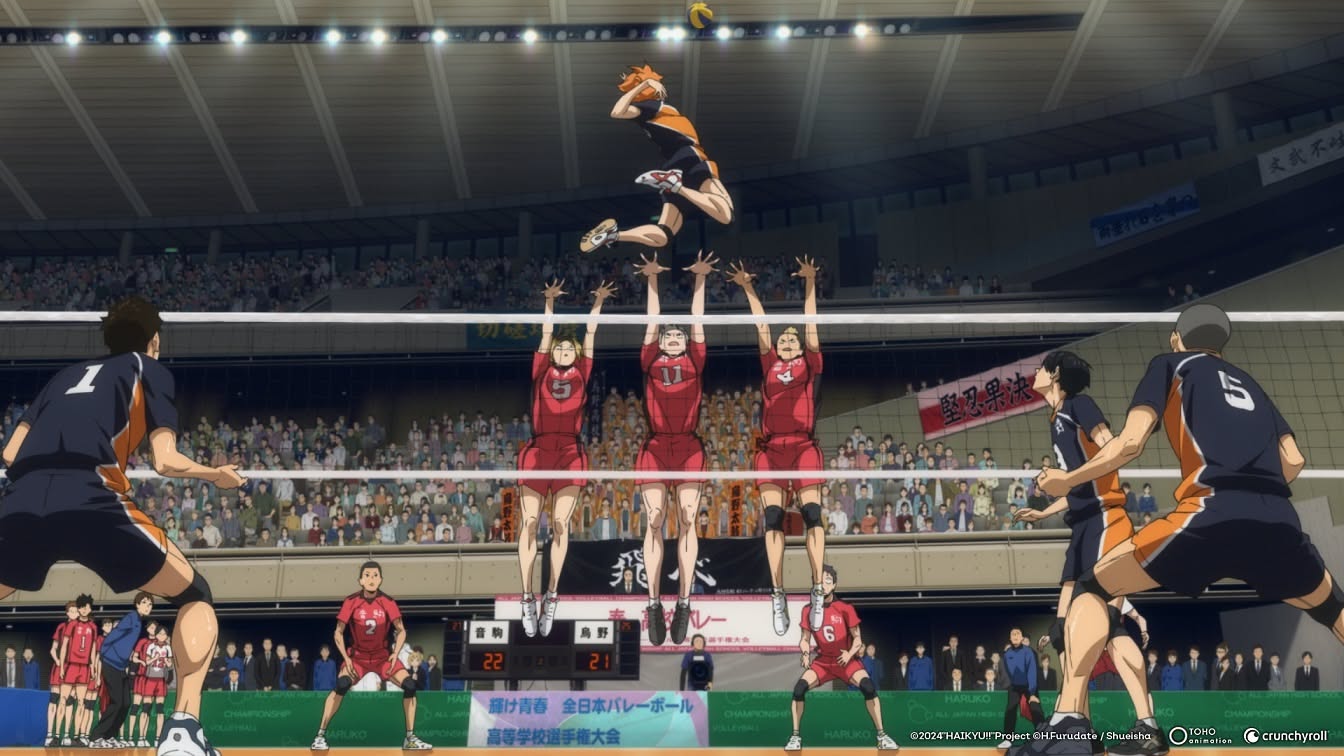
For nearly a decade, sports anime enthusiasts have lived with a singular, mythical promise lingering in the back of their minds: the “Battle at the Garbage Dump.” What began as an informal practice match between two fallen powerhouses in Haikyu!!‘s inaugural season steadily morphed into one of the most meticulously built rivalries in modern shonen history. Following a historic box office run that generated over $100 million worldwide, Haikyu!! The Dumpster Battle (Gekijōban Haikyu!! Gomi Suteba no Kessen) has finally landed on global streaming platforms. Its digital arrival is more than just a convenient home viewing milestone—it is a cultural victory lap that cements the Karasuno versus Nekoma clash as the undisputed pinnacle of contemporary sports storytelling.
Directed and written by series veteran Susumu Mitsunaka, the film adapts chapters 294 through 325 of Haruichi Furudate’s manga into a breathless, hyper-focused 85-minute feature. Free from the commercial breaks and weekly cliffhangers of traditional television broadcasting, the streaming debut allows audiences worldwide to experience the match as it was always intended: a continuous, suffocating, and deeply euphoric endurance test where every rally carries generational weight.
The Narrative Architecture of an Inevitable Clash
Most tournament arcs in sports anime are governed by clear adversarial dynamics. Protagonists confront ideological opposites: arrogant prodigies, tyrannical coaches, or unyielding physical monoliths. Karasuno’s prior hurdles fit this mold brilliantly—Aoba Johsai represented tactical vengeance, while Shiratorizawa stood as an indomitable meritocracy. Yet, the clash with Nekoma High operates on an entirely distinct narrative frequency. There are no villains on the court at Tokyo Metropolitan Gymnasium; there is only mutual reverence, shared lineage, and an unspoken pact that stretches back to their grandfathers’ generation.
Generational Legacy: Ukai, Nekomata, and the Promise Kept
The foundation of the Dumpster Battle rests on the historic bond between former coaches Ikkei Ukai and Yasufumi Nekomata. For decades, the two mentors staged practice matches, yearning to face one another on an official national stage—a dream that eluded them their entire lives. When Keishin Ukai and Nekomata finally exchange nods across the net in an official Spring Tournament setting, the film honors that generational debt without lingering in overt melodrama. The emotional stakes are inherently understood: this is a match with no tomorrow, a “game over” that cannot be remedied with another practice set.
Kenma Kozume and the Suffocation of Shoyo Hinata
At the center of The Dumpster Battle lies the psychological chess match between Karasuno’s exuberant middle blocker, Shoyo Hinata, and Nekoma’s detached setter, Kenma Kozume. Where Hinata represents boundless, kinetic hunger, Kenma treats volleyball as a puzzle game requiring optimization, threat mitigation, and resource management. Their dynamic elevates the film from an impressive athletic exhibition to a masterclass in psychological warfare.
Kenma’s strategy against Karasuno is agonizingly deliberate. Recognizing that Hinata’s offense thrives on momentum and spatial freedom, Kenma systematically “cages” the crow. Through surgical serves, positional baiting, and Nekoma’s legendary floor defense, Kenma limits Hinata’s run-up space, gradually clipping his wings. The visual metaphor of a bird confined inside an expanding digital cage brilliantly illustrates Kenma’s analytical mindset. Hinata is not simply being outscored; he is being starved of the sensation that makes him feel alive: the act of flying.
Yet, true to Furudate’s thematic core, this suffocation is not born out of malice. Kenma does not seek to break Hinata’s spirit out of cruelty; he does it because Hinata is the first opponent who genuinely threatens to bore-proof his life. Hinata’s eventual counter—a breathtaking, gravity-defying open-spike that shatters Kenma’s calculations—does not humiliate the setter; it awakens him.
Production I.G’s Masterclass: Kinetic Velocity and the First-Person Gaze
While the episodic seasons of Haikyu!! set the gold standard for sports television, The Dumpster Battle showcases Production I.G operating with unconstrained cinematic firepower. The animation direction under Susumu Mitsunaka strips away superfluous exposition, utilizing pure kinetic syntax to tell the story. Ball physics feel tangible, shoes squeak with visceral weight against polished hardwood, and the rhythmic percussion of digs and spikes mirrors an accelerating heartbeat.
The Climactic First-Person Sequence
The technical zenith of the film arrives during the penultimate rally, captured entirely from Kenma Kozume’s first-person perspective. It is a staggering creative decision that stands among the most visually inventive sequences in modern anime history. The camera is not an omniscient observer; it is Kenma himself, drenched in sweat, vision blurring around the edges, gasping for oxygen as the ball relentlessly ricochets across the court.
Every erratic head turn, every desperate lunge, and the distorted squeaks of the arena floor pull the viewer directly into Kenma’s sensory overload. We do not just watch his physical exhaustion—we inhabit it. In this single sequence, Production I.G bridges the gap between traditional 2D character animation and experiential cinema, proving that animation can capture the subjective reality of elite athleticism better than live-action ever could.
Why the Feature Film Format Paid Off (Despite the Trade-Offs)
When Toho Animation initially announced that the remaining narrative of Haikyu!! would be adapted into a two-part theatrical project rather than a full fifth season, the fandom was understandably anxious. Adapting a match that spanned 33 manga chapters into an 85-minute film risked cutting critical character beats, particularly for supporting players like Lev Haiba or Kei Tsukishima. Some minor inner monologues and tactical pauses did indeed end up on the cutting room floor.
However, in retrospect, the cinematic format proved to be an inspired artistic choice. The compressed runtime mirrors the anaerobic reality of a high-level volleyball set. By excising extended flashbacks and keeping the focus squarely on the baseline exchange, the film generates an overwhelming sense of momentum. The match becomes a runaway train, preventing the audience from catching their breath until the final ball slips from sweat-slicked fingers.
The Emotional Zenith: “Tanoshii” and the Soul of Shonen Athletics
The ultimate triumph of The Dumpster Battle is not decided on the scoreboard. It is found in a single, quiet phrase whispered on the hardwood floor: “Tanoshii” (“It’s fun”).
When the final ball drops—not on a thunderous kill, but on a tragic, anti-climactic slip of the ball from Kenma’s exhausted hands—there is no dramatic despair. Instead, Kenma looks up at Tetsuro Kuroo, his childhood friend who introduced him to the sport, and simply thanks him for teaching him to play volleyball. It is an emotional crescendo that subverts every convention of the sports genre. The decades-long rivalry between the crows and the cats concludes not with triumphant roars, but with smiles, mutual gratitude, and an acknowledgment that the process of competing was the true reward.
Now that Haikyu!! The Dumpster Battle is readily available for global audiences to stream, analyze, and rewatch at will, its legacy is definitively secured. It stands as an unvarnished love letter to youth athletics, an animation triumph, and an undeniable reminder of why Haruichi Furudate’s masterpiece remains the crown jewel of modern sports anime.
Have you streamed the Dumpster Battle yet? Did the movie format do justice to the manga, or do you wish it had been a full television season? Sound off in the comments below with your favorite moments from Karasuno vs. Nekoma!