In the grand tapestry of Eiichiro Oda’s magnum opus, milestone chapters are never mere chronological markers; they are thematic detonations. Chapter 1000 crystallized Monkey D. Luffy’s ascension atop Onigashima, while Chapter 1100 plunged readers into the devastating emotional nexus of Bartholomew Kuma’s tragic bargain. As the manga charges toward Chapter 1200, the narrative gravity has shifted entirely to Elbaf—the sacred, frost-bitten realm of giants that has loomed over the story since Little Garden. But beneath the idyllic mead halls and booming warrior bravado lies a brewing cataclysm. A viral, meticulously curated community theory is taking the fandom by storm: that Chapter 1200 will expose the catastrophic Void Century war relics buried deep within the roots of Elbaf, simultaneously unleashing the divine, unchained fury of the exiled Prince Loki.
For decades, readers assumed Elbaf was an archaic sanctuary of martial honor, untouched by modern corruption. Yet, as the Egghead Island arc shattered the illusion that the ancient world was primitive—revealing instead an era of unfathomable technological supremacy—Elbaf’s true role in the world order must be radically reassessed. The land of the giants is not merely an isolated Viking wonderland; it is the fortified vault of Joy Boy’s fallen alliance.
The Subterranean Genesis: Treasure Tree Adam and the Buried Relics
To understand what lies beneath Elbaf, one must first look upward to the sprawling canopy of the Treasure Tree Adam. In One Piece lore, the arboreal giants Adam and Eve serve as cosmic pillars. While the Sunlight Tree Eve funnels solar illumination thousands of meters down into Fish-Man Island—directly beneath Mary Geoise—the colossal Adam tree has long been celebrated merely as the source of the world’s strongest wood, the very timber that birthed the Thousand Sunny and the Oro Jackson. However, the architectural dichotomy Oda has established suggests something far more sinister.
Architectural Inversion: The Underworld of the Ancient Kingdom
If Mary Geoise sits atop the world to enforce tyrannical order, Elbaf’s roots descend into the forgotten past. The prevailing theory suggests that the lower tiers of Elbaf—often referenced in Norse folklore as Niflheim or the subterranean roots of Yggdrasil—house the decommissioned war engines of Joy Boy’s global faction. When the Iron Giant, Emet, awakened on Egghead to reveal ancient machinery powered by the mysterious “Mother Flame” and ancient Haki storage, it confirmed that the Void Century was fought with autonomous dreadnoughts and bio-mechanical weapons.
Why did the World Government never conquer Elbaf? Historically, the Gorosei attributed their hesitation to the sheer military might of the Giant Warrior Pirates. Yet, astute theorists argue that the true deterrent is mutually assured destruction. Entombed within the roots of Adam are relics engineered during the Void Century: colossal war armaments, weaponized continental movers, and perhaps the dormant sister-units of Emet. Elbaf is not an innocent kingdom; it is an arsenal waiting for an ignition source.
The Chained Sovereign: Deconstructing Prince Loki’s Divine Wrath
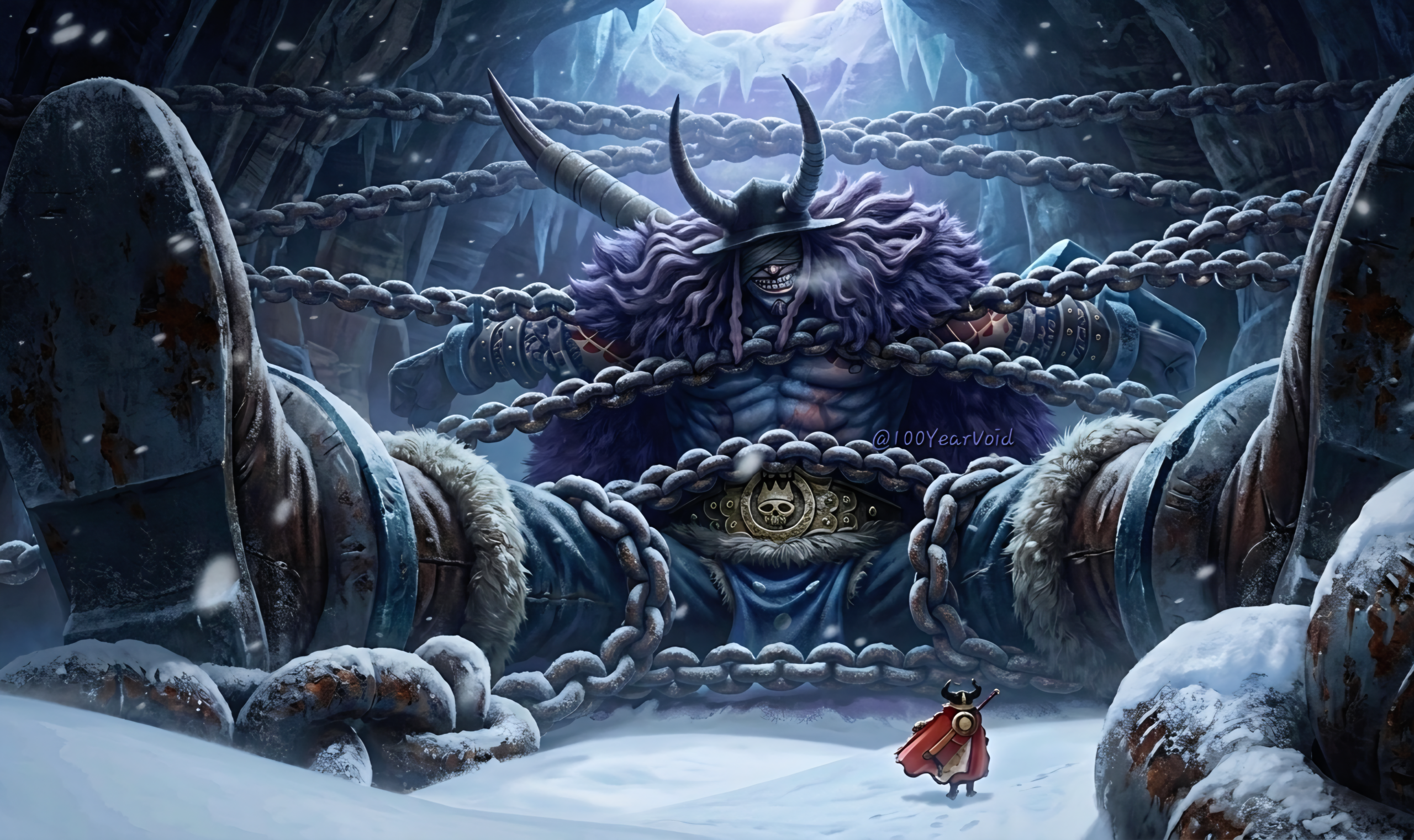
Enter Prince Loki, a figure who spent hundreds of chapters as a comedic footnote regarding Charlotte Lola’s rejected arranged marriage, only to be reintroduced as a terrifying, Seastone-bound anomaly. Bound by massive chains in the bowels of the kingdom, Loki’s aesthetic—blindfolded, snarling, and crackling with raw, malignant energy—draws an unmistakable parallel to Norse mythology’s Fenrir, the monstrous wolf destined to break his bonds during Ragnarök.
Mythological Inversion and the “Cursed” Devil Fruit
Loki’s self-proclaimed status as the “Sun God” or the harbinger of world destruction is not empty posturing. Rumors surrounding the royal patricide of King Harald point toward an ideological schism. Loki did not merely slaughter his father out of petty malice; he consumed Elbaf’s legendary, protected Devil Fruit to prevent the royal lineage from submitting to or bargaining with outside forces. Whether this fruit is an Ancient or Mythical Zoan tied to the apocalyptic serpent Jörmungandr, a catastrophic weather-manipulating Paramecia, or an inverse foil to Nika’s liberating dawn, its sheer potency requires him to be anchored to the very bedrocks of the world.
Chapter 1200 is primed to be the moment these bonds shatter. In literary structure, a captive god does not stay bound forever. When Loki’s unshackled divine wrath is finally unleashed, it will not just destabilize Elbaf’s political hierarchy—it will activate the dormant Void Century relics sleeping beneath his feet. The Seastone chains restraining him may double as the literal seal keeping the island’s subterranean armaments in stasis.
The Geopolitical Crossroads: God’s Knights, Joy Boy, and the Final War
The timing of this impending explosion could not be more volatile. With the global broadcast of Dr. Vegapunk confirming the world is sinking into the ocean, every major superpower is positioning for the end-state conflict. The World Government can no longer afford to leave Elbaf unmonitored. The imminent descent of the Holy Knights—potentially spearheaded by figures tied to the enigmatic Figarland bloodline—sets up a multi-front ideological collision.
Consider the thematic stakes:
- The Red Hair Paradigm: Shanks has made Elbaf his de facto protectorate, knowing full well what lies in its depths. If Shanks represents the gatekeeper maintaining balance, Loki represents the chaotic impulse to burn the established board to the ground.
- Luffy’s Inevitable Paradox: As the reincarnation of Joy Boy, Luffy arrives in Elbaf not as a conqueror, but as the harbinger of liberation. However, liberation in Elbaf cannot come from a festival alone; it requires reconciling with the apocalyptic weapons forged in Joy Boy’s name eight hundred years ago.
- The Ancient Weapon Synergy: With Pluton slumbering beneath Wano and Poseidon residing in the oceanic deep, Elbaf’s relics may represent the mechanical interface required to counteract the Celestial Dragons’ orbital terror, the Uranus-fueled laser grid.
The Cultural Impact: Why Chapter 1200 Demands a Narrative Rubicon
Within the wider anime and manga community, serialized milestones operate as vital cultural watercoolers. Chapters like 900 (the destruction of the Queen Mama Chanter) and 1044 (the revelation of Gear 5) reshaped the entire discourse across social media, forums, and content platforms overnight. We are now in the Final Saga, where Eiichiro Oda is visibly shedding his trademark narrative decompression in favor of breakneck revelations.
Chapter 1200 represents more than just another triple-zero celebration; it is the theoretical threshold where the mystery box of One Piece ceases to collect questions and begins detonating answers. The convergence of Loki’s unrestrained power, the unearthed sins of the Void Century war, and the Straw Hats standing atop the roots of the world creates the perfect staging ground for a legendary shift in modern Shonen history.
If the theories hold, Chapter 1200 will not just elevate Prince Loki from a shadowy rogue into an apocalyptic anti-hero—it will unearth the devastating iron skeletons of an ancient war, proving that the sins of the past are actively carving the battlefield for the future. The dawn is coming, but as Elbaf’s subterranean secrets threaten to surface, the world may have to survive the dark nightmare of Ragnarök first.
What do you think lies hidden in the deepest roots of Elbaf? Is Prince Loki a catastrophic enemy destined to clash with Gear 5, or the misunderstood key to Joy Boy’s ultimate battle plan? Drop your wildest theories in the comments below!