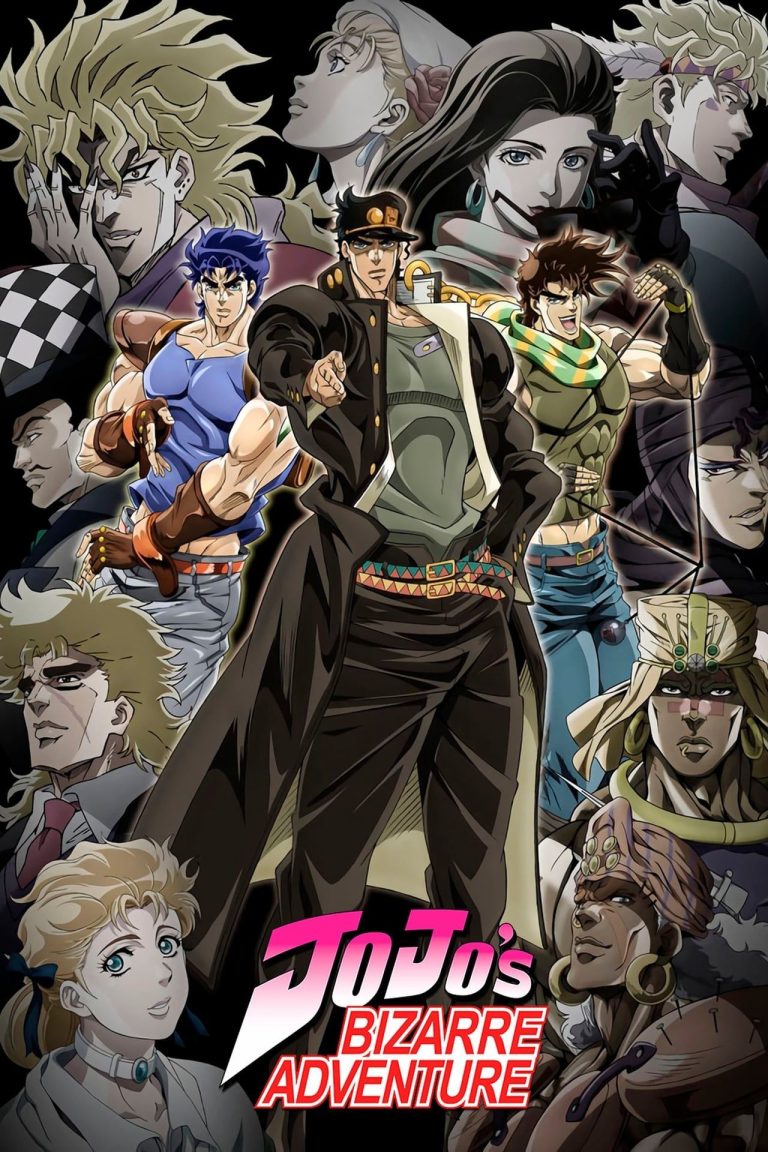
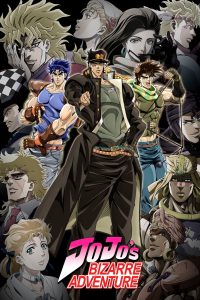
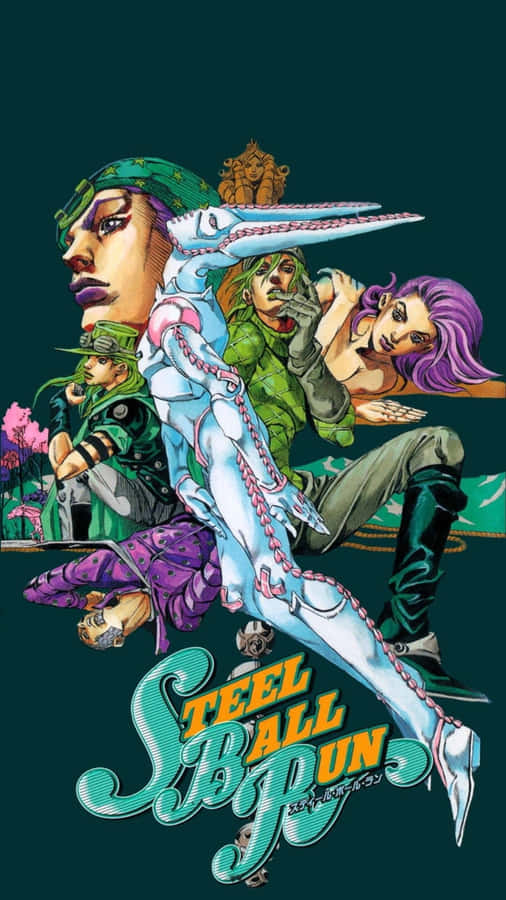
Ever since the melancholic strings of the Stone Ocean finale faded into the digital ether, an unspoken tension has gripped the global anime community. For over a decade, David Production accomplished the seemingly impossible: adapting Hirohiko Araki’s generational, genre-defying odyssey with stylistic reverence, sound-design wizardry, and hyper-stylized fidelity. Yet, all six animated installments—from the cobblestone streets of Victorian England to the humid concrete of Green Dolphin Street Prison—were merely the prelude to an undisputed summit. In the collective consciousness of manga purists and anime enthusiasts alike, one name reverberates like thunder over the American prairie: Steel Ball Run.
Widely regarded as Araki’s magnum opus, Part 7 of JoJo’s Bizarre Adventure is routinely stacked alongside titans like Berserk and Vinland Saga on top-tier manga rankings. But taking this sprawling, dust-choked epic from the printed page to television screens is not a routine production greenlight. It represents an unprecedented intersection of cinematic storytelling, character deconstruction, and technical dread for an animation studio tasked with rendering a ceaseless cavalry charge across nineteenth-century America.
A Golden Ratio Shift: Araki’s Leap into the Seinen Frontier
To understand the ravenous buzz surrounding Steel Ball Run, one must appreciate its historic context within Araki’s creative journey. Originally serialized in Weekly Shonen Jump in 2004 before migrating to the monthly, mature-skewing Ultra Jump in 2005, Part 7 served as a spiritual hard reset. Unburdened by decades of tangled continuity, Araki seized the opportunity to reinvent his visual language and thematic aspirations from the ground up.
The premise is ostensibly straightforward: an eccentric, high-stakes trans-American horseback race boasting a fifty-million-dollar purse, tracking from San Diego Beach to New York City in 1890. Yet beneath the veneer of historical sports fiction lies an intricate political thriller, an existential search for divine relics, and an unforgiving supernatural western. Moving to a monthly release cadence allowed Araki’s line work to reach Renaissance-like heights, trading kinetic punch-outs for sprawling double-page landscape spreads, photorealistic anatomy, and an atmospheric graininess that remains unmatched in modern manga.
The Ghost of the American Mythos
Araki replaces the urban labyrinths of Morioh and the sun-bleached alleys of Naples with the untamed, hostile topography of the American frontier. Salt flats, treacherous canyons, blistering blizzards, and scorched deserts do not just serve as backdrops; they are active combatants. The sheer scale of this world requires David Production to dramatically expand its artistic palette, moving away from hyper-saturated neon interior sets toward sweeping, dust-blown cinematic horizons.
Beyond Heroes and Villains: The Tragic Duality of Johnny and Gyro
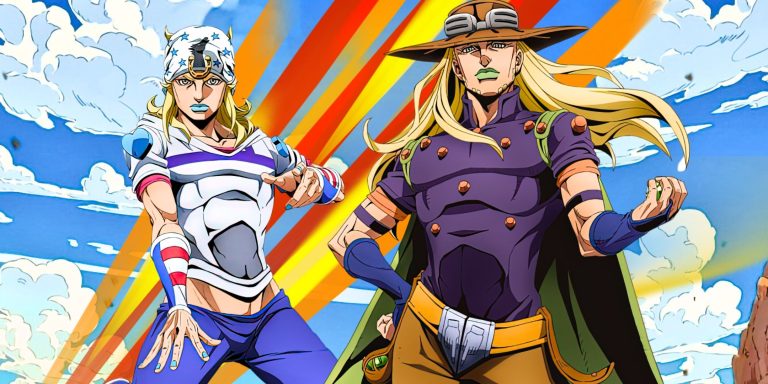
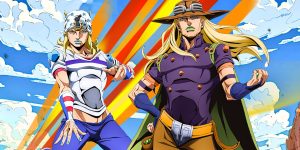
At the beating heart of Steel Ball Run is the definitive buddy dynamic in modern sequential art: Johnny Joestar and Gyro Zeppeli. Unlike the noble paragons or rebellious delinquents that headlined earlier parts, Johnny is arguably Araki’s most vulnerable and morally complex protagonist. A disgraced, arrogant former horse-racing prodigy who lost the use of his legs after a self-inflicted act of hubris, Johnny begins the journey not as an aspiring hero, but as a bitter, desperate husk searching for a reason to live.
He is not striving to go from “zero to positive,” as he famously confides; he simply wants to claw his way back from “negative to zero.” That desperate, selfish hunger provides Johnny with what characters call the “dark determination”—a ruthless glint in his eye that often blurs the lines between savior and monster. Contradicting him is Gyro Zeppeli, a flamboyant Neapolitan royal executioner armed with mystical steel orbs, comedic idiosyncrasies, and a hidden heart burdened by an ethical crisis over an innocent boy awaiting the guillotine.
Their relationship is a masterclass in dynamic character progression. It eschews traditional shonen tropes in favor of weary campfire philosophy, bizarre deadpan jokes about mozzarella cheese, and an agonizing mutual vulnerability. For David Production, casting these two and nailing their vocal chemistry will determine the emotional success of the entire project; they are two broken souls traversing an indifferent continent, searching for redemption at full gallop.
Tusk, Ball Breaker, and the Mathematics of the Spin
Where earlier installments relied strictly on Stands as spiritual avatars of the self, Steel Ball Run bridges the metaphysical divide by introducing the Spin—a pseudo-scientific, ancient discipline grounded in the Golden Ratio and the Fibonacci sequence. It is a brilliant mechanical evolution that acts as the thematic descendant of early-generation Hamon (Ripple), yet executes with the mind-bending precision of late-era Stand battles.
The progression of Johnny’s Stand, Tusk, mirrored across four distinct Acts, symbolizes his psychological rehabilitation. Each evolution is not triggered by a sudden surge of shonen willpower, but through grueling mechanical mastery of the Golden Rectangle and sheer existential realization. The battles in Steel Ball Run—from the reality-warping pocket dimensions of Funny Valentine’s Dirty Deeds Done Dirt Cheap (D4C) to the prehistoric terror of Diego Brando’s Scary Monsters—ditch urban brawls for high-speed, mounted skirmishes where positioning, bullet trajectory, and equine momentum dictate life or death.
The Equestrian Nightmare: Can David Production Actually Animate This?
For all the narrative brilliance of Part 7, the elephant in the room has four legs and gallops at forty miles per hour. In the animation industry, horses are notoriously feared. Animating quadrupedal locomotion—where complex muscular systems, shifting skeletal anatomy, and dynamic weight transfers must be maintained frame-by-frame—is an excruciatingly resource-intensive process. A single horse trotting in place is enough to send a production schedule into turmoil; Steel Ball Run demands dozens of them, at full sprint, colliding, leaping canyons, and maneuvering amidst dimensional rifts.
The 3D CGI vs. Hand-Drawn Crossroads
This technical roadblock is widely considered the reason for the silence surrounding Part 7’s announcement. Fans and industry analysts continuously debate how David Production will surmount this hurdle:
The Pure 2D Route: While artistically ideal to capture Araki’s heavy, textured hatch-work, this approach risks production meltdowns, severe animator burnout, or massive visual inconsistency across a multi-cour run.
The Hybrid 3DCG Model: The far more realistic, production-sustainable route involves utilizing state-of-the-art 3D models for the horses, layered underneath cel-shaded textures, with hand-drawn close-ups and key character cuts layered on top. Studios like MAPPA (in Attack on Titan) and Orange have proven that CG can handle immense scale, but David Production must ensure these models harmonize with Araki’s distinctive, tactile line art rather than jarring the viewer out of the narrative immersion.
Add to this the ongoing discourse surrounding distribution: after the controversial, batch-release rollout of Stone Ocean on Netflix—which many fans argued extinguished the weekly cultural momentum of the series—the community is virtually unanimous in demanding a return to classic, weekly television broadcasts for Part 7. An epic of this magnitude requires breathing room, collective analysis, and time for the hype to cultivate episode by episode.
The Horizon Beckons: Anime’s Next Great Frontier
The anticipation surrounding a Steel Ball Run anime adaptation is no ordinary fandom wish-fulfillment; it is the yearning for a generational shift in what high-concept supernatural storytelling can accomplish on screen. It is an unsparing tragedy wrapped inside an electrifying race, anchored by two of the most deeply human characters Hirohiko Araki ever penned.
David Production has climbed every mountain thrown before them since 2012, but the dust of San Diego Beach is an entirely different frontier. Whenever that fateful teaser trailer finally drops, it won’t just signal another chapter for the Joestar bloodline—it will mark the arrival of one of the most daring productions in modern anime history. Mount up, ladies and gentlemen; the race is coming.
Are you hoping for a fully hand-drawn adaptation, or do you trust David Production to nail a hybrid 3D approach for the horses? Who is your dream voice cast for Johnny Joestar and Gyro Zeppeli? Drop your theories in the comments below!