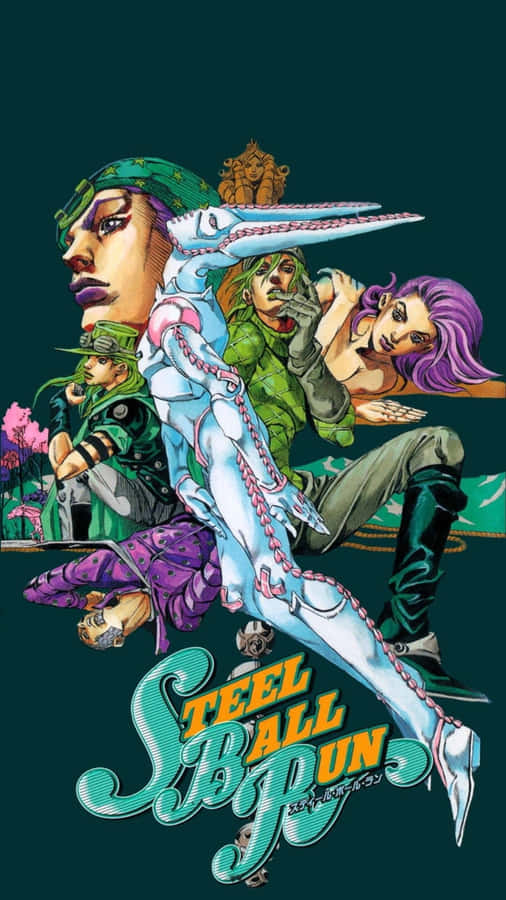
When the apocalyptic crescendo of JoJo’s Bizarre Adventure: Stone Ocean concluded in late 2022, it left behind more than just a radically altered timeline—it triggered a collective, global intake of breath across the anime sphere. For over a decade, David Production has pulled off one of the most astonishing multi-generational feats in contemporary animation, dutifully adapting Hirohiko Araki’s eccentric lineage from 19th-century Victorian England to a hyper-stylized Florida correctional facility. Yet, every veteran fan and industry insider knows the unspoken truth: everything produced thus far has merely been the preamble. The true summit of Araki’s artistic and thematic ambition lies buried under the sun-bleached desert sands of 1890 North America. We are speaking, of course, of Part 7: Steel Ball Run.
Widely regarded not just as the zenith of the JoJo canon but as one of the greatest manga narratives ever penned, Steel Ball Run represents a colossal artistic shift. As persistent rumors, enigmatic studio murmurings, and speculative production timelines circulate across the internet, the anime ecosystem stands on the precipice of a seismic event. But adapting this sprawling, trans-continental epic is no mere victory lap for David Production—it is a terrifying, technically punishing gauntlet that will redefine the studio’s legacy.
A Transcontinental Rebirth: The Seinen Evolution of Araki’s Universe
To understand the ferocity of the current buzz, one must first recognize the structural pivot that Steel Ball Run brought to Hirohiko Araki’s creative journey. Originally serialized in Weekly Shonen Jump in 2004 before shifting to the monthly seinen imprint Ultra Jump in 2005, Part 7 unshackled Araki from the unrelenting deadlines and demographic censorship of mainstream shonen manga. The monthly schedule granted him the canvas to expand panel compositions into breathtaking, widescreen panoramas reminiscent of Sergio Leone’s spaghetti westerns, all while layering his narrative with nuanced historical, philosophical, and moral ambiguity.
Rather than continuing down the path of linear escalation, Steel Ball Run completely detached itself from prior continuity, staging a soft reboot of the universe. The premise is audaciously cinematic: an eccentric philanthropist named Steven Steel organizes a cross-country equestrian race spanning 6,000 kilometers from San Diego Beach to New York City, boasting a monumental fifty-million-dollar purse. Yet beneath the veneer of an athletic spectacle lies a sprawling supernatural conspiracy orchestrated by none other than the 23rd President of the United States, Funny Valentine, revolving around the recovery of the mystical “Saint’s Corpse.” The transition from classic battle manga to an interstate political thriller paved the way for mature storytelling rarely witnessed in serial comic art.
Johnny Joestar and Gyro Zeppeli: Vulnerability, Cynicism, and the Golden Spin
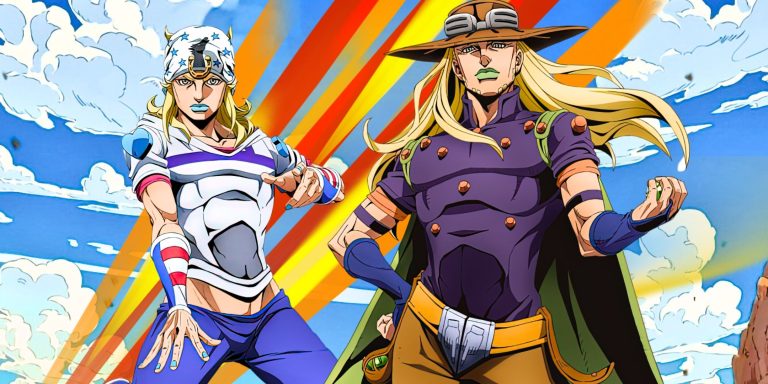
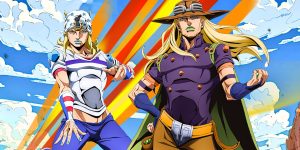
At the beating heart of Steel Ball Run is what remains arguably the most compelling dual-protagonist dynamic in modern graphic fiction: Johnny Joestar and Gyro Zeppeli. In an inspired subversion of classic shonen tropes, Araki introduces Johnny not as an unyielding paragon of virtue, but as a deeply flawed, bitter, and paraplegic former racing prodigy. Johnny begins his journey not with an ambition to save the world, but from a profound state of spiritual and physical stagnation—a hero operating at a psychological “negative,” desperate merely to claw his way back to “zero.”
The Deconstruction of the Jojo Archetype
Unlike Jonathan Joestar’s chivalry or Jotaro Kujo’s unshakeable stoicism, Johnny harbors a distinct coldness, characterized by what Gyro identifies as “dark determination”—the ruthless, unflinching willingness to kill in pursuit of his goal. This internal desperation forms a sharp, delightful contrast with Gyro Zeppeli, a disgraced executioner from the Kingdom of Naples whose absurd eccentricity, penchant for pun-laden songs, and flash of gold-plated teeth mask a devastating burden of familial honor and moral conscience. Their relationship eschews cliché anime melodrama, evolving instead into an authentic, deeply intimate brotherhood forged through shared campfires, near-death standoffs, and unspoken mutual dependence.
The Geometry of the Spin
Narratively, Part 7 also revolutionizes the franchise’s combat mechanics by introducing the Spin—a supernatural martial art utilizing the Golden Ratio and Fibonacci sequence. In contrast to the straightforward punch-ghost mechanics of earlier Stand manifestations, Gyro’s steel spheres and Johnny’s evolving Stand, Tusk, merge sacred geometry with visceral kinetic physics. The visual realization of the Golden Spiral, curling energy vectors, and fingernail-projectile ballistics promises to provide David Production with an avant-garde stylistic playground unlike anything seen since Diamond is Unbreakable.
The Equine Nightmare: David Production’s Greatest Technical Gamble
If the narrative pedigree of Steel Ball Run is undisputed, the primary question dominating industry forums is logistical: How on earth will it be animated? In the animation industry, horses are notorious as the single most complex, cost-prohibitive, and labor-intensive subject to draw by hand. Their intricate skeletal anatomy, constant muscular deformation, and dynamic quadrupedal locomotion during sustained, high-speed gallops represent an animator’s ultimate trial by fire.
In Steel Ball Run, horses are not secondary background props; they are essential characters involved in non-stop, high-octane chases through sandstorms, blizzards, muddy swamps, and urban asphalt across dozens of consecutive battles. David Production cannot rely on traditional hand-drawn keyframing alone without risking catastrophic production bottlenecks, nor can they cut corners with rigid, jarring 3DCG models without provoking the fury of a fiercely protective fan base.
Industry analysts anticipate that the studio will likely adopt an ambitious hybrid methodology. By integrating advanced cel-shaded 3DCG pipelines—reminiscent of Studio Orange’s boundary-pushing craft or the sophisticated equine rigs seen in modern historical productions—with heavily detailed, hand-drawn close-ups to preserve Araki’s distinct cross-hatching and fashion-forward aesthetics, David Production could pioneer a new technical standard. The sheer scale of this challenge is precisely why an adaptation cannot be rushed; it demands unprecedented pre-production time, significant financial backing, and an expanded roster of elite technical talent.
Patriotism, Plunder, and the Saint: Why Steel Ball Run Resonates
Beyond the technical obstacles and thrilling races, the cultural resonance of Part 7 stems from its unapologetic deconstruction of historical mythmaking. Funny Valentine, with his dimensional Stand Dirty Deeds Done Dirt Cheap (D4C), serves as an extraordinary antagonist—a leader whose nationalist ethos and rhetoric of “taking the first napkin” force audiences to confront uncomfortable truths about collective sacrifice, imperialism, and manifest destiny. It is an American historical epic seen through the hyperbolic, feverish prism of an Italian-fashion-obsessed Japanese auteur.
The race across the American frontier functions as a spiritual pilgrimage. Every participant carries their own existential cross, and survival is not dictated by raw power levels, but by sheer adaptability, tactical ingenuity, and moral grit. As current anime trends increasingly gravitate toward safe, predictable sub-genres, the raw ambition of Steel Ball Run feels refreshing, mature, and undeniably necessary.
The Long Trail Ahead: The Horizon of JoJo’s Next Era
The mounting anticipation surrounding the Steel Ball Run anime is more than just standard sequel hype; it is a recognition that David Production is standing at the threshold of their definitive magnum opus. Bringing this multi-state odyssey to life represents an enormous artistic and financial gamble, but the cultural payoff stands to be historic. If executed with the care, stylistic bravery, and technical ingenuity the studio has brought to bear since 2012, Part 7 will not merely satisfy long-time readers—it could reshape the ceiling of what modern serialized anime can achieve.
The trail ahead is long, unforgiving, and treacherous, but the race is inevitable. All that remains now is for David Production to drop the starting flag.
What are your biggest hopes—and deepest anxieties—for the inevitable Steel Ball Run anime adaptation? Do you want a hybrid 2D/3D visual pipeline, or should the studio take all the time it needs for hand-drawn majesty? Sound off in the comments below, and keep your browser locked to Wibux.com for breaking industry news, deep dives, and production updates!