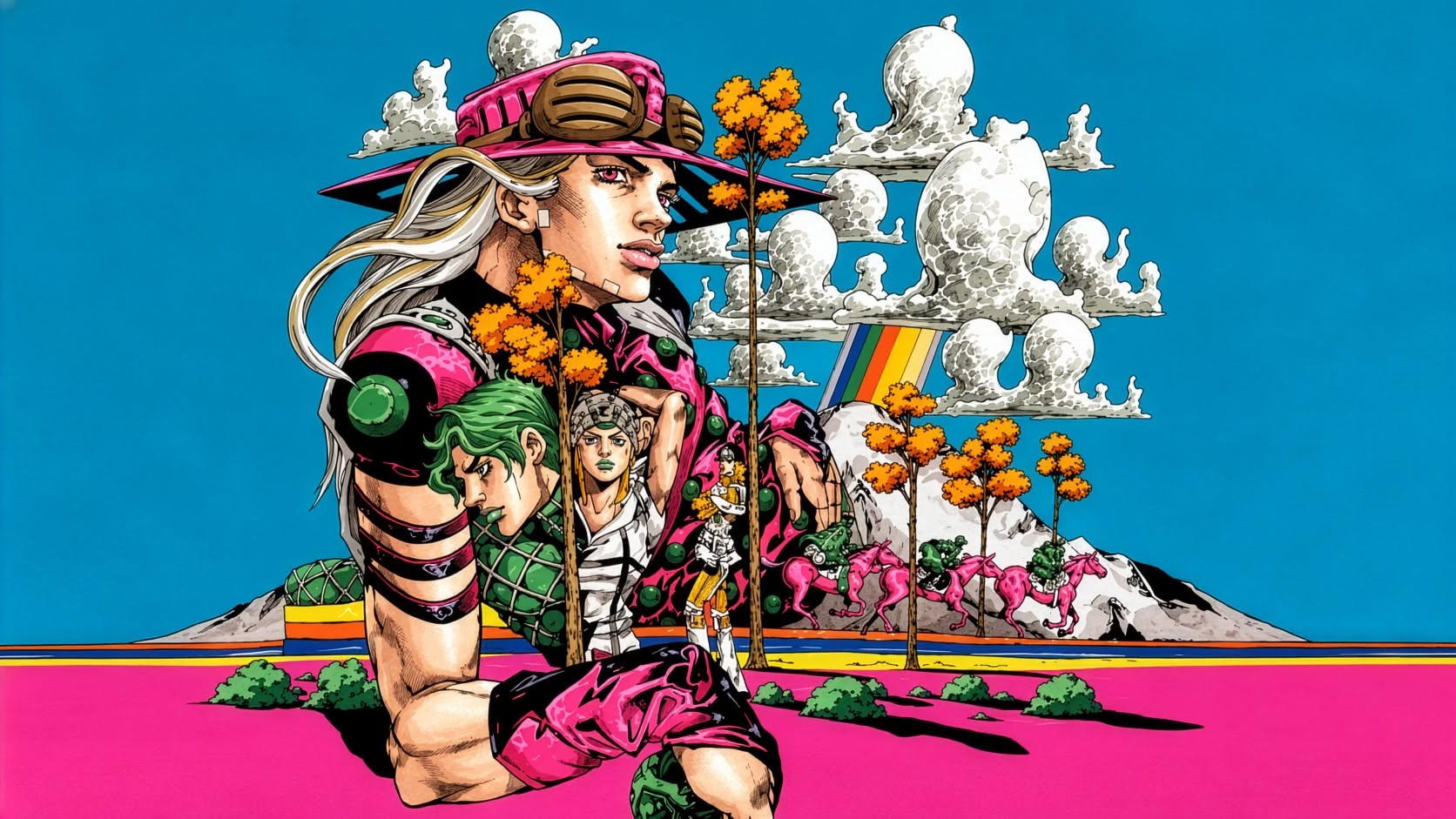
Ever since the bittersweet, melancholic notes of Stone Ocean faded into the anime ether, leaving audiences suspended between parallel timelines and emotional exhaustion, a singular, thunderous question has echoed across the pop-culture landscape: When will we ride? In the pantheon of Japanese sequential art, few transitions carry as much mythical weight as the paradigm shift initiated by Hirohiko Araki in 2004. What began as a bold, trans-American horseback odyssey morphed into something far more transcendent: JoJo’s Bizarre Adventure: Steel Ball Run. Long hailed by critics and manga purists as Araki’s uncontested magnum opus, the prospect of its anime adaptation isn’t merely another seasonal announcement; it is the holy grail of modern anime productions.
For David Production—the animation powerhouse that has meticulously nurtured the lineage of the Joestar bloodline from the gothic Victorian alleys of Phantom Blood to the humid confines of Green Dolphin Street Prison—Part 7 represents both an artistic zenith and an unprecedented technical gauntlet. The hype circulating through forums, social media, and convention floors is reaching a fever pitch. But bringing this sprawling, supernatural Western epic to the screen requires more than just goodwill; it demands an evolutionary leap in production infrastructure, creative vision, and narrative stewardship.
The Seinen Rebirth: Why Steel Ball Run is Araki’s Masterpiece
To understand the immense buzz surrounding Steel Ball Run, one must appreciate the tectonic narrative shift it represents in Hirohiko Araki’s career. Originally launched in Weekly Shōnen Jump before shifting early in its serialization to the monthly seinen pages of Ultra Jump, the story liberated Araki from the breakneck pacing and strict demographic limitations of traditional adolescent manga. In doing so, Araki was gifted canvas space—breathing room to let characters stew in existential dread, historical consequence, and complex morality.
Set against the sprawling, hostile backdrop of an alternate-history 1890s America, the narrative engine is the Steel Ball Run race: a grueling, 6,000-kilometer cross-country trek from San Diego to New York City boasting a fifty-million-dollar purse. Yet, the race is merely the stage for a grander, far more conspiratorial drama involving forgotten faith, continental expansion, and the fragmented relics of a Holy Corpse. By stripping away decades of entrenched continuity, Araki engineered an intoxicating blend of Sergio Leone-style grit, historical pastiche, and surreal body horror that redefined what JoJo’s Bizarre Adventure could be.
Johnny Joestar and Gyro Zeppeli: A Symbiotic Masterclass in Psychology
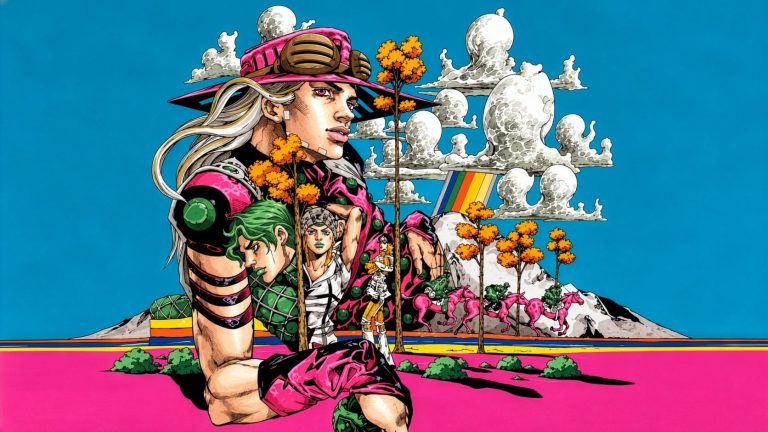
At the beating heart of this sprawling dust bowl are two of the most thoroughly realized protagonists in sequential fiction. The dynamic between Johnny Joestar and Gyro Zeppeli moves far beyond the classic shōnen rival-mentor archetype; it is an agonizing, deeply tender study of codependency, trauma, and redemption.
The Fall and Ascent of Johnny Joestar
Johnny is not Jonathan, nor is he Jotaro. Paralyzed from the waist down following a catastrophic tragedy born of hubris, Johnny begins his journey not from a place of heroic ambition, but from profound emotional and physical deficit. His famous inner monologue—that he does not seek to go from “zero to positive,” but simply wants to return from “negative to zero”—is one of the most painfully raw self-assessments in manga history. Johnny possesses a “Dark Determination,” a merciless fire in his eyes that terrifies even seasoned killers. Watching his gradual, bloody mastery of Tusk, an evolving Stand tied to his emotional maturation, transforms Johnny from a broken prodigy into a relentless force of nature.
Gyro Zeppeli and the Way of the Spin
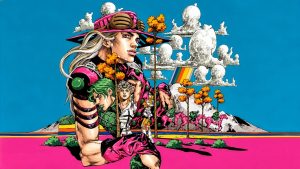
Contrasting Johnny’s brooding, morally gray intensity is Gyro Zeppeli, a disgraced Neapolitan executioner’s son armed with steel spheres, a pair of personalized grillz, and an unshakeable sense of duty. Gyro serves as the story’s charismatic vanguard, introducing the narrative’s primary kinetic marvel: the Spin. Moving beyond the solar-powered Hamon of early JoJo, the Spin relies on the Golden Ratio—a universal, mathematical harmony found within nature that can distort spatial dimensions, bypass invulnerability, and weaponize rotational kinetic force. The banter between Johnny and Gyro, punctuated by absurd musical interludes about mozzarella cheese alongside genuinely heartbreaking sacrifices, forms the emotional core that David Production must preserve at all costs.
The Elephant in the Studio: David Production’s Equestrian Gauntlet
Why has David Production hesitated to officially plant the flag on Part 7? The answer boils down to an infamous industry reality: horses. In the realm of hand-drawn 2D animation, animating horses is notoriously one of the most arduous, time-consuming, and cost-prohibitive challenges imaginable. Their complex four-beat gait, intricate musculature, and shifting skeletal frames require master-level key animation to avoid looking stiff or weightless.
In Steel Ball Run, horses are not incidental background set-pieces; they are the primary conduits of action. Stampedes across the Arizona desert, cavalry skirmishes along the Rocky Mountains, and high-speed Stand duels atop galloping steeds dominate almost every major narrative arc. David Production faces a monumental technical fork in the road:
Option A leans heavily into sophisticated 3D CG modeling for the steeds, an approach that has historically faced intense backlash from anime purists if not executed with the artisan finesse of studios like Orange or Polygon Pictures. Option B relies on hybrid 2D/3D workflows, blending heavily textured cel-shaded models for distant racing sequences with painstakingly detailed hand-drawn sakuga for mid-shots and climactic duels. To conquer this mountain, the studio will require an extended pre-production runway, generous budgeting, and a dedicated team of mechanical and organic animation specialists to ensure the visual prestige of the series remains untarnished.
The Corpse, The President, and Dimensional Warfare
Beyond its protagonists and logistical hurdles, the anime community’s fervor is fueled by what awaits in the latter half of the narrative: one of the greatest antagonists in fiction. Funny Valentine, the 23rd President of the United States, turns conventional villainy inside out. Driven by an unyielding, fanatical patriotism and armed with the multidimensional Stand Dirty Deeds Done Dirt Cheap (D4C), Valentine challenges the viewer with a chilling ethical dilemma: Is monstrous ruthlessness justifiable if the ultimate beneficiary is the collective prosperity of one’s nation?
The clashes involving the Holy Corpse Parts, multiversal folding, and conceptual Stand abilities push Araki’s creative logic into overdrive. Sequences like the “Civil War” confrontation, “Scary Monsters,” and the reality-shattering introduction of “Ball Breaker” demand a visionary director capable of translating Araki’s hyper-detailed, non-Euclidean artistic compositions into fluid, mind-bending cinematic language.
The Horizon Awaits: When Will the Starting Pistol Fire?
While David Production has kept its cards notoriously close to its chest, the industry tea leaves paint a compelling picture. The studio has deliberately diversified its portfolio in recent years—steering smash hits like Fire Force, Urusei Yatsura, and Undead Unluck—a strategic move that expands their talent pool and hones their technological pipeline. Steel Ball Run is not a matter of if, but how perfectly.
When that first teaser trailer inevitably drops—when the whistle blows, the dust sweeps across the plains, and Gyro’s steel balls begin their golden, rotational hum—it will mark the beginning of one of the most culturally seismic runs in modern anime history. Araki’s sprawling odyssey of broken souls running across a forgotten continent is ready to redefine the medium once more.
What are your personal hopes for the Steel Ball Run anime adaptation? Do you think David Production can conquer the challenge of animating the equestrian sequences, or should they outsource the 3D pipelines? Let your voice be heard in the comments below, and keep your browsers locked to Wibux.com for all the latest breaking anime news, deep-dive features, and industry analysis.