In the pantheon of sequential art, few transitions are as mythologized as Hirohiko Araki’s migration from the kinetic, hyper-stylized pages of Weekly Shonen Jump to the monthly, boundary-pushing canvas of Ultra Jump in 2005. That shift gave birth to Steel Ball Run—a historical, trans-continental race epic that simultaneously rebooted the multi-generational JoJo continuity and fundamentally redefined the emotional depth of the entire franchise. Ever since the climactic, reality-resetting finale of David Production’s Stone Ocean adaptation concluded on Netflix, the global anime community has held a unified, collective breath. The silent consensus among critics and die-hard enthusiasts alike is unequivocal: Part 7 is not merely the next installment on the production slate; it is Araki’s undisputed magnum opus.
Yet, bringing this sprawling, equine-heavy western thriller to the small screen represents an animation crucible unlike anything David Production has tackled over the past twelve years. With social media perpetually ablaze with casting theories, speculative key visual leaks, and debates over the preservation of Araki’s high-fashion editorial aesthetics, the buzz surrounding a potential Steel Ball Run anime has reached a fever pitch. To understand why Part 7 commands such reverent discourse requires peering deep into its philosophical machinery, its mechanical innovations, and the sheer logistical audacity required to animate it.
A Transcendental Pivot: How Steel Ball Run Redefined Araki’s Universe
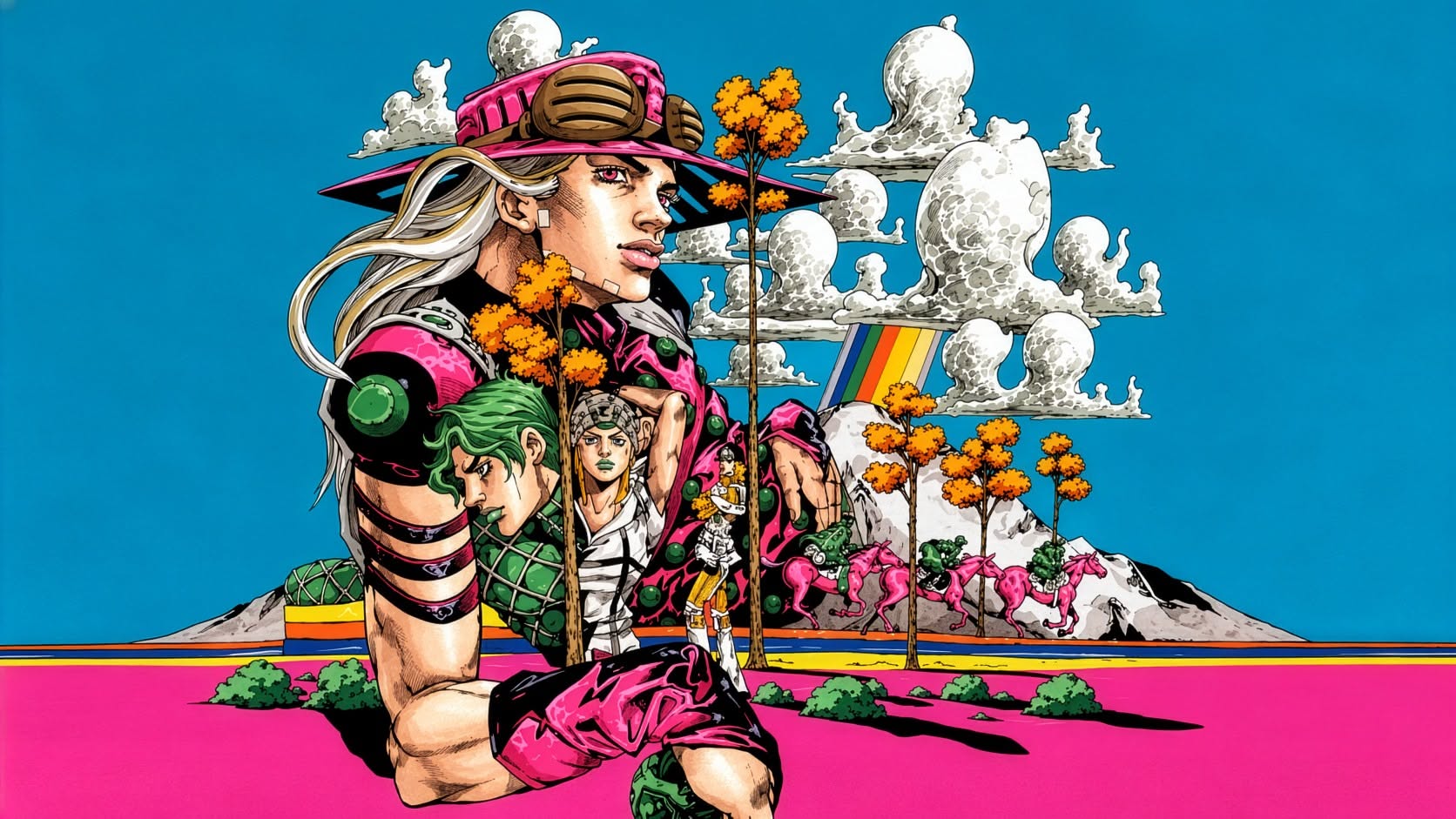
When readers were first introduced to the year 1890 and the eccentric promoter Steven Steel, the narrative initially masqueraded under the standalone title Steel Ball Run before officially bearing the JoJo’s Bizarre Adventure moniker. This was more than a marketing sleight of hand; it was an artistic liberation. Freed from the relentless deadlines and demographic censorship of weekly shonen serialization, Araki unleashed a grounded, morally complex narrative that juxtaposed American manifest destiny with cosmic horror.
The premise is deceptively straightforward: thousands of intrepid, eccentric racers gather in San Diego to traverse six thousand miles across the untamed American frontier to New York City, competing for an eye-watering fifty-million-dollar purse. Yet beneath this high-octane cross-country derby lies a metaphysical conspiracy orchestrated by the charismatic twenty-third President of the United States, Funny Valentine. The true goal of the race is not sporting glory, but the excavation of the scattered, mummified relics of the “Saint’s Corpse”—a holy artifact imbued with the power to bestow reality-altering Stands and secure an era of unassailable global prosperity for America at the expense of the rest of the world.
Johnny Joestar and Gyro Zeppeli: A Masterclass in Dual Protagonism
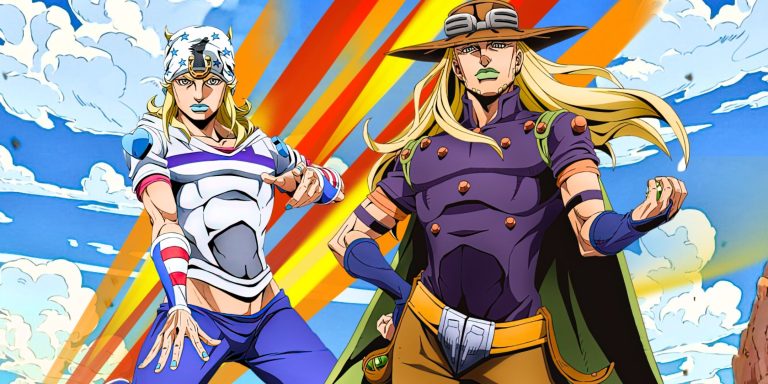
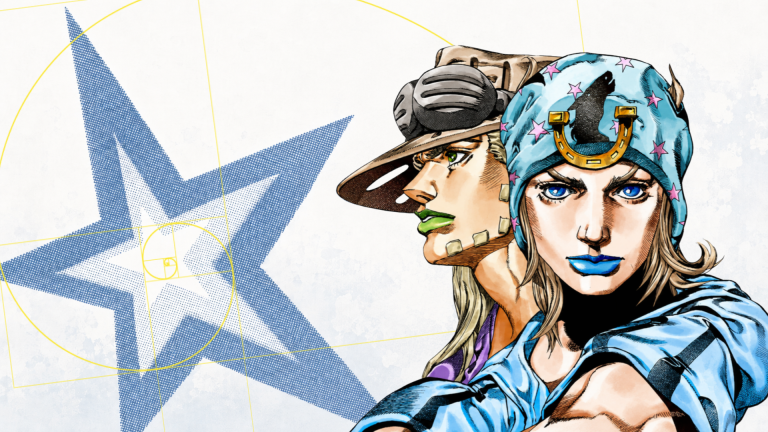
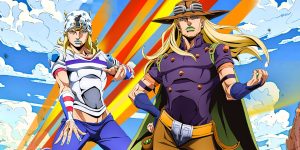
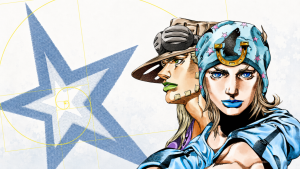
At the beating heart of this sprawling journey is a character dynamic that stands peerless in modern manga: the fragile, symbiotic brotherhood between Johnny Joestar and Gyro Zeppeli.
From Paraplegic Cynic to Reluctant Saint: Johnny’s “Dark Determination”
Unlike Jonathan Joestar’s unyielding chivalry or Jotaro Kujo’s stoic righteousness, Johnny Joestar begins his journey as an entirely fallen idol. Once a prodigal jockey blinded by vanity, wealth, and adolescent arrogance, a reckless dispute leaves him shot through the spine, permanently paraplegic, and utterly abandoned by high society. Johnny does not enter the Steel Ball Run out of nobility or patriotic duty; he enters out of an all-consuming, desperate desire to “get back to zero.”
Araki paints Johnny with a distinct shade of psychological realism rarely afforded to shonen protagonists. Possessing what the narrative explicitly dubs a “dark determination”—an unrelenting, borderline sociopathic willingness to kill if it means securing the Corpse Parts—Johnny is a fundamentally flawed anti-hero. His Stand, Tusk, mirrors this evolution. Progressing through four developmental “Acts,” Tusk transforms from a meager fingernail-spinning projectile into an interdimensional, gravity-shattering colossus, perfectly visualising Johnny’s painful ascent from self-loathing invalid to spiritual enlightenment.
The Eccentric Executioner and the Mechanics of the Spin
Serving as Johnny’s mentor, emotional anchor, and moral compass is Gyro Zeppeli, a disgraced royal executioner from the Kingdom of Naples who entered the race to win royal clemency for an innocent boy sentenced to death. Flamboyant, petty, yet harboring an ancient code of medical honor, Gyro brings with him the lore-defining concept of The Spin.
Acting as the spiritual and technical successor to the Ripple (Hamon) from Parts 1 and 2, the Spin is a discipline founded on the principles of the Golden Ratio—the divine mathematical spiral observed throughout nature. By hurling specially balanced steel balls, Gyro can manipulate muscle fibers, bypass armor, distort spatial dimensions, and harness infinite rotational kinetic energy. The relationship between Johnny and Gyro transcends standard battle-manga pairings; it is a masterclass in organic character writing, oscillating between absurd campfire gags about the days of the week and devastating existential conversations about fate, duty, and sacrifice.
The Equine Crucible: David Production’s Greatest Technical Test
While the narrative foundation of Steel Ball Run is bulletproof, the central obstacle delaying an official production announcement is entirely mechanical: animating horses. In the lexicon of traditional 2D animation, quadrupeds are notoriously regarded as production graveyards. Capturing the intricate skeletal mechanics, shifting muscle tissue, and realistic cadence of a galloping horse requires an immense budget, high-tier key animators, and excruciating labor.
Now consider that Steel Ball Run features dozens of jockeys racing across deserts, snowy mountain passes, and dense forests over the course of an estimated 36 to 48 episodes. David Production cannot rely entirely on traditional hand-drawn frames without risking severe studio burnout and catastrophic quality drops. Conversely, leaning too heavily on rudimentary 3D CGI risks alienating a passionate fanbase accustomed to the studio’s hyper-stylized line art, iconic cross-hatching, and dramatic color-palette shifts.
Industry insiders speculate that David Production will need to pioneer an advanced hybrid workflow—similar to the bespoke 3D cel-shaded methodologies utilized by Studio Orange (Trigun Stampede) or the visceral rotoscope-blended equine choreography seen in WIT Studio’s earlier seasons of Attack on Titan. Finding the sweet spot between structural CGI efficiency and raw, hand-drawn emotional expression during close-quarters jousts is the singular frontier David Production must conquer to do justice to Araki’s breathtaking two-page spreads.
Funny Valentine, “The First Napkin,” and Peak Thematic Ambition
An anime adaptation of Part 7 will also elevate one of the most culturally fascinating antagonists in fiction: President Funny Valentine. Armed with the dimensional-traversing Stand Dirty Deeds Done Dirt Cheap (D4C), Valentine is not a cartoonish supervillain, but an unyielding, radicalized patriot. His philosophical monologue regarding “who takes the first napkin”—an allegory for authority, social inertia, and the nature of power—remains one of Araki’s most quoted and philosophically rich texts.
The thematic clash between Johnny’s deeply personal, self-interested salvation and Valentine’s utilitarian, imperialistic nationalism elevates Steel Ball Run from an action-adventure into a profound critique of historical ambition. Alongside beloved secondary characters like the tragic mountain warrior Mountain Tim, the shape-shifting Diego Brando (the alternate universe’s raptor-wielding Dio), and the courageous, espionage-driven Lucy Steel, the narrative operates at a relentless, cinematic tier of tension that modern anime rarely dares to explore.
The Horizon Ahead: When Will the Starting Gun Fire?
With David Production currently balancing a diverse roster of projects, patience remains a virtue for the JoJo faithful. Yet, history has shown that when the studio commits to Araki’s vision, they deliver adaptations that reshape the cultural zeitgeist. Steel Ball Run represents not just another season of anime, but the ultimate convergence of western cinema, mathematical mysticism, and visceral supernatural combat.
The starting gun for the Steel Ball Run has not officially fired, but the thunder of hooves on the American horizon is growing louder by the day. When David Production finally drops that long-awaited teaser trailer, expect the anime world to stop in its tracks.
How do you think David Production should tackle the challenge of horse animation—pure hybrid CGI or uncompromising 2D? Who is your dream voice cast for Johnny and Gyro? Drop your theories in the comments below, and keep your browsers locked to Wibux.com for all your breaking JoJo updates!