
Ever since the cosmic, bittersweet strings of Pucci’s Made in Heaven unraveled reality at the climax of Stone Ocean, the global anime community has been caught in a state of suspended animation. For over a decade, David Production pulled off what was once deemed impossible: adapting Hirohiko Araki’s wildly flamboyant, anatomically eccentric, and chronologically sprawling epic into a coherent, genre-defining modern classic. Yet, with the original Joestar timeline officially laid to rest, eyes have turned west across the Atlantic to the dusty, sun-bleached frontier of late-19th-century America. We have arrived at the threshold of JoJo’s Bizarre Adventure: Steel Ball Run—a narrative monument frequently hailed not merely as Araki’s magnum opus, but as one of the greatest manga serialized in the history of the medium.
The buzz surrounding an eventual anime adaptation is no longer an insular conversation on fan message boards; it is an industry-wide point of fascination. Transforming Steel Ball Run into an episodic television production presents a breathtaking confluence of creative ambition, logistical dread, and thematic evolution. To adapt Part 7 is to embrace a total reinvention of what JoJo fundamentally represents.
The Seinen Metamorphosis: From Shonen Excess to American Grit
To understand the ravenous demand for a Steel Ball Run anime, one must first appreciate the seismic shift that birthed the manga in 2004. Originally launched in Weekly Shonen Jump as a seemingly separate story before explicitly integrating into the franchise, the series truly caught fire when Araki transitioned publication to the monthly seinen magazine Ultra Jump. Unshackled from the relentless pacing and editorial censorship intrinsic to youth-oriented weeklies, Araki’s creative palette deepened exponentially.
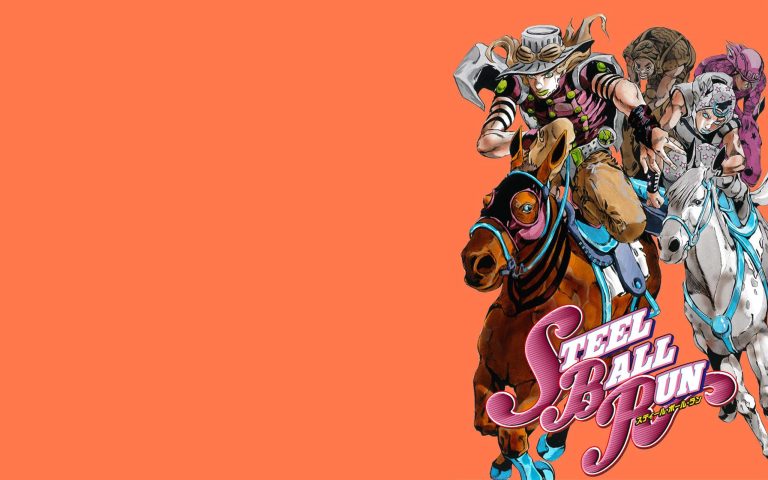
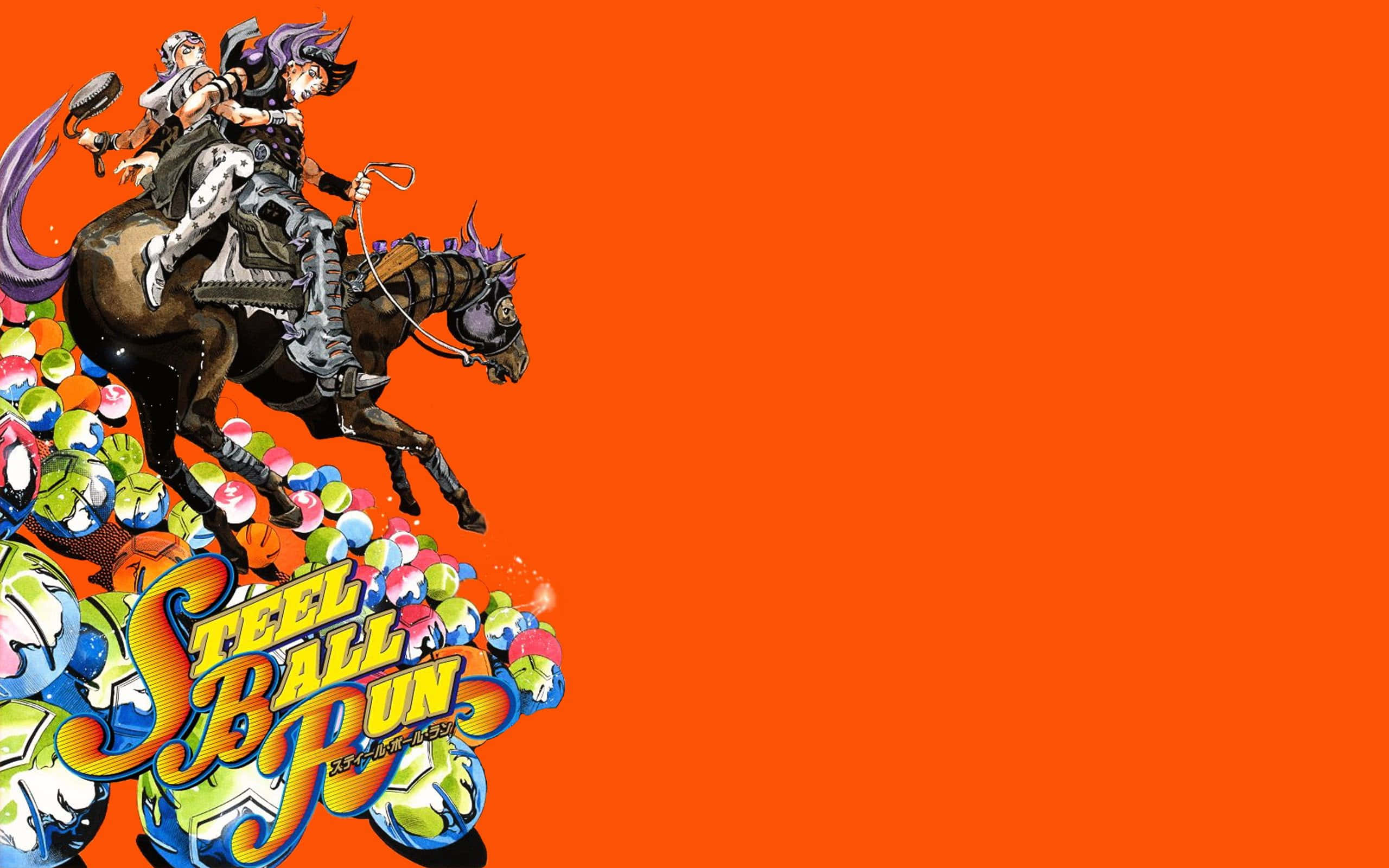
Steel Ball Run reframes the franchise from a succession of supernatural monster-of-the-week skirmishes into a grueling, six-thousand-kilometer transcontinental horse race from San Diego to New York. The 1890 backdrop allows Araki to deconstruct American mythology through a surrealist, sepia-toned lens. It is a world of dirty boots, trail dust, corporate corruption, and ruthless survivalism, punctuated by divine mysteries and biomechanical miracles. The scale is colossal, trading suburban Japanese alleys and claustrophobic Italian villas for the suffocating expanse of the Monument Valley desert and frozen Midwestern plains.
Johnny Joestar and Gyro Zeppeli: Flawed Humanity and Brotherly Gravitas
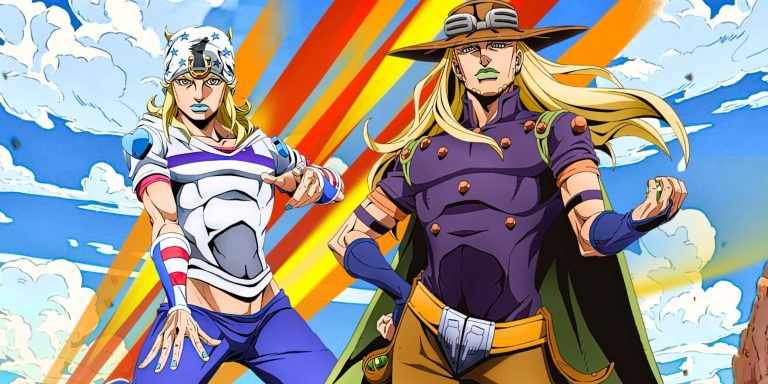
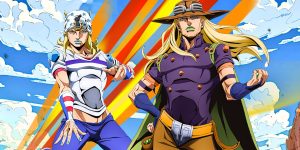
At the beating heart of this cross-country odyssey is the dynamic between Johnny Joestar and Gyro Zeppeli, a duo whose psychological complexity easily eclipses any prior protagonist pairing in the franchise’s history.
Dark Determination vs. The Golden Rectangle
Unlike Jonathan Joestar’s unwavering Victorian chivalry or Jotaro Kujo’s stoic, invincible cool, Johnny Joestar begins his journey as an unlikable, washed-up prodigy. Paralyzed from the waist down due to an act of childish arrogance, Johnny is a fallen idol hollowed out by grief and self-pity. He is explicitly defined by what Araki terms “Dark Determination”—a terrifying, remorseless glint in his eyes that proves he will sacrifice anything, and anyone, simply to reclaim what he lost. Johnny is not riding across the continent to save the world; he is fighting to bring himself back from “negative” to “zero.”
Balancing Johnny’s brooding existential crisis is Gyro Zeppeli, arguably Araki’s most charismatic creation. A disgraced executioner from the Kingdom of Naples with grill-engraved teeth, eccentric comedic quirks, and an agonizing secret burden of empathy, Gyro serves as Johnny’s mentor, companion, and philosophical anchor. Through Gyro, Araki introduces The Spin—a mystical martial art based on the Fibonacci sequence and the golden ratio. Replacing the breathing techniques of Hamon and acting alongside traditional Stands, the Spin transforms kinetic energy, mathematics, and anatomical physics into weaponized metaphysics. The slow-burning, intensely poignant brotherhood forged between Johnny and Gyro as they trade bizarre camp jokes and bleed together across the frontier remains the emotional anchor that David Production must preserve at all costs.
The CGI Equine Nightmare: David Production’s Greatest Technical Trial
While narrative hype remains at a fever pitch, animators and industry insiders understand the elephant—or rather, the horse—in the room. Steel Ball Run is, from its opening salvo, an equestrian epic. Dozens of thoroughbreds, mustangs, and cavalry mounts charge across dynamic, shifting landscapes, kicking up dirt, shifting muscle groups, and colliding at breakneck speeds.
Why Animating Horses Is the Anime Industry’s Final Boss
In traditional 2D animation, quadrupedal motion—specifically equine anatomy—is notoriously difficult, expensive, and time-consuming to execute. The skeletal movement of a running horse requires an intricate understanding of weight, muscle deformation, and fluid momentum that can break even seasoned key animators. When multiplied by hundreds of race participants vying for positions in tight formations, pure hand-drawn 2D animation becomes a fiscal and scheduling impossibility for a multi-cour television series.
This reality brings David Production to an existential crossroads. While the studio has displayed brilliant, kinetic flourishes in Fire Force and the recent reboot of Urusei Yatsura, its historical handling of 3D CGI in JoJo—most notably seen in early opening sequences and background vehicles—has varied widely. To bring Steel Ball Run to life with the prestige it commands, the production committee must invest in bleeding-edge hybrid technology. We may see cell-shaded CGI models utilized for distance charges, seamlessly blended with artisan 2D key animation for close-up standoffs, stirrup-to-stirrup combat, and dramatic character beats. The visual fidelity of the horses will ultimately dictate whether the adaptation is remembered as an immortal masterpiece or a compromised compromise.
Manifest Destiny and Divine Intervention: The Villainy of Funny Valentine
Beyond its protagonists, Steel Ball Run is propelled by one of the most intellectually compelling antagonists in modern fiction: the 23rd President of the United States, Funny Valentine. Accompanied by his interdimensional Stand, Dirty Deeds Done Dirt Cheap (D4C), Valentine seeks the scattered, mummified relics of an ancient saint believed to be Jesus Christ, scattered across the American continent.
Valentine is neither a sadistic vampire nor a paranoid mob boss hiding his identity; he is an ultra-nationalist zealot driven by absolute, unyielding patriotism. He views the Holy Corpse as the ultimate cosmic asset—a divine aegis that will divert all misfortune away from the United States and push it onto the rest of the globe. His ideological clashes with Johnny Joestar complicate the traditional binary of hero and villain, elevating the race into an exploration of imperial expansion, faith, utilitarian ethics, and the destructive gravity of human desire.
The Long Road Ahead: Anticipating the Starting Gun
Adapting JoJo’s Bizarre Adventure: Steel Ball Run is David Production’s Everest. It demands a maturation of style: swapping the hyper-saturated 1980s neon palettes and techno-glam aesthetics of earlier parts for dusty, naturalistic earth tones punctuated by explosive psychedelic surrealism. It requires a composer capable of blending Ennio Morricone-inspired spaghetti western guitars with bombastic orchestral operatics. Most importantly, it requires patience—from both the production pipeline and an expectant global fandom eager for perfection.
The cultural anticipation is not simply about seeing favorite panels moving on a screen; it is about witnessing an author’s artistic summit finally claim its place in the global anime pantheon. When the starting gun inevitably fires in San Diego, the world will be watching to see if David Production can tame the stallion.
How do you think David Production should tackle the legendary equestrian animation challenges of Part 7? Who is your dream voice cast for Gyro Zeppeli and Johnny Joestar? Let your voice be heard in the comments below, and stay locked to Wibux.com for all breaking anime industry updates!