When Jolyne Cujoh and Enrico Pucci brought the original JoJo continuity to a reality-shattering, universe-resetting climax at the end of Stone Ocean, it marked the end of a generational era. Yet for the manga faithful and the broader anime community, that cosmic reset was never viewed as an ending. Instead, it was greeted as the inevitable prologue to an adaptation of modern sequential art’s undisputed holy grail: JoJo’s Bizarre Adventure: Steel Ball Run.
Consistently trading blows with Kentaro Miura’s Berserk at the absolute apex of critically acclaimed manga ratings, Steel Ball Run (Part 7) is widely heralded as Hirohiko Araki’s magnum opus. Moving away from the urban supernatural brawls of 1980s through 2000s Japan and Europe, Part 7 reimagines the franchise through the dust-choked lens of an 1890s trans-American equestrian race. As David Production closes the book on the original Joestar bloodline, the persistent buzz surrounding a Steel Ball Run anime has mutated from idle wish-fulfillment into a deafening industry discourse. The question is no longer whether David Production will adapt it, but how any animation studio can survive the sheer cinematic ambition required to pull it off.
The Seinen Rebirth: How Ultra Jump Liberated Araki’s Vision
To understand the monumental cultural weight of Steel Ball Run, one must first understand its unconventional publishing history. When the series first serialized in 2004, it ran in Weekly Shonen Jump simply as Steel Ball Run, stripped of the “JoJo” moniker in a deliberate gambit to test whether Araki’s storytelling could stand detached from brand recognition. However, the true metamorphosis occurred in 2005 when the series transitioned to the monthly publication Ultra Jump.
Liberated from the suffocating deadlines of a weekly schedule and the demographic constraints of a teenage audience, Araki’s craft evolved drastically. His panel layouts widened into sweeping, cinematic vistas inspired by Sergio Leone westerns; his narrative themes matured into morally grey existential philosophy; and his character designs transitioned from hyper-muscular bravado to neoclassical, high-fashion figure studies. The Steel Ball Run race—a punishing 6,000-kilometer cross-country dash from San Diego Beach to New York City—became a panoramic critique of late-nineteenth-century American ambition, greed, and divine retribution, setting a literary bar that no previous JoJo part had dared to attempt.
Johnny Joestar and Gyro Zeppeli: Fractured Men and the Golden Spin
At the beating heart of Part 7’s critical reverence is the symbiotic relationship between its two leads, a dynamic that decisively departs from traditional shonen and seinen archetypes.
The Psychology of “Dark Determination”
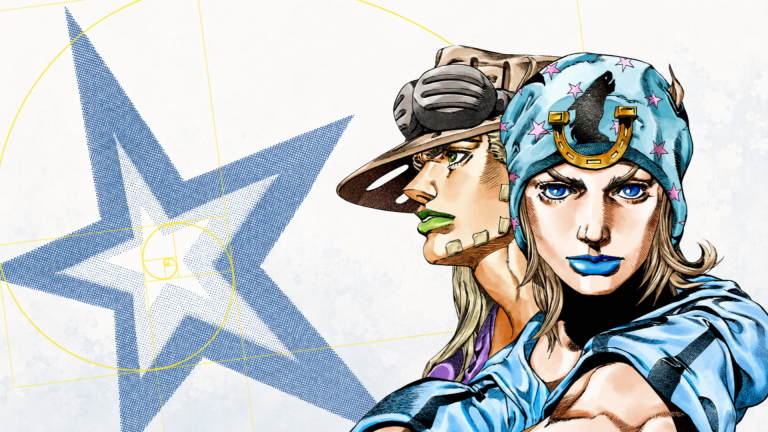
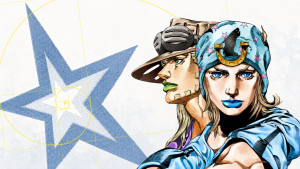
Unlike the incorruptible Jonathan or the swaggering Jotaro, Johnny Joestar begins his journey as an unlikable, fallen idol. A former horse-racing prodigy whose reckless arrogance resulted in a gunshot wound that left him paraplegic, Johnny is depressed, bitter, and driven by a singular, self-admitted “dark determination.” His goal is not to rescue humanity or defeat a cosmic evil; he simply wants to find out if the mysterious phenomenon he witnessed can return his legs to functionality. He is a man desperate to move from “negative back to zero.”
His Stand, Tusk, reflects this traumatic inner pilgrimage. Rather than arriving fully realized, Tusk evolves through four distinct “Acts,” mirroring Johnny’s psychological rehabilitation from a crawling, nail-firing novice into a wielder of spatial-rending infinity.
The Golden Ratio and the Way of the Spin
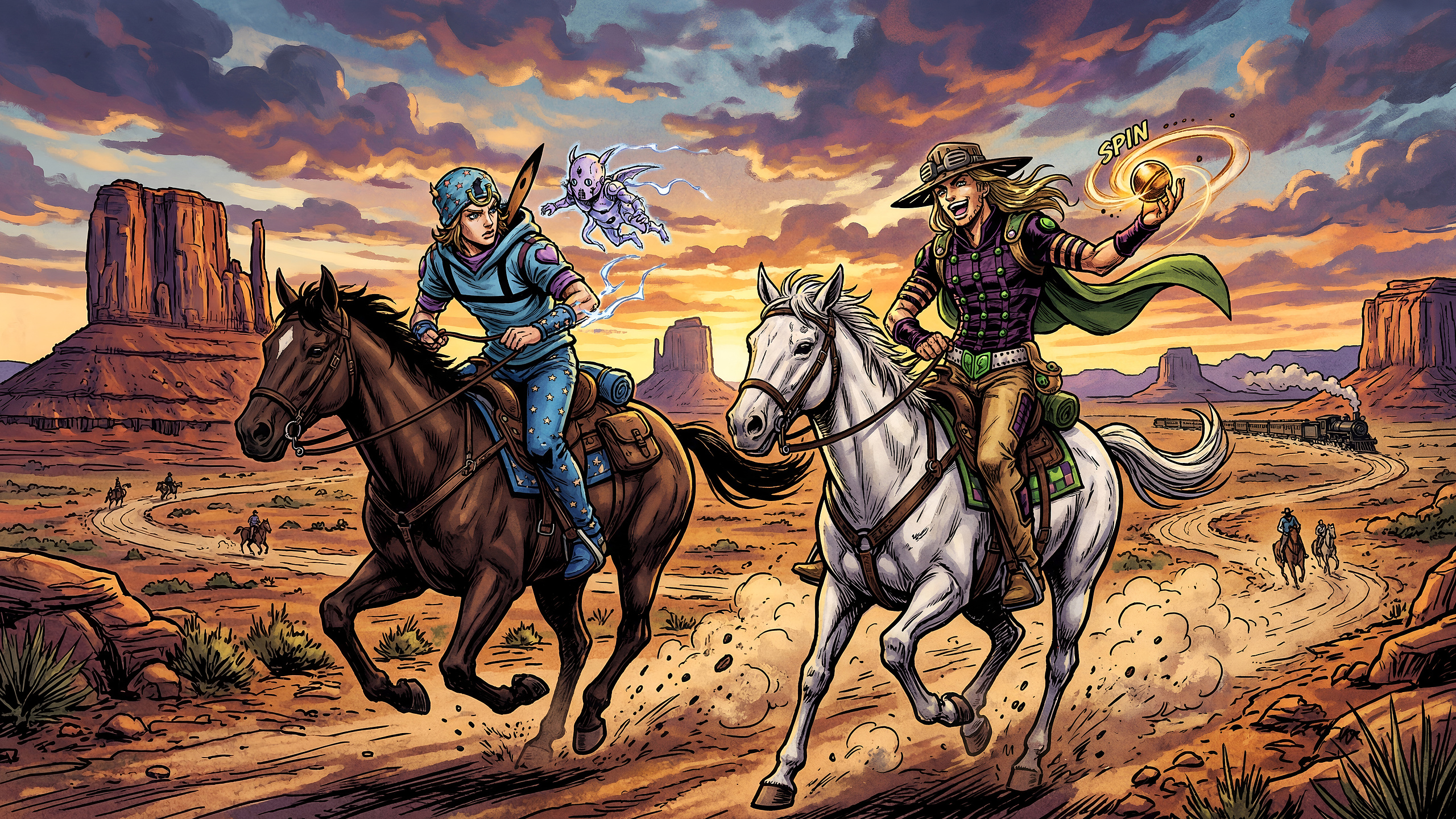
Counterbalancing Johnny’s moral ambiguity is Gyro Zeppeli, an eccentric, grill-wearing Neapolitan executioner racing to secure clemency for an innocent child condemned to death. Gyro serves not merely as a partner, but as an intellectual and spiritual mentor. Through Gyro, Araki re-contextualizes the series’ mystical roots, swapping the biological Hamon (Ripple) of Parts 1 and 2 for the Spin—a devastating martial art rooted in the mathematics of the Golden Rectangle and the Fibonacci Sequence.
The philosophical back-and-forth between Johnny and Gyro—ranging from nonsensical debates about days of the week to poignant reflections on human fragility—forms what is undeniably the most nuanced, emotionally resonant friendship in Araki’s 35-year portfolio.
The Technical Hurdle: David Production’s Equestrian Nightmare
If the narrative of Steel Ball Run is a masterpiece, its production reality is an animator’s waking nightmare. Ask any veteran animator to list the hardest things to draw consistently in hand-drawn 2D animation, and horses will inevitably place near the top. Animating four-legged animals requires an intricate understanding of shifting muscular anatomy, kinetic weight, perspective, and foreshortening. Steel Ball Run does not just feature horses; it features herds of thoroughbreds charging across dynamic environments at full gallop, framed by swirling dust, river currents, and supernatural Stand effects.
This technical roadblock is widely recognized as the primary reason David Production did not rush into production following 2022’s Stone Ocean. To bring Part 7 to life without visually bankrupting the studio, the production team will inevitably need to deploy an integrated hybrid pipeline:
- Cel-Shaded 3DCG Integration: Utilizing sophisticated 3D models for the horses during wide-angle, multi-rider tracking shots—similar to the approach utilized in modern racing anime or MAPPA’s dynamic action sequences—while reserving 2D animation for close-ups.
- Sakuga-Driven Climax Sequences: Hand-drawn priority frames for pivotal duels, Stand manifestations, and emotional character climaxes where mechanical CG would break the organic grittiness of Araki’s line-work.
- Sound Design Architecture: The auditory profile will demand thunderous acoustic precision—from the tactile clack of Gyro’s steel spheres to the rhythmic, heart-pounding cacophony of thundering hooves across the Great Plains.
The Ideological Crucible: Funny Valentine and Patriotic Absolutism
An adaptation’s greatness is inevitably tethered to its antagonist, and in Funny Valentine, the 23rd President of the United States, Steel Ball Run possesses arguably the most fascinating villain in modern manga. Backed by his reality-hopping Stand, Dirty Deeds Done Dirt Cheap (D4C), Valentine’s pursuit of the mummified Corpse Parts of an unnamed holy figure (strongly implied to be Jesus Christ) is not born of sadistic greed, but of an unyielding, utilitarian patriotism.
Valentine’s infamous “First Napkin” monologue encapsulates an ideology of preemptive geopolitical dominance: the belief that whoever dictates the cultural, financial, and military standard holds the power to shape humanity’s future. When set against Johnny’s intensely personal, often ruthless selfishness, Steel Ball Run blurs the line between protagonist and antagonist, culminating in ideological clashes that demand prestige-television-level screenwriting and pacing.
Verdict: The Horizon for David Production’s Next Frontier
With David Production flexing its technical chops across diverse properties like Urusei Yatsura and Fire Force, the studio has been methodically leveling up its technological toolkit. The creative hiatus since Stone Ocean is not a sign of indifference; it is a tactical breath before ascending an animation Everest.
Steel Ball Run is not just the next installment in a long-running franchise. It is a cinematic, genre-defying western epic that has the raw material to redefine what is possible in the prestige anime landscape. If David Production can strike the balance between innovative 3D spatial tech and the lavish, neoclassical soul of Araki’s illustrations, the upcoming adaptation will not just dominate social media metrics—it will cement the JoJo saga’s legacy as an enduring pillar of global pop culture.
Now over to you, Stand users: How should David Production approach the infamous horse animation challenge? Do you trust a hybrid 3DCG pipeline, or should they take all the time they need for pure 2D sakuga? Sound off in the comments below!