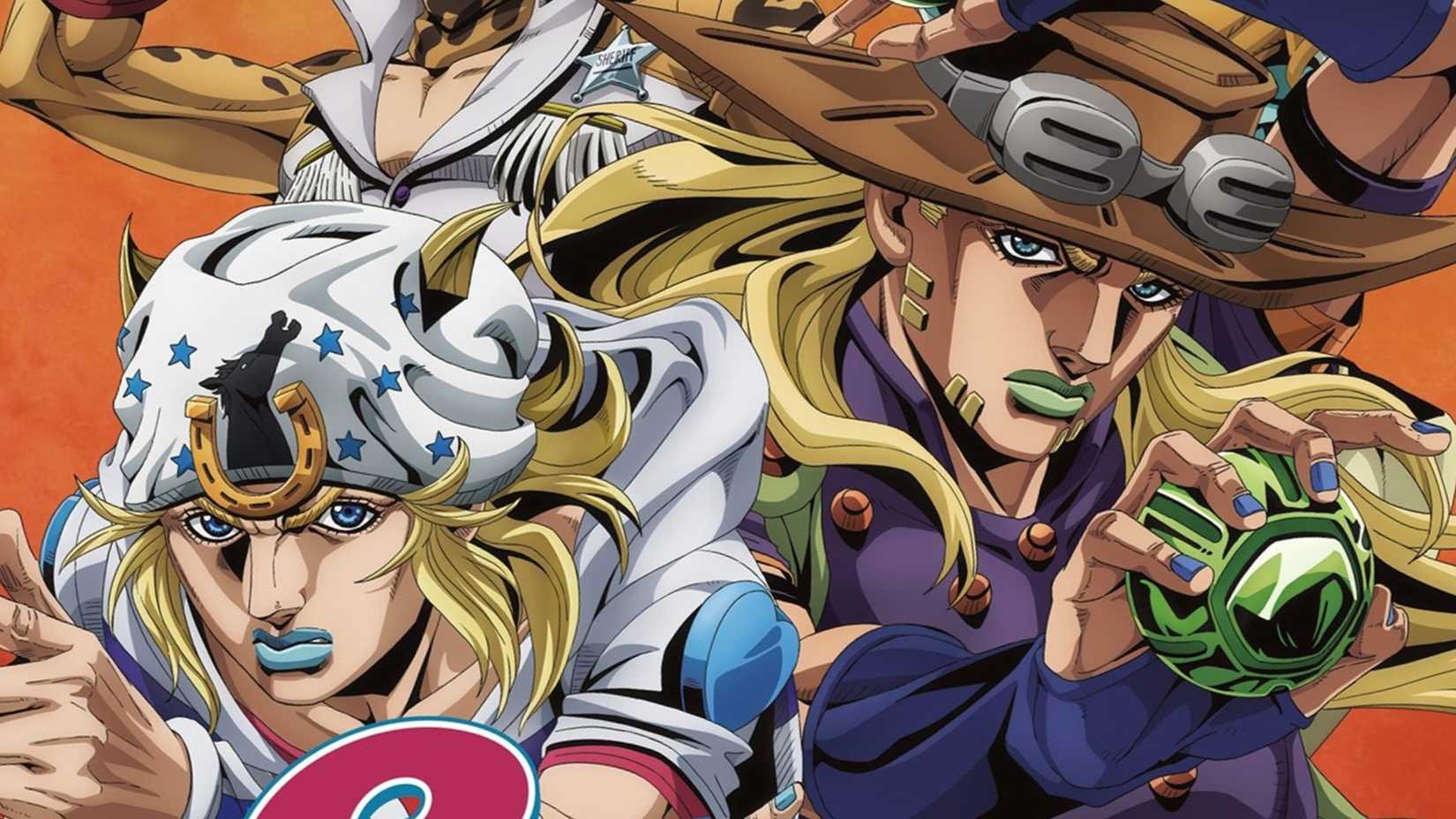
Ever since the cosmic, universe-resetting finale of Stone Ocean aired on Netflix, a singular, deafening question has reverberated through the global anime zeitgeist: When does the race begin? For over three decades, Hirohiko Araki’s multi-generational opus has reinvented itself across eras, aesthetics, and tonal shifts. Yet, within the collective consciousness of manga purists and casual streaming audiences alike, one arc stands unchallenged at the summit of critical adulation: JoJo’s Bizarre Adventure: Steel Ball Run. Sitting perpetually near the absolute pinnacle of manga rankings on MyAnimeList and AniList, Part 7 is not merely the next canonical installment waiting in David Production’s greenlight queue—it is Araki’s masterwork, a reinvention so profound it fundamentally shifted the artistic ceiling of the franchise.
The murmurs of pre-production, voice cast speculations, and insider teases have reached a fever pitch. Adapting this 1890 trans-American equestrian marathon requires more than routine animation logistics; it demands an artistic, financial, and technical metamorphosis. As the community gears up for what could be the definitive modern anime adaptation of the decade, the road across the American frontier stands as David Production’s ultimate proving ground.
Rebirth Across the Frontier: How Part 7 Redefined Araki’s Magnum Opus
To understand the monumental buzz surrounding Steel Ball Run, one must first recognize its historical context within the manga industry. Serialized initially in Weekly Shonen Jump before migrating to the monthly, mature pastures of Ultra Jump in 2005, Part 7 freed Hirohiko Araki from the punishing weekly deadlines and demographic constraints of typical shonen publication. The monthly release cycle granted him expansive horizontal canvases, allowing for staggeringly detailed panoramic landscapes of the American wilderness, intricate psychological depth, and complex philosophical debates on morality, patriotism, and human ambition.
Set within an alternate timeline severed from the Joestar bloodline’s original universe, Steel Ball Run centers around a cross-country horse race spanning San Diego to New York City, backed by eccentric industrialist Steven Steel and driven by an unprecedented fifty-million-dollar prize pool. However, beneath the grit of dusty boots and galloping hooves lies an esoteric search for the Saint’s Corpse—scattered relics possessing miraculous powers capable of shifting global geopolitical supremacy. By blending historical revisionism with the uncanny logic of supernatural Stand battles, Araki crafted an epic that trades straightforward heroism for morally compromised, existential survival.
The Crippled Prodigy and the Executioner: Deconstructing the Central Duo
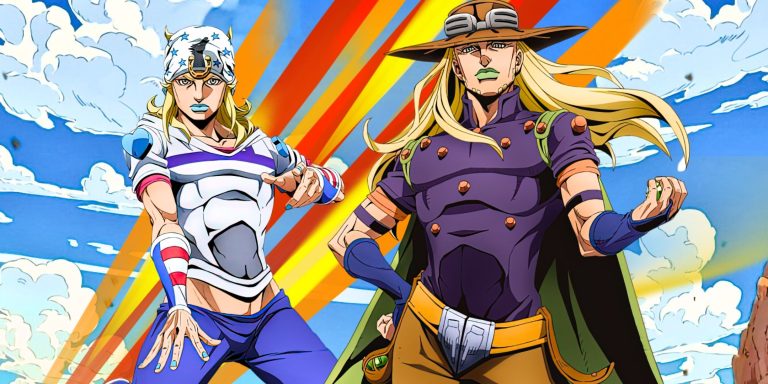
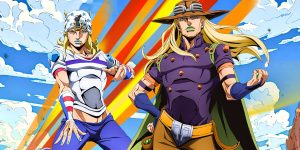
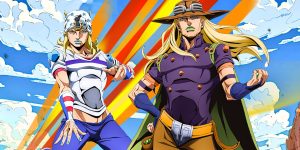
At the beating heart of Steel Ball Run is the most masterfully written dynamic in Araki’s vast bibliography: the partnership between Johnny Joestar and Gyro Zeppeli. Where previous JoJo protagonists operated on varying gradients of intrinsic altruism, Johnny and Gyro operate entirely on personal, deeply flawed convictions.
Johnny Joestar’s Dark Determination
Johnny Joestar represents a radical deconstruction of the archetypal shonen protagonist. A former horse-racing prodigy whose career and mobility were stolen by an impulsive, arrogant mistake that left him paraplegic, Johnny begins his journey not out of a desire to save the world, but from sheer, raw desperation. When he encounters Gyro Zeppeli’s mystic rotating spheres and momentarily feels his legs twitch with life, Johnny’s motivation crystalizes: he must learn the secret of the Spin to claw his way from a “negative” existence back to “zero.” Throughout the race, Araki visually frames Johnny with the chilling concept of “dark determination”—eyes burning with unhesitating, ruthless willingness to kill anyone who stands between him and self-actualization. His Stand, Tusk, evolves in tandem with his emotional and physical breakthroughs, marking one of the most compelling coming-of-age trajectories in modern sequential art.
Gyro Zeppeli and the Way of the Spin
Operating as Johnny’s mentor, companion, and philosophical foil is Gyro Zeppeli, a disgraced executioner from the Kingdom of Neapolis. Flamboyant, absurdly humorous (famous for his opera-singing gags and gold-capped teeth spelling “GO! GO! ZEPPELI”), Gyro enters the race to win an amnesty plea for an innocent child condemned to die by political mandate. Beyond his tragic nobility, Gyro introduces the cornerstone mechanic of Part 7: The Spin. Grounded in the ancient mathematical principle of the Golden Ratio and the Fibonacci spiral, the Spin serves as the soft-magic precursor and counterpart to Stands. It is kinetic science transmuted into metaphysical power, weaponizing rotational energy through steel spheres to manipulate gravity, anatomy, and spacetime itself. The chemistry between Gyro’s eccentric bravado and Johnny’s brooding pragmatism forms an emotional ballast that elevates Part 7 leagues above traditional tournament arcs.
The Equestrian Nightmare: David Production’s Greatest Technical Gauntlet
While the story is universally heralded, the looming challenge of animating Steel Ball Run is the primary reason fans have held their breath with equal parts anticipation and trepidation. In the animation industry, horses are notorious; animating a galloping quadruped requires complex muscular articulation, constant perspective shifts, and precise anatomical timing. In Steel Ball Run, horses do not merely exist in the background—they are central combatants, dynamic conveyances, and emotionally expressive extensions of their riders.
David Production has rightfully earned its status as a boutique powerhouse through its hyper-stylized, frame-loyal adaptations of Parts 1 through 6, celebrated for their explosive color shifts, onomatopoeic typography, and kinetic fight choreography. However, handling a 4,000-mile race with hundreds of distinct racers, dynamic dynamic chases across arid deserts, snowy bluffs, and marshlands presents a logistical mountain. Rumors within industry circles point toward the heavy necessity of a hybrid production model: meticulously rendered 3D CGI horse rigs layered with hand-drawn, cell-shaded 2D finishing to maintain Araki’s heavy cross-hatching aesthetic. If David Production can strike the elusive visual balance seen in high-end projects like Orange’s Trigun Stampede or MAPPA’s hyper-detailed horse sequences in late-stage Attack on Titan, Steel Ball Run could set a transformative precedent for equestrian action in anime.
The Cultural Catalyst: Antagonists, Memes, and Global Impact
Beyond the central duo and technical complexities, an adaptation of Part 7 brings one of pop-culture’s most captivating villains to the screen: Funny Valentine, the 23rd President of the United States. Valentine is a terrifying manifestation of hyper-nationalism, armed with the multiversal Stand Dirty Deeds Done Dirt Cheap (D4C) and an unshakeable, terrifying conviction that the ends justify the means. His philosophical diatribes regarding “the first napkin”—the concept that power is derived from the first individual who sets the societal standard that all others follow—resonate with unnerving contemporary relevance.
Simultaneously, the digital landscape is already primed for the inevitable cultural explosion. From early internet virality centered on Gyro’s nonsensical “Pizza Mozzarella” ballad to the sheer visual iconography of character designs like Diego Brando and Mountain Tim, Part 7 possesses an organic, meme-fueled lifeblood that modern algorithmic platforms devour. When an adaptation finally drops, it won’t merely occupy the Saturday morning streaming slot; it will commandeer social discourse across global communities.
The Starting Pistol Awaits
JoJo’s Bizarre Adventure: Steel Ball Run is more than an anime adaptation waiting for a date on an anime release schedule. It represents the maturation of an artist at the zenith of his imaginative powers, translated by an animation studio that has dedicated over a decade to honoring his legacy. It is a grueling, heartbreaking, beautifully philosophical journey about broken men, cosmic spirals, and the violent birth of a modern age. When the starting gun eventually fires, it promises to be nothing short of revolutionary.
How do you think David Production should tackle the legendary horse race? Will hybrid CGI do justice to Araki’s pen work, or are you hoping for purely hand-drawn sakuga? Let us know your thoughts in the comments below, and stay tuned to Wibux.com for all breaking anime and manga updates!