When the history of modern pop culture is written, 2024 will forever be marked by a profound, heartbreaking collective pause: the passing of Akira Toriyama. For four decades, the maestro of modern shonen did not merely influence the anime landscape—he defined its structural DNA, its comedic timing, and its visual vocabulary. Yet, out of that somber shadow emerged Dragon Ball Daima, a production that has transitioned from an anticipated 40th-anniversary celebration into something profoundly sacred. It is Toriyama’s definitive swansong, a project where he immersed himself deeper into scriptwriting, lore creation, and conceptual artistry than any television project since the original run of the manga.
The premiere of Dragon Ball Daima does not merely hit the ground running; it recalibrates the entire franchise. By dragging Son Goku and the Earth’s defenders out of their multiversal comfort zones and plunging them into the uncharted, bureaucratic absurdities of the Demon Realm (Makai), the series delivers an exhilarating synthesis of nostalgic whimsy and canonical expansion. It is a stunning affirmation that Dragon Ball’s greatest asset was never its god-shattering power levels, but the pure, unrestrained curiosity of its creator.
The Philosophy of Regression: Why Turning “Mini” Restores the Magic
Upon its initial reveal, cynical corners of the fandom reflexively drew comparisons to 1996’s Dragon Ball GT. The premise of Goku being rendered diminutive once again felt, on paper, like well-trodden ground. However, the premiere episode of Daima instantly dispels that trepidation by framing the regression not as an accidental handicap, but as a deliberate narrative and thematic stripping-down of the franchise’s overwhelming scale.
Over the past decade of Dragon Ball Super, the stakes climbed so stratospherically that Goku and Vegeta routinely traded blows with Gods of Destruction, brushed shoulders with the Omni-King, and unlocked forms that rendered traditional hand-to-hand combat secondary to cosmic light shows. By turning the cast “Mini” via a shrewd, paranoid wish from the newly introduced King Gomah, Toriyama effectively hits the emotional and physical reset button. The physical shrinkage reintroduces genuine vulnerability. Goku can no longer rely purely on raw kinetic inertia; center of gravity matters again, limb reach dictates defense, and the legendary Nyoibo (Power Pole) reclaims its sacred mantle as an extension of the martial artist’s spirit rather than a forgotten relic.
A Return to the Boyhood Spirit of 1984
There is an infectious, child-like exuberance in observing Goku navigate his pint-sized form. Rather than spiraling into existential dread, Goku immediately attempts to gauge his reach, throwing experimental roundhouses and laughing at his altered momentum. It reflects Toriyama’s core thematic thesis: Son Goku is not a savior driven by messianic duty, but an eccentric country boy fascinated by the mechanics of movement and the thrill of the unknown. Turning the cast small is a metatextual masterstroke—it turns the audience back into children right alongside him.
Cracking Open Makai: The Long-Awaited Deep Dive into the Demon Realm
For decades, the Demon Realm existed as one of the most tantalizing, underdeveloped fringes of Dragon Ball cosmology. Relegated to the margins of the Daizenshuu guidebooks, passing mentions in the Majin Buu arc via Dabura, and non-canon video games like Dragon Ball Heroes and Xenoverse, the realm finally receives its authoritative, canonical codification in Daima.
The premiere recontextualizes the climax of Dragon Ball Z with absolute brilliance. Watching King Gomah and his sycophantic minister, Degesu, review archived footage of the battle with Kid Buu like anxious bureaucrats watching a military coup is Toriyama comedy at its zenith. The revelation that the Demon Realm is structured into distinct tiers—the First, Second, and Third Worlds—immediately constructs a fascinating new world-building topology. Furthermore, the episode drops seismic lore revelations regarding the origins of the Namekians, hinting that the race did not merely originate from Planet Namek, but possesses deep, historic roots tied to the mystical infrastructure of the Demon Realm itself.
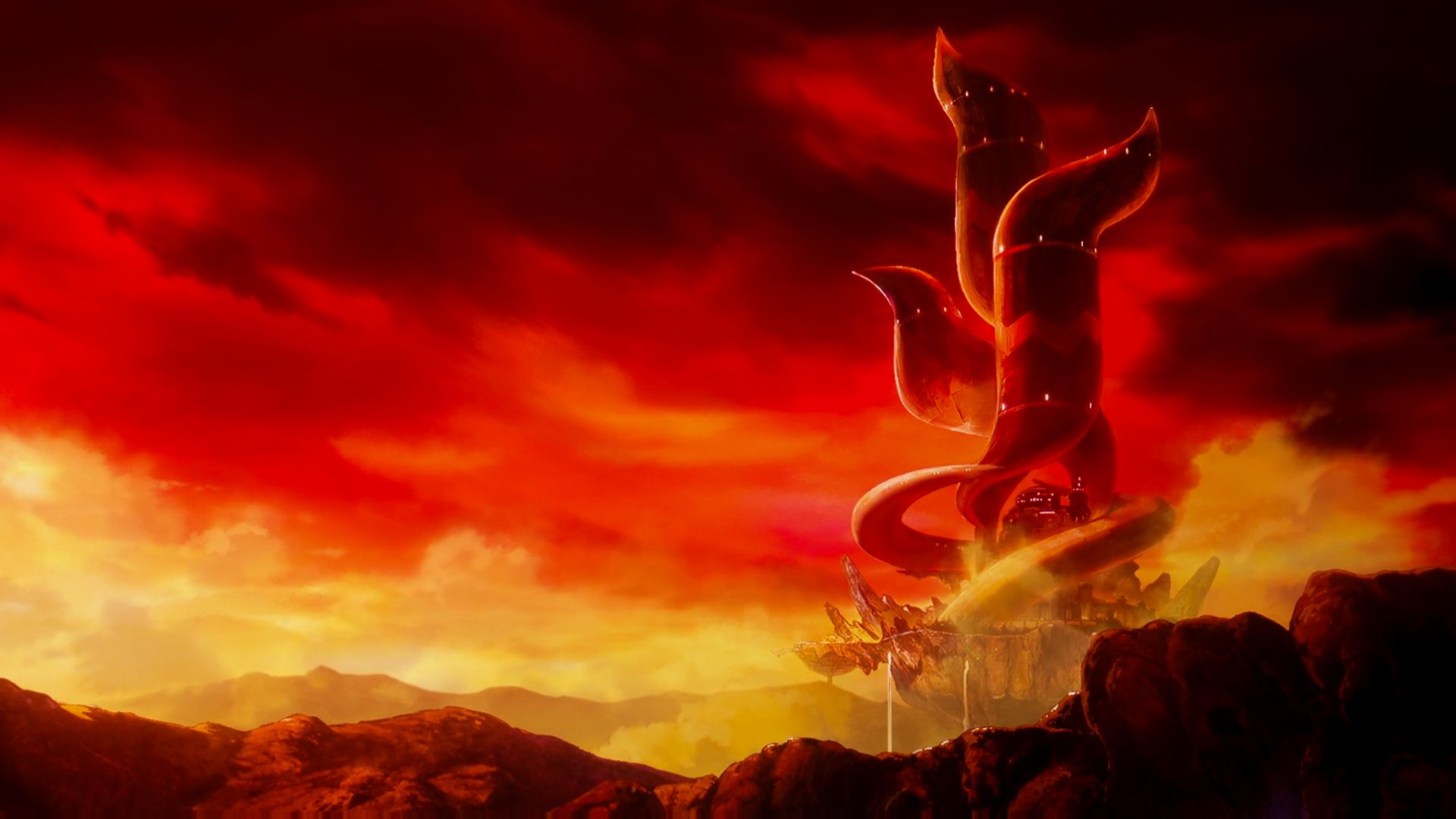
By shifting the battleground away from the glossy, hyper-clean cosmic arenas of the Tournament of Power and dropping our heroes into the atmospheric, gothic, and fungal landscapes of the Demon Realm, Daima recaptures the dirty, fantasy-adventure texture of early Dragon Ball. It feels mystical, weird, and slightly perilous in ways the franchise hasn’t touched in over thirty years.
A Visual Triumph: Peak Toei Animation and Kinetic Martial Arts
From an aesthetic and technical standpoint, the premiere of Dragon Ball Daima is a staggering artistic triumph for Toei Animation. Under the shared directorial helm of Aya Komaki (renowned for her transcendent work on One Piece Film: Red and the Wano arc) and Yoshitaka Yashima, the production values are uncompromisingly cinematic.
The digital compositing avoids the glossy, oversaturated plastic look that plagued early Dragon Ball Super. Instead, character designer Katsuyoshi Nakatsuru adapts Toriyama’s late-era aesthetic with reverence: rounded edges, expressive facial elasticity, and a softer, watercolor-adjacent palette that evokes classic cell-animation nostalgia while taking advantage of cutting-edge modern pipeline compositing.
When the action sequences manifest, the choreography is breathtaking. Rather than relying on static close-ups of reciprocating fists masked by speed-lines, the premiere showcases deliberate, spatial martial arts:
Each movement carries palpable weight. Footwork is distinctly mapped out across environments; impacts generate physical recoil rather than just generic energy dust, and camera pans dynamically follow the kinetic trajectory of the strikes. The fluid sakuga sequences honor Toriyama’s background in kung-fu cinema, proving that Toei treated this project with the prestige reserved for the master’s ultimate bow.
Glorio, Shin, and the New Chemistry of Adventure
A great road-trip narrative requires dynamic friction, and Daima understands this implicitly. The introduction of Glorio—the enigmatic, trench-coated pilot hailing from the Demon Realm—injects a stoic, morally ambiguous foil to Goku’s relentlessly casual demeanor. Glorio’s tech-infused starship and calculated pragmatism contrast delightfully with Goku’s obsession with local culinary treats and instinctual eagerness to brawl.
Equally crucial is the revitalization of the Supreme Kai, Shin. Frequently reduced to a wide-eyed spectator of escalating Saiyan transformations in prior arcs, Shin’s Mini form and familial ties to Degesu and the Demon Realm thrust him directly into the narrative cockpit. The dynamic between Goku, Shin, and Glorio provides a tight, three-man core dynamic that feels remarkably fresh. It is focused and nimble, deliberately moving away from the bloated ensemble cast to give breathing room to dialogue, exploration, and character-driven situational humor.
The Eternal Legacy of Akira Toriyama
It is impossible to watch the premiere of Dragon Ball Daima without feeling an undercurrent of poetic melancholy. Every quirky creature design, every strangely retro piece of technology, and every dry, irreverent joke carries the indelible signature of a genius who never took himself too seriously, even when crafting modern mythologies. Daima is not a product born of corporate obligation; it is a labor of pure, unadulterated passion from a creator saying goodbye on his own terms.
By returning to the fundamentals of journey, mystery, and martial arts, Daima proves that the true heart of Dragon Ball is not the color of a Saiyan’s hair, but the thrill of stepping onto an unfamiliar spaceship and venturing into the unknown with an unshakeable grin.
Over to you, Wibux readers: What was your favorite moment from the Dragon Ball Daima premiere? Do you love the deep dive into Demon Realm lore, and what do you think of Goku’s Mini combat style? Drop your theories and tributes to Toriyama in the comments below!