Ever since the melancholic strings of Duffy’s “Distant Dreamer” signaled the close of Stone Ocean and brought Hirohiko Araki’s original Joestar lineage to its universe-resetting climax, a singular, deafening chant has echoed across the anime community: When is Steel Ball Run? For over a decade, manga purists and anime-only converts alike have treated Part 7 not merely as the next chronological step in a flamboyant franchise, but as holy scripture. Sitting comfortably alongside Berserk and Vinland Saga atop MyAnimeList’s all-time greatest manga rankings, JoJo’s Bizarre Adventure: Steel Ball Run is Hirohiko Araki’s undisputed magnum opus—a work of staggering artistic maturity, existential depth, and breathless kineticism. Yet, as rumors churn and speculation reaches a fever pitch regarding David Production’s next move, the prospect of adapting this transcontinental equestrian epic presents both the studio’s greatest triumph and its most intimidating technical nightmare.
The Trans-American Renaissance: Rebirth of an Epic
To understand the ravenous hunger for a Steel Ball Run anime, one must first appreciate its context within Araki’s legendary career. Launched in 2004, the series began as an ambiguous project that initially downplayed its JoJo branding before officially migrating from the weekly deadlines of Weekly Shonen Jump to the monthly, mature pastures of Ultra Jump. This structural liberation completely transformed Araki’s craft. No longer tethered to rapid-fire weekly pacing, the mangaka indulged in lavish double-page spreads, deeply layered character studies, and an atmospheric realism previously unseen in the franchise.
A Cross-Country Crucible in 1890
Set against the dusty, sun-bleached expanse of late-19th-century North America, Steel Ball Run centers on an eccentric 6,000-kilometer horse race spanning from San Diego Beach to New York City. The prize? A staggering fifty million dollars. But beneath the veneer of an outrageous sporting spectacle organized by eccentric promoter Steven Steel lies a geopolitical conspiracy soaked in blood, religious mysticism, and cosmic destiny. By stripping away decades of accumulated Stand lore and starting fresh in an alternate continuity, Araki constructed a sprawling Western that deconstructs the American mythos while elevating his signature supernatural combat to high art.
Johnny Joestar & Gyro Zeppeli: Dual Protagonism and Dark Resolve
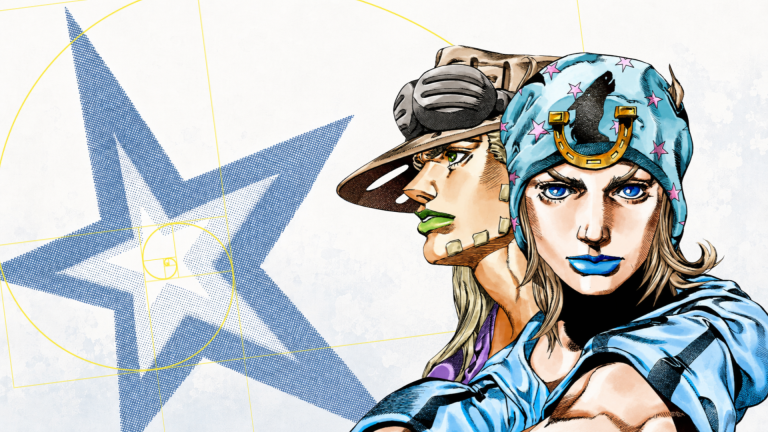
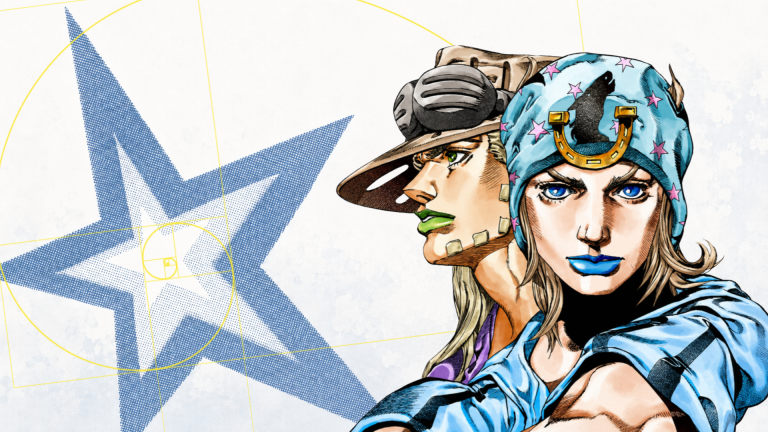
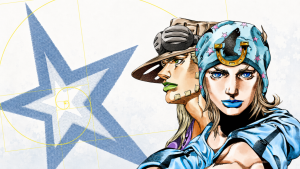
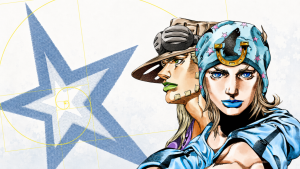
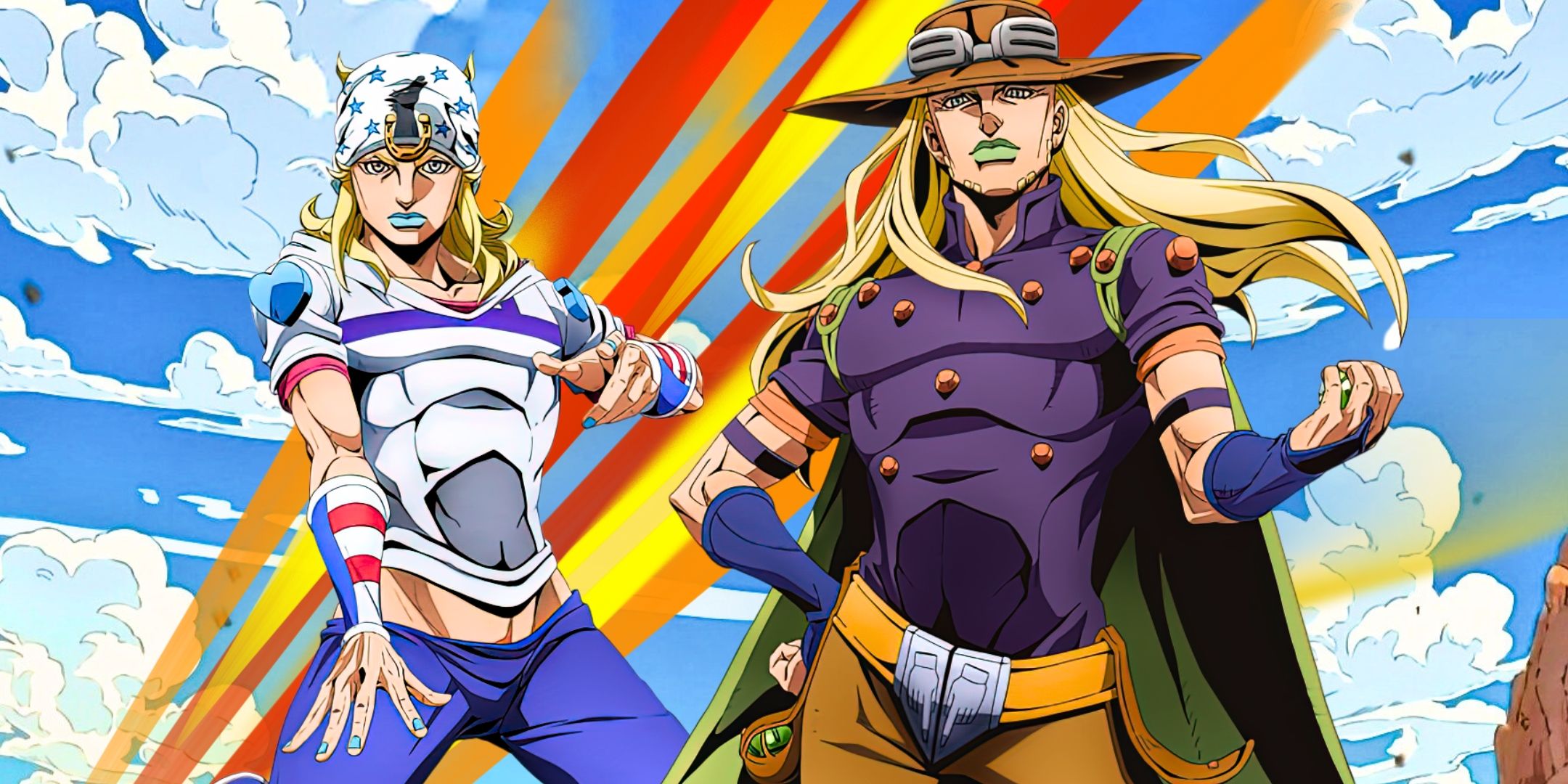
At the center of this dust storm is the greatest duo Araki has ever penned: Johnny Joestar and Gyro Zeppeli. Their dynamic represents a profound subversion of shonen conventions, trading noble crusades for raw, selfish humanity.
Johnny Joestar is deliberately designed as the antithesis of his noble Part 1 ancestor, Jonathan. Paralyzed from the waist down following a senseless act of adolescent arrogance, Johnny is a washed-up former racing prodigy trapped in bitter isolation. He is cynical, morally grey, and burdened by what Araki explicitly terms “dark determination”—a terrifying, bottomless hunger to claw his way out of zero and back to one, regardless of the ethical cost. Johnny is not riding across America to save the world; he is chasing the fleeting miracle of walking again, sparked by a chance encounter with an enigmatic Neapolitan executioner.
The Golden Ratio: Transcending the Stand Phenomenon
That executioner is Gyro Zeppeli, a man who effortlessly balances aristocratic gravitas with sheer absurdity. Whether he is flashing his gold teeth engraved with “GO! GO! ZEPPELI,” singing nonsensical improvised ballads about pizza mozzarella, or agonizing over his duty to his homeland, Gyro acts as the moral and spiritual compass of the journey. Central to Gyro’s combat prowess is the Spin—a sophisticated martial discipline rooted in the Fibonacci sequence and the mathematical Golden Ratio. Rather than immediately introducing conventional punch-ghost Stands, Steel Ball Run re-anchors its power system in physical manipulation, trajectory calculations, and kinetic energy via rotating steel spheres. When Johnny’s Stand, Tusk, gradually evolves through its four Acts, it feels less like an unearned sudden power-up and more like an agonizing, step-by-step psychospiritual evolution.
The Animator’s Nightmare: David Production’s Technical Gauntlet
While fans eagerly await the sight of Johnny and Gyro riding into the sunset, animators across Tokyo are likely breaking out into a cold sweat. There is an open secret within the anime industry: horses are career-endingly difficult to animate in 2D.
The Equestrian Dilemma
Unlike humanoid characters whose anatomical motion cycles can be simplified, a galloping horse demands an intricate, four-legged rhythm with complex muscle flexation, skeletal shifting, and shifting center-of-gravity physics. Steel Ball Run doesn’t just feature a horse or two standing in a background shot—it demands dozens of steeds careening through rugged terrain at breakneck speeds while their riders exchange gunfire, deploy nails as spinning projectiles, and warp spatial dimensions.
For David Production, a studio that has earned immense goodwill for its faithful, color-palette-shifting JoJo adaptations since 2012, this presents a monumental fork in the road:
1. The Full-CGI Route: Utilizing sophisticated 3D cel-shaded models for the horses (similar to the techniques perfected by Studio Orange in Trigun Stampede or MAPPA in Chainsaw Man). While cost-effective and structurally consistent, poorly executed CGI risks alienating a fan base that cherishes David Production’s distinct hand-drawn punch.
2. The Hybrid Approach: Employing detailed 3D assets for wide, sweeping race sequences and high-speed cavalry charges, seamlessly blended with artisan 2D close-ups during intimate character moments and dramatic standoffs. If David Production can pull off this hybrid pipeline with the visual fidelity Araki’s dense cross-hatching deserves, they will set a new benchmark for modern television anime.
Funny Valentine and the Horrors of Manifest Destiny
A discussion of Steel Ball Run is fundamentally incomplete without addressing its main antagonist, the 23rd President of the United States, Funny Valentine. Operating with an unwavering, terrifying brand of utilitarian patriotism, Valentine seeks the scattered mummified fragments of the Saint’s Corpse to secure America’s eternal geopolitical dominance through divine providence.
His Stand, Dirty Deeds Done Dirt Cheap (D4C), introduces mind-bending multiversal mechanics that will test any director’s ability to construct visual clarity amidst temporal chaos. Valentine’s infamous “First Napkin” philosophical monologue remains one of the sharpest commentaries on societal conformity and sovereign authority ever written in manga. He isn’t a cackling madman like Dio Brando or a paranoid recluse like Yoshikage Kira; he is a charismatic, hyper-competent statesman whose conviction is so magnetic that readers frequently find themselves questioning if our flawed protagonists are actually on the wrong side of history.
The Verdict: The Cultural Horizon Beckons
The transition into the Steel Ball Run era also demands structural introspection from its distributors. The fragmented “batch release” strategy executed by Netflix during Stone Ocean noticeably fractured community discussions and stifled the weekly social-media frenzy that defined Golden Wind and Stardust Crusaders. For an adaptation of this pedigree to capture the global zeitgeist, it requires the steady, communal drumbeat of a weekly broadcast, allowing each heart-stopping sprint and gut-wrenching sacrifice to breathe.
Hirohiko Araki’s masterwork stands as a monument to narrative ambition, proving that a long-running franchise can completely shed its skin and emerge more vital than ever. The road from San Diego to New York is paved with shattered bones, golden spirals, and unbreakable resolve. David Production holds the reins to anime history’s next great frontier—and when that starting pistol finally fires, the entire medium will shake.
Which sequence from Steel Ball Run are you most desperate to see animated—the chaotic “Who Shot Johnny Joestar?” puzzle, the haunting Sugar Mountain trial, or the fateful final clash? Drop your theories and dream voice-cast picks in the comments below!