
Ever since the melancholic strains of Duffy’s “Distant Dreamer” brought the curtain down on Stone Ocean, a palpable, electric tension has gripped the global anime community. For over a decade, David Production pulled off what critics once considered impossible: adapting the labyrinthine, genre-bending generational saga of Hirohiko Araki’s JoJo’s Bizarre Adventure into an iconic, era-defining anime franchise. Yet, despite six parts of triumphant vampiric clashes, globe-trotting Stand battles, and mafia melodrama, every seasoned fan knows that the journey so far was merely the prologue to Araki’s undisputed magnum opus: Part 7, Steel Ball Run.
Currently sitting near the absolute zenith of MyAnimeList’s all-time manga rankings, Steel Ball Run is not just another sequel; it is a seismic cultural artifact. Relocating the narrative to an alternate-history 1890s America, it chronicles a grueling, cross-country horse race spanning San Diego to New York. But behind the insatiable online clamor and viral concept trailers lies a daunting reality. David Production stands before a creative and logistical precipice that will define the studio’s legacy for the next decade.
A New Frontier: Araki’s Seinen Metamorphosis
To understand the immense anticipation surrounding Steel Ball Run, one must examine the creative liberation that birthed it. Originally launched in Weekly Shonen Jump in 2004 before transitioning to the monthly Ultra Jump, the series marked Hirohiko Araki’s transition into the seinen demographic. Free from the breakneck pacing and editorial constraints of weekly shonen publication, Araki unleashed an unprecedented level of visual density, narrative complexity, and thematic maturity.
The clean lines and popping, punchy vignettes of Stardust Crusaders and Diamond is Unbreakable evolved into sprawling, cross-hatched landscapes drenched in sweat, grime, and the romantic fatalism of the American frontier. Steel Ball Run strips away the safety net of the familiar Joestar lineage. It resets the cosmology, trading urban streets and coastal prisons for an arid, unforgiving continent where the stakes feel violently real and spiritually transcendent. For David Production, replicating this shift requires nothing short of a total overhaul of their established visual pipeline.
The Chemistry of Desperation: Johnny, Gyro, and the Mechanics of the Spin
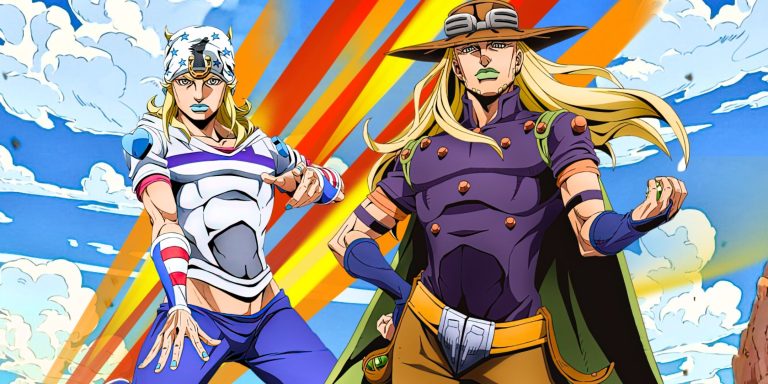
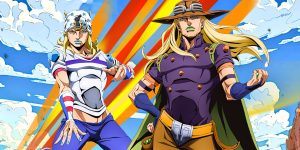
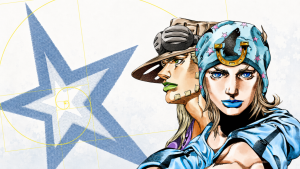
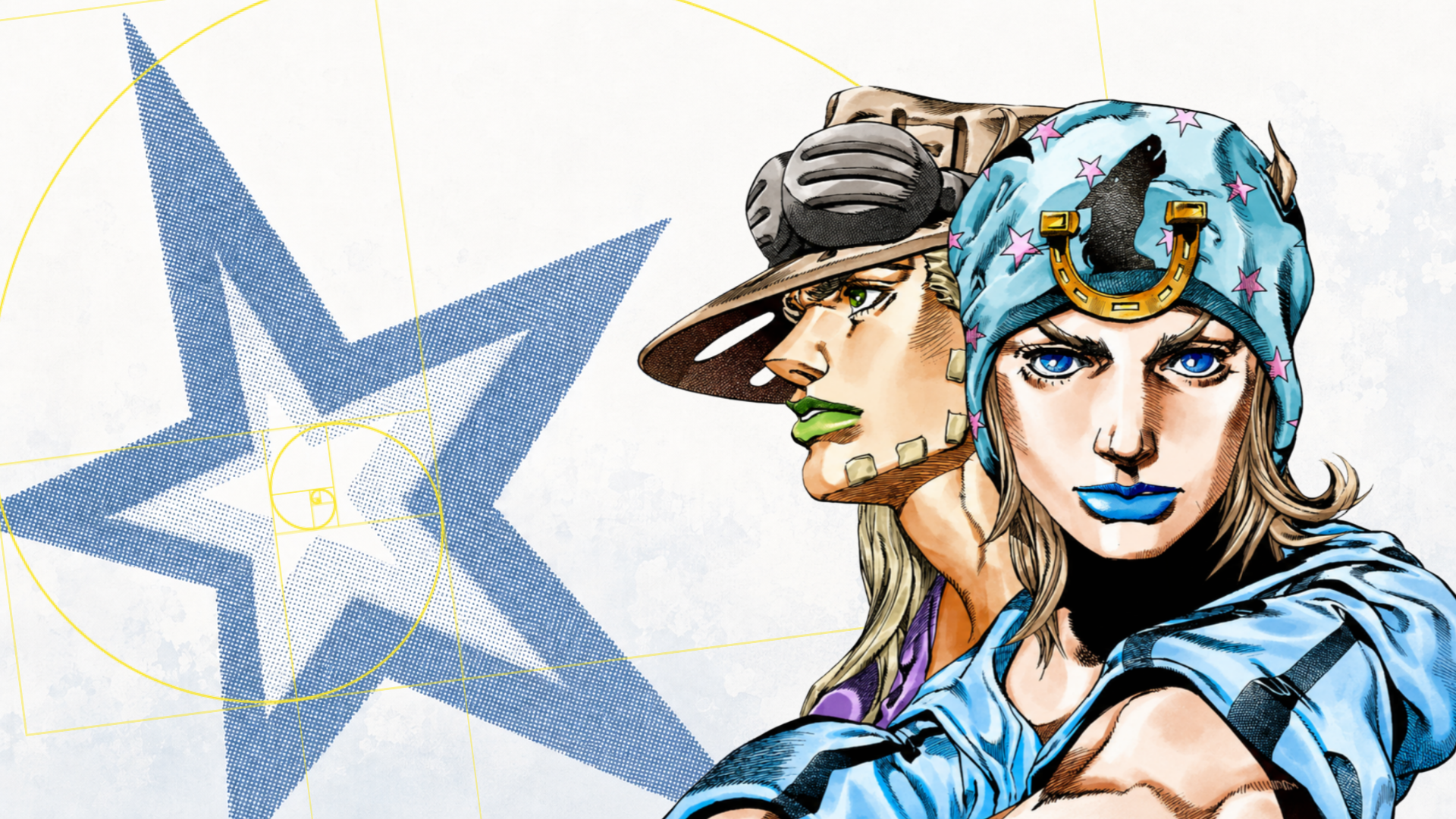
At the beating heart of this Western-supernatural hybrid is arguably the greatest dual-protagonist dynamic in manga history: Johnny Joestar and Gyro Zeppeli.
Johnny is a subversion of every traditional shonen protagonist. Paralyzed from the waist down following an act of youthful arrogance, he is neither righteous nor noble. He is bitter, desperate, and driven by what Araki explicitly characterizes as a “dark determination”—a cold, unwavering hunger to escape his personal purgatory. His goal is not to save the world; it is simply to find a way back to “zero,” to reclaim his footing both literally and existentially.
Enter Gyro Zeppeli, a disgraced Neapolitan executioner’s son armed with twin revolving steel spheres and a tooth inscribed with “GO! GO! ZEPPELI.” Gyro introduces the narrative to The Spin—an ancient kinetic martial art grounded in the mathematical perfection of the Golden Ratio. Where Hamon was mystical breathwork and Stands were psychic projections, the Spin is high-concept physical science elevated to divine mysticism.
From Tusk to Ball Breaker: Reimagining Stand Battles
The progression of Johnny’s Stand, Tusk, mirrors his tortuous emotional rehabilitation. As Johnny uncovers the deeper secrets of the Spin under Gyro’s mentorship, Tusk evolves through four distinct Acts, shifting from firing fingernails as rudimentary kinetic bullets to commanding infinite rotational gravity capable of tearing through dimensional barriers. Translating these intricate physics-based metaphysics to the screen demands a level of visual direction that David Production has teased before, but never sustained across a multi-cour production.
The Equestrian Nightmare: David Production’s Technical Gauntlet
If fans are wondering why an official announcement has remained elusive, the answer boils down to a single, notoriously terrifying word for 2D animators: horses.
Animating horses is universally recognized as one of the most grueling trials in the animation industry. Their intricate four-legged gait cycles, shifting skeletal structures, and rippling musculature push traditional hand-drawn keyframers to their limits. In Steel Ball Run, horses are not background accessories; they are central combatants, pacing the trans-American race across dunes, rivers, snowscapes, and urban cobblestones.
David Production cannot rely exclusively on traditional 2D animation without risking an industrial burnout of catastrophic proportions. Modern productions—from Wit Studio’s Attack on Titan to MAPPA’s Vinland Saga—have increasingly leaned on 3DCG hybrid techniques for complex livestock movement. However, the signature David Production aesthetic lives and dies on heavily stylized line weight, hyper-expressive poses, and kinetic on-screen sound effects (katakana). To satisfy purists, the studio must pioneer a seamless cell-shaded CGI pipeline for the equestrian scenes that blends imperceptibly with hand-drawn close-ups of Johnny’s desperate scowl and Gyro’s golden grin.
Patriotism, Plunder, and the Saint’s Corpse
Beyond the technical hurdles lies a narrative of staggering ideological depth. What begins as an eccentric sports spectacle rapidly mutates into an occult espionage thriller centered on the scattered mummified relics of the Saint’s Corpse—a supernatural proxy for Jesus Christ himself.
Opposing our riders is the 23rd President of the United States, Funny Valentine, whose Stand, Dirty Deeds Done Dirt Cheap (D4C), allows him to traverse parallel dimensions. Valentine remains one of modern fiction’s most chilling antagonists precisely because his villainy is devoid of petty sadism. He is a hyper-utilitarian patriot driven by the sincere desire to seize the Corpse to bless his nation with eternal prosperity, willingly casting all corresponding misfortune onto the rest of the planet. The philosophical battle between Valentine’s collectivist imperialism and Johnny’s raw, personal salvation elevates the race into an operatic commentary on the cost of the American Dream.
The Starting Gun Awaits
The buzz surrounding Steel Ball Run is not standard pre-release hype; it is a cultural reckoning. As the anime industry faces shifting production models and an ever-increasing demand for prestige adaptations, tackling Part 7 is David Production’s ultimate statement of artistic maturity. They are not merely animating another season of TV—they are translating Hirohiko Araki’s masterwork to a global audience waiting with bated breath.
When that starting gun finally fires and the race across the desert begins, the world will be watching to see if David Production can tame this wild stallion. Until then, the fandom waits at the starting line, spinning the steel balls and counting down the days until Johnny Joestar rides again.
What are your biggest hopes—and deepest anxieties—for the Steel Ball Run anime adaptation? Do you want David Production to pursue a pure hand-drawn aesthetic, or are you open to a high-end 3D hybrid? Sound off in the comments below!