When the apocalyptic, universe-resetting strings of Bach faded out at the climax of JoJo’s Bizarre Adventure: Stone Ocean, an unspoken collective breath caught in the throats of millions of anime fans worldwide. For over a decade, David Production pulled off what was once deemed impossible: adapting Hirohiko Araki’s generational, multi-era manga into a globally revered multimedia titan without sacrificing its flamboyant, hyper-stylized DNA. Yet, every milestone reached from Phantom Blood through Stone Ocean felt like a prelude to one singular, monolithic horizon. That horizon is Steel Ball Run—Araki’s seventh part, widely hailed not just as his magnum opus, but as one of the single greatest manga narratives ever committed to paper.
Whispers of production leaks, enigmatic voice-actor shifts, and studio capacity discussions have transformed social media feeds into a high-stakes saloon standoff. Adapting Steel Ball Run is not merely a matter of continuing an episodic pipeline; it represents a seismic artistic pivot. Taking place in an alternate universe, Part 7 reimagines the Joestar lineage within a gritty, late-19th-century trans-American horse race. It is a grueling, introspective epic where supernatural Stand battles collide with dust, sweat, historical conspiracy, and the metaphysical mysteries of the Golden Ratio. For David Production, greenlighting Part 7 is both a victory lap and a terrifying production gamble.
The Trans-American Frontier: Araki’s Masterclass in Reinvention
To understand why the internet combusts at the mere mention of a Steel Ball Run anime teaser, one must grasp the structural shift that birthed the manga. In 2004, Araki transitioned the series from the frantic weekly sprint of Weekly Shonen Jump to the monthly pages of Ultra Jump. The change broke open his storytelling canvas. Unshackled from weekly page limits and censorship guidelines, Araki pivoted from popcorn-tactical brawls into an atmospheric, character-driven Western odyssey spanning 6,000 kilometers from San Diego Beach to New York City.
The premise is deceptively accessible: eccentric philanthropist Stephen Steel organizes the “Steel Ball Run,” an unprecedented equestrian derby offering a staggering fifty-million-dollar bounty. Racers from every corner of the globe converge—nomadic outlaws, stoic Native American track-masters, royal cavalry officers, and eccentric inventors. Yet beneath this frontier spectacle lies an occult proxy war engineered by the highest echelons of the United States government. The race course itself traces the scattered, mummified relics of an ancient, miraculous Holy Corpse. Whoever gathers these pieces inherits absolute cosmic fortune and geopolitical dominance, grounding Araki’s surreal sensibilities in real-world historical grit.
A Partnership of Flaws: Johnny, Gyro, and the Geometry of the Spin
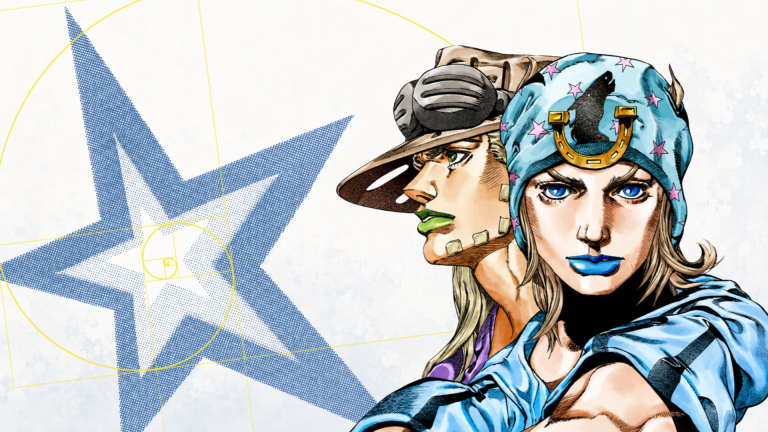
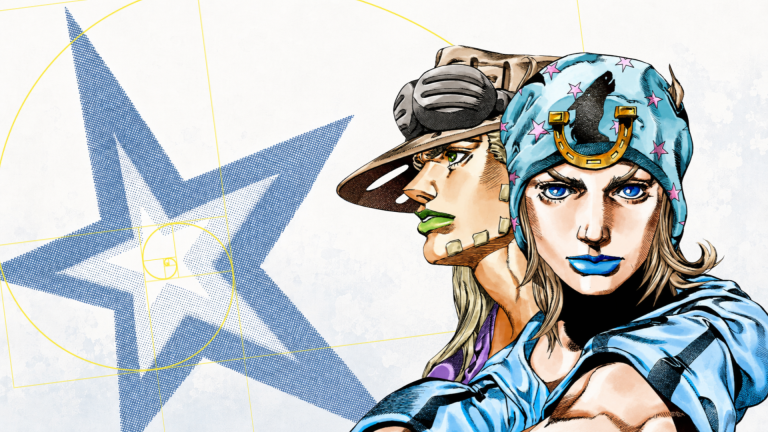
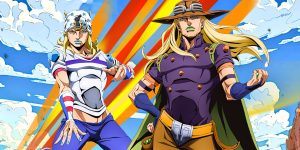
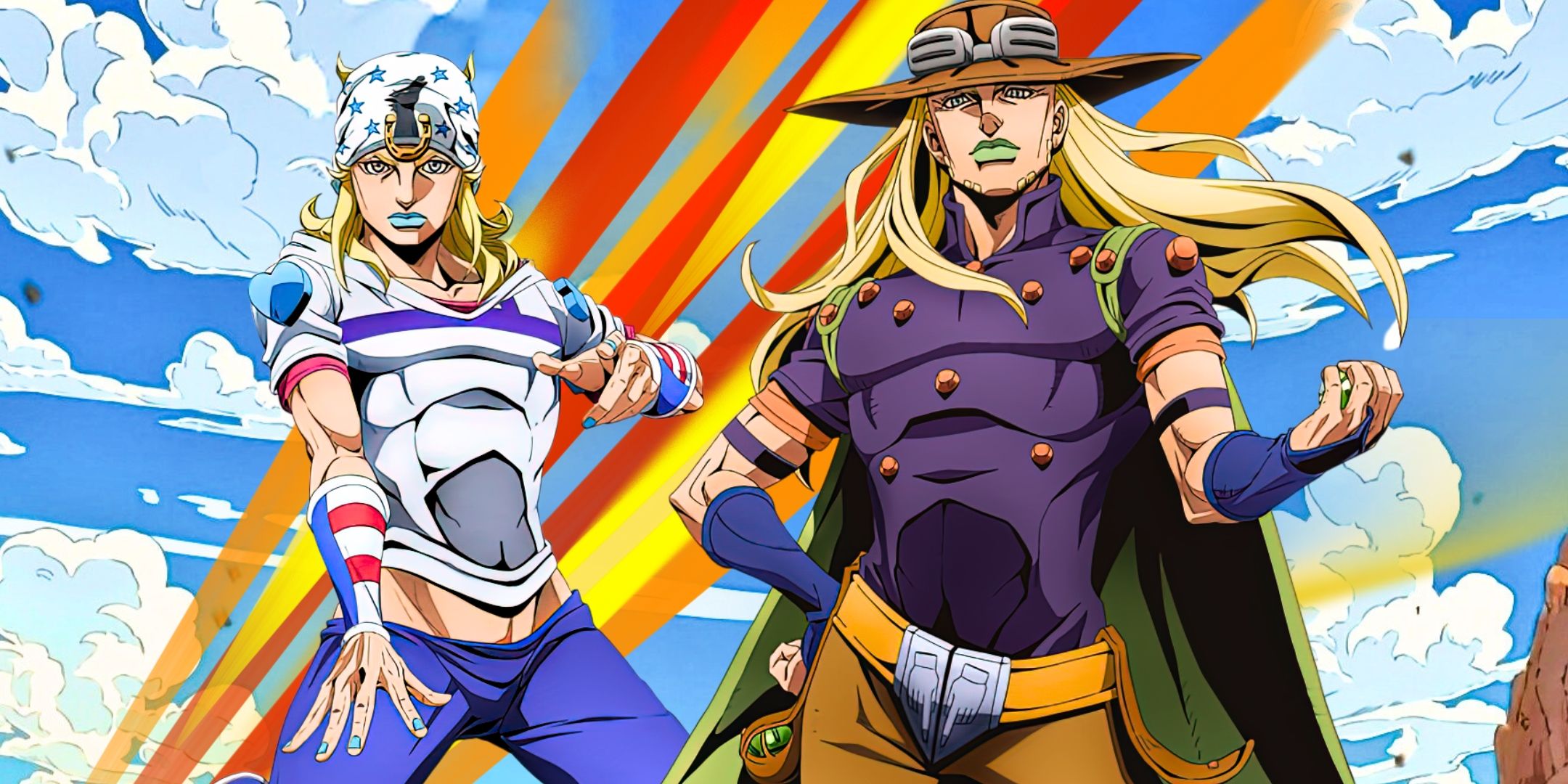
At the beating heart of Part 7 is a dynamic that subverts every classic shonen trope: the co-dependent journey of Johnny Joestar and Gyro Zeppeli. Previous JoJo protagonists entered their respective stories as towering pillars of charisma or morality. Jonathan was a gentleman saint; Jotaro was an unflinching stoic; Giorno was an untouchable strategist. Johnny Joestar, by stark contrast, begins his journey as an absolute wreck of a human being.
From Hubris to Humility: Johnny Joestar’s Dark Determination
Once a prodigal jockey basking in the toxic adulation of high society, Johnny’s arrogance cost him everything. A reckless altercation leaves him shot, paraplegic, and abandoned by his opportunistic peers. When the race begins, Johnny is neither heroic nor noble; he is bitter, traumatized, and searching for a reason to exist. His motivation is fundamentally selfish: after accidentally touching one of Gyro Zeppeli’s mystical steel spheres and momentarily regaining sensation in his legs, Johnny enters the deadly transcontinental race solely to reclaim his body.
Johnny’s eventual Stand, Tusk, mirrors this harrowing psychological evolution. Progressing through distinct “Acts,” Tusk transforms alongside Johnny’s mental state—from a defensive, cherubic creature that fires rotational fingernail projectiles into an interdimensional, unstoppable titan powered by absolute despair and ruthless conviction. Araki frequently illustrates Johnny with what characters call the “eyes of a killer”—a terrifying, bottomless determination that blurs the line between protagonist and tragic anti-hero.
The Executioner’s Ballad: Gyro Zeppeli and the Golden Ratio
If Johnny is the tortured soul of the narrative, Gyro Zeppeli is its flamboyant, tragic spine. A disgraced executioner from the Kingdom of Naples, Gyro enters the race to win royal amnesty for an innocent child condemned to death. Flashing gold teeth bearing the engraving “GO! GO! ZEPPELI,” Gyro masks profound philosophical weight beneath terrible puns, bizarre vocalizations, and effortless theatrical swagger.
More crucially, Gyro serves as Johnny’s mentor in The Spin—the franchise’s metaphysical evolution of Part 1 and 2’s Hamon. Rooted in Renaissance geometry, cellular physics, and the Fibonacci sequence, the Spin allows users to harness infinite kinetic momentum using spherical objects. It is a visually mesmerizing concept that demands top-tier animation direction: the subtle curve of a spinning steel sphere refracting light, bending organic matter, and unlocking the natural secrets of the universe through kinetic mathematics.
The Four-Legged Elephant in the Room: The Challenge of Equestrian Animation
If fans are desperate for Steel Ball Run, why hasn’t it arrived yet? The answer comes down to pure production terror: horses.
In traditional 2D hand-drawn animation, equines are notorious production killers. A horse’s complex skeletal structure, rhythm of motion, changing muscle mass during gallops, and dynamic camera angles demand an absurd number of man-hours from high-level key animators. Now, multiply that difficulty by thirty: a crowded pack of hundreds of horses charging through shifting terrain—arid deserts, muddy river basins, blizzards, and densely forested mountains—while riders unleash reality-bending Stands.
Historically, industry studios have turned to 3DCG to mitigate equestrian chaos, with mixed results. Fans still recall the jarring, weightless CG mounts that occasionally broke immersion in shows like Attack on Titan or Berserk (2016). David Production finds itself at a crucial crossroads. To do justice to Araki’s obsessively detailed horse musculature and dynamic track lines, the studio must either invest in a breakthrough hybrid 2D/3D pipeline or take years of painstaking pre-production to ensure the animation holds weight, speed, and tactile grit. The long silence from David Production isn’t apathy; it is the calculated silence of an animation powerhouse engineering its most technically ambitious project to date.
Patriotism, Morality, and the Saint’s Corpse
An adaptation of Steel Ball Run will also bring to the screen what is universally recognized as modern manga’s most compelling antagonist: the 23rd President of the United States, Funny Valentine. Far removed from the cartoonish sadism of traditional villains, Valentine is a deeply patriotic, ideologically resolute leader whose Stand, Dirty Deeds Done Dirt Cheap (D4C), allows him to traverse parallel dimensions seamlessly.
Valentine’s philosophical duel with Johnny and Gyro elevates Part 7 beyond a typical supernatural adventure. His famed “First Napkin” monologue—a treatise on how power, social hierarchy, and historical legacy are established by the one who dictates the terms of engagement—presents a terrifyingly coherent worldview. The clash between Johnny’s desperate personal pursuit of redemption and Valentine’s fanatical, utilitarian vision for American dominance subverts the clear-cut morality of previous parts, presenting a layered political thriller cloaked in supernatural dust.
The Countdown to the Starting Gun
The buzz surrounding JoJo’s Bizarre Adventure: Steel Ball Run is not just the routine clamor for another seasonal anime; it is the anticipation of a cultural event. Part 7 represents Hirohiko Araki operating at the absolute zenith of his visual and thematic maturity. It is a story about the crawl toward personal worth, the price of ambition, and the unbreakable bonds formed in the dust of an uncaring frontier.
David Production has proved time and again that they understand the beating soul of JoJo better than anyone. When the studio finally signals the start of the race with that inevitable, internet-shattering teaser trailer, anime fans will bear witness to something extraordinary: the golden standard of manga adaptation sprinting full tilt into a whole new world.
Are you ready to see Gyro’s Spin and Johnny’s Tusk animated, or do you fear the potential reliance on CGI horses? Which scene from the manga are you most desperate to see brought to life? Drop your theories and countdown wishlists in the comments below!