Few announcements in the contemporary anime landscape carry the seismic gravity of a potential JoJo’s Bizarre Adventure: Steel Ball Run production order. Ever since the melancholic final chords of Stone Ocean faded into the rain-slicked tarmac of Cape Canaveral, putting a definitive, tragic bow on the generational bloodline of Jonathan Joestar, the worldwide community has directed its gaze toward a singular horizon: the dust-choked trails of late 19th-century America. For over a decade, Hirohiko Araki’s Part 7 has not merely lived as a fan favorite; it has reigned supreme near the pinnacle of critically acclaimed manga on platforms like MyAnimeList, frequently spoken of in hushed, reverent tones alongside titans like Berserk and Vinland Saga. Now, as whispers around David Production’s production slate reach a fever pitch, the industry confronts a tantalizing question: how does an animation studio translate Araki’s technical, philosophical, and aesthetic magnum opus into reality?
A Transcontinental Odyssey: The Shift from Shonen Brawler to Seinen Masterwork
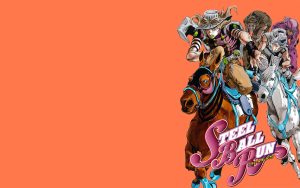
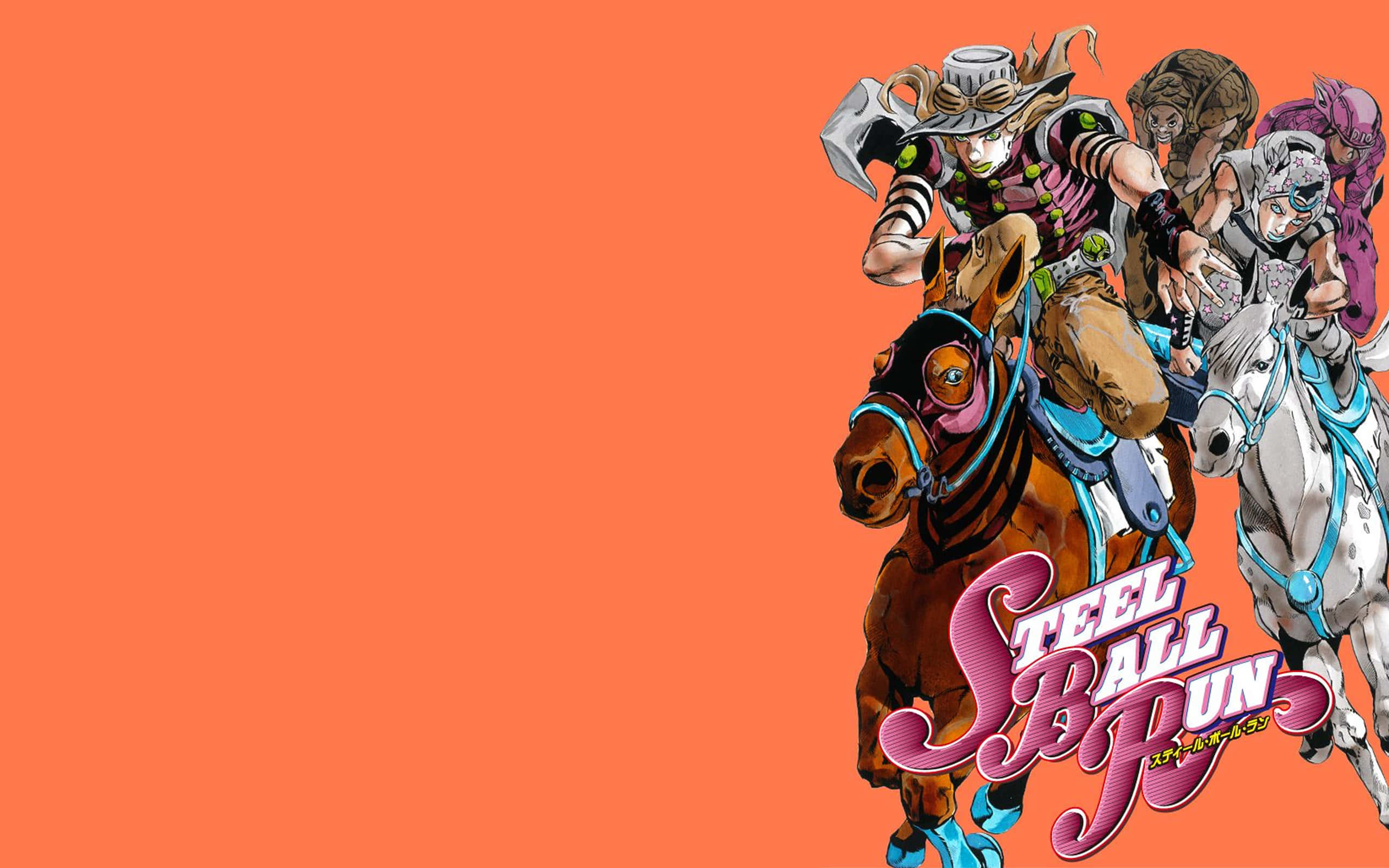
A High-Stakes Continental Derby Across 1890 America
To understand the sheer magnitude of the Steel Ball Run discourse, one must examine its evolutionary lineage. When serialization began in 2004 within Weekly Shonen Jump, it bore the deceptively detached title Steel Ball Run, initially divorced from the mainline JoJo moniker. However, the turning point arrived with its relocation to the monthly pages of Ultra Jump in 2005. Freed from the relentless weekly deadlines and the demographic straitjacket of standard shonen publishing, Araki’s creativity mutated into its most sophisticated form yet.
The premise is deceptively cinematic: a 6,000-kilometer cross-country equestrian race spanning from the Pacific coast of San Diego to the bustling metropolis of New York City, boasting a staggering $50 million cash prize. Yet beneath this frontier carnival organized by eccentric promoter Steven Steel lies an intricate tapestry of historical revisionism, geopolitical intrigue, and cosmic destiny. By wiping the slate clean and rebooting his multiverse, Araki shed the cumulative baggage of five previous generations, delivering a sprawling, western-infused road trip that interrogates American mythology with visceral, kaleidoscopic violence.
Broken Heroes and Ancient Geometry: Johnny Joestar and Gyro Zeppeli
Johnny Joestar: The Flawed Paraplegic and His Search for Negative-to-Zero
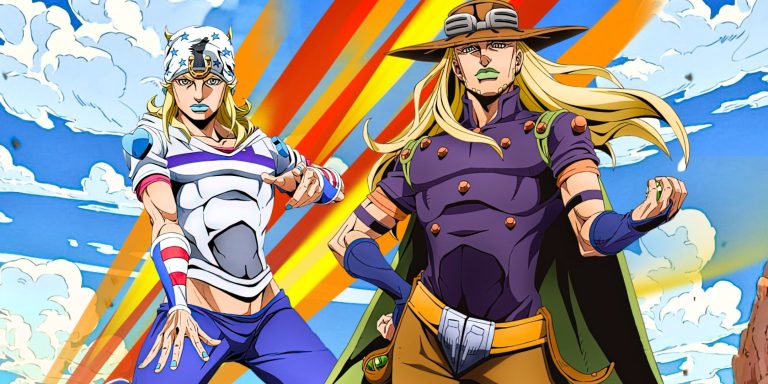
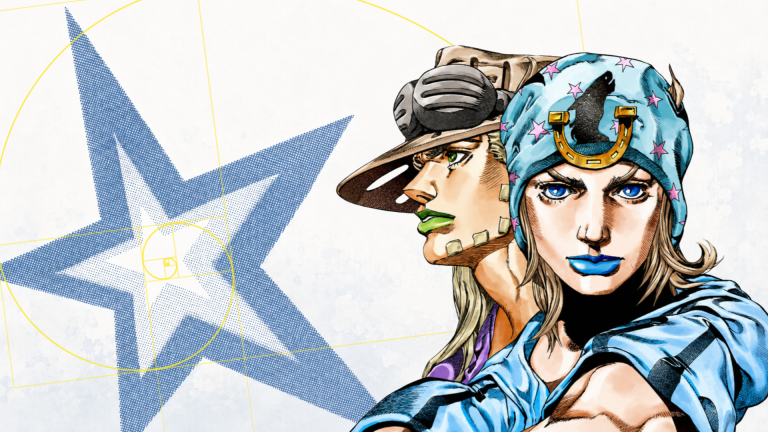
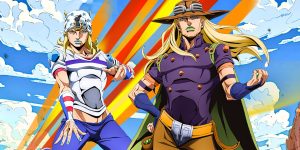
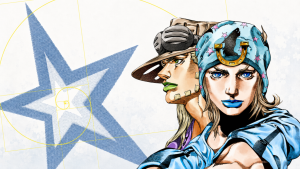
At the center of this sun-scorched odyssey stands Johnny Joestar, perhaps the most psychologically complex protagonist in the franchise’s history. Far removed from Jonathan’s chivalric saintliness or Jotaro Kujo’s stoic invulnerability, Johnny begins the story as a fallen prodigy. An arrogant former jockey paralyzed from the waist down in a reckless, ego-driven altercation, he is bitter, unrepentant, and isolated. He does not embark on the Steel Ball Run to save the world; he rides because touching Gyro Zeppeli’s rotating steel spheres briefly caused his dormant legs to twitch with life.
Johnny’s evolution—materialized through his Stand, Tusk, which progressively evolves through distinct acts—is not a traditional hero’s journey of ascending to greatness. It is an excruciating, morally ambiguous struggle to claw his way out of the depths. Johnny’s driving motivation, famously defined as his desperation to move from “negative to zero,” gives Part 7 an introspective melancholy rarely matched in action fiction. When Johnny develops the “dark determination”—an unblinking, murderous resolve signified by the terrifying hollow light in his eyes—Araki presents an uncomfortably compelling subversion of the traditional JoJo moral code.
Gyro Zeppeli: Executioner Pride and the Physics of the Spin
Equally mesmerizing is Gyro Zeppeli, a disgraced royal executioner hailing from the Neapolitan Kingdom whose caustic wit, gold-plated grill, and quirky running gags mask an existential burden. Gyro is the ideological and mechanical anchor of Part 7, introducing the Spin: an ancient, mathematically derived technique based on the golden ratio and the Fibonacci sequence. Where Hamon harnessed the respiratory rhythm of biological life, the Spin weaponizes the intrinsic geometry of the universe itself.
The chemistry between Johnny and Gyro represents the absolute peak of Araki’s dual-protagonist storytelling. Their fireside conversations, ridiculous puns, and shared traumas forge a deep, unbreakable camaraderie that serves as the tender emotional core amid the relentless, bloody chaos of their continental trek. Their relationship is not built on master-and-disciple platitudes, but on two broken men pushing each other past their psychological frontiers.
The Elephant—or Stallion—in the Room: David Production’s Equestrian Hurdle
The conversation surrounding a Steel Ball Run anime cannot proceed without confronting the monumental technical hurdle that has haunted production committees for years: the horses. In the animation industry, horses are notoriously recognized as the ultimate trial by fire. A quadruped’s anatomical movement—the complex shifting of muscular planes, dynamic weight distribution during a gallop, and the intricate articulation of hooves and hocks—demands an astronomical amount of labor that pushes traditional 2D production pipelines to the brink of collapse.
Multiply this challenge by dozens of steeds thundering in tandem across wide plains, dynamic camera sweeps, dust clouds, and Araki’s notoriously dense, cross-hatched linework. David Production, despite their exceptional track record of stylized color shifts, kinetic typography, and unwavering faithfulness to the source material, faces a logistical gauntlet. A purely hand-drawn approach across 40 to 50 episodes is economically and physically improbable in the modern television animation ecosystem.
Consequently, insiders and fans anticipate an ambitious hybrid model. The studio may look toward cutting-edge cel-shaded 3DCG assets for long-distance pack shots and rapid-motion gallops—similar to the hybrid models successfully implemented in modern spectacles like Chainsaw Man or Kingdom—while reserving painstakingly handcrafted 2D frames for close-ups, emotional confrontations, and Stand clashes. If David Production can marry state-of-the-art rigging with their signature hyper-saturated aesthetic, they will set a new technological benchmark for the medium.
Corpse Parts, Manifest Destiny, and Political Metaphysics
No discussion of Part 7 is complete without analyzing its audacious central conflict: the retrieval of the mummified Holy Corpse. As Johnny and Gyro cross the wilderness, the race transforms into a covert scavenger hunt for relics that bestow transcendent Stand abilities. Enter Funny Valentine, the 23rd President of the United States, an antagonist whose charismatic patriotism and philosophical doctrine of “taking the first napkin” redefine what a villain can be.
Armed with Dirty Deeds Done Dirt Cheap (D4C)—a Stand capable of shifting through infinite parallel dimensions—Valentine does not operate out of megalomania, but out of an unyielding, dangerously messianic belief in American exceptionalism. The dynamic between Valentine’s noble yet catastrophic imperialist vision and Johnny’s fiercely selfish search for personal redemption elevates Steel Ball Run into an exquisite thematic meditation on power, sacrifice, and the moral cost of ambition.
The Verdict: An Inevitable Horizon
While David Production has kept official production timelines close to the chest—diverting recent manpower to projects like Undead Unluck and the continuous expansion of the broader JoJo multimedia ecosystem—the arrival of Steel Ball Run is fundamentally a question of when, not if. The cultural demand is undeniable, the source material is a certified masterclass, and the prestige of pulling off such an adaptation would immortalize the studio in the annals of anime history.
The path forward is treacherous, paved with hyper-complex equestrian rigs, intense pacing demands, and massive expectations. Yet, as Gyro Zeppeli famously imparted, the shortest route is not always the detour; sometimes, the detour is the fastest path. Whenever the starter gun finally fires for this transcontinental tour de force, the medium of anime will never be the same.
What are your thoughts on David Production adapting Steel Ball Run? Can 3DCG horses live up to Araki’s breathtaking manga art, or should the studio take all the time it needs? Drop your theories and dream casting choices in the comments below!