
Ever since the melancholic, bittersweet chords of Duffy’s “Distant Dreamer” faded over the final frame of Stone Ocean in late 2022, a palpable, electric tension has gripped the global anime community. The multi-generational Joestar bloodline, stretching from Victorian England to the sun-bleached concrete of Green Dolphin Street Prison, had achieved its cosmic thematic terminus. Yet, for millions of devoted fans across Reddit threads, Japanese message boards, and social media feeds, the end of Part 6 was never truly the end. It was merely the prologue to the promised land: JoJo’s Bizarre Adventure: Steel Ball Run.
Regarded universally by critics and the fandom as mangaka Hirohiko Araki’s undisputed magnum opus, Steel Ball Run (Part 7) sits atop MyAnimeList’s all-time highest-rated manga rankings for good reason. It is not merely another evolutionary step for the franchise; it is a profound reinvention. As rumors swirl regarding David Production’s next production cycle and internal slate, the whispers surrounding the anime adaptation of Steel Ball Run have reached a cultural fever pitch. To adapt Part 7 is not simply to greenlight another season—it is to tackle one of the most mechanically demanding, emotionally mature, and aesthetically transcendent sagas in modern sequential art.
A Clean Slate on the Frontier: Araki’s Seinen Metamorphosis
To understand the immense buzz surrounding Steel Ball Run, one must grasp its unique publishing pedigree. Serialized initially in Weekly Shonen Jump in 2004 before migrating to the monthly seinen magazine Ultra Jump in 2005, Part 7 freed Araki from the grueling weekly deadlines and thematic constraints of traditional shonen storytelling. The result was a dramatic shift in pacing, moral complexity, and anatomical realism.
Set in a completely separate, alternate-timeline continuity in 1890, Steel Ball Run chronicles an audacious, coast-to-coast equestrian race spanning 6,000 kilometers from San Diego Beach to New York City. With a grand prize of fifty million dollars dangling on the horizon, the marathon brings together outlaws, aristocrats, assassins, and prodigies under the sprawling, dust-choked banner of the American frontier. But beneath the spectacle orchestrated by race promoter Steven Steel lies a far darker, supernatural geopolitical conspiracy: the race route is meticulously plotted to uncover the scattered, sacred mummified remnants of the Holy Corpse.
From Punch-Ghosts to Kinematics: The Rebirth of Combat
While Stands do return, Steel Ball Run pivots from the raw punch-ghost skirmishes of Stardust Crusaders toward a nuanced fusion of historical weapon combat, elemental powers, and a brand-new metaphysical science known as The Spin. Rooted in the biological and physical properties of the Golden Ratio (Fibonacci Sequence), this ancient Neapolitan technique channels kinetic rotational energy into deadly, reality-bending trajectories. This thematic evolution gave Araki room to explore dynamic, outdoor skirmishes where terrain, momentum, wind resistance, and geometry matter just as much as supernatural manifestations.
The Anatomy of a Partnership: Johnny Joestar and Gyro Zeppeli
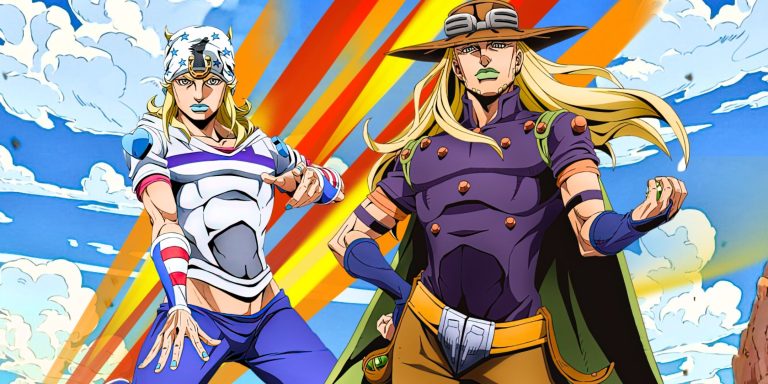
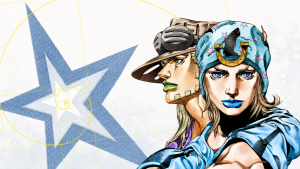
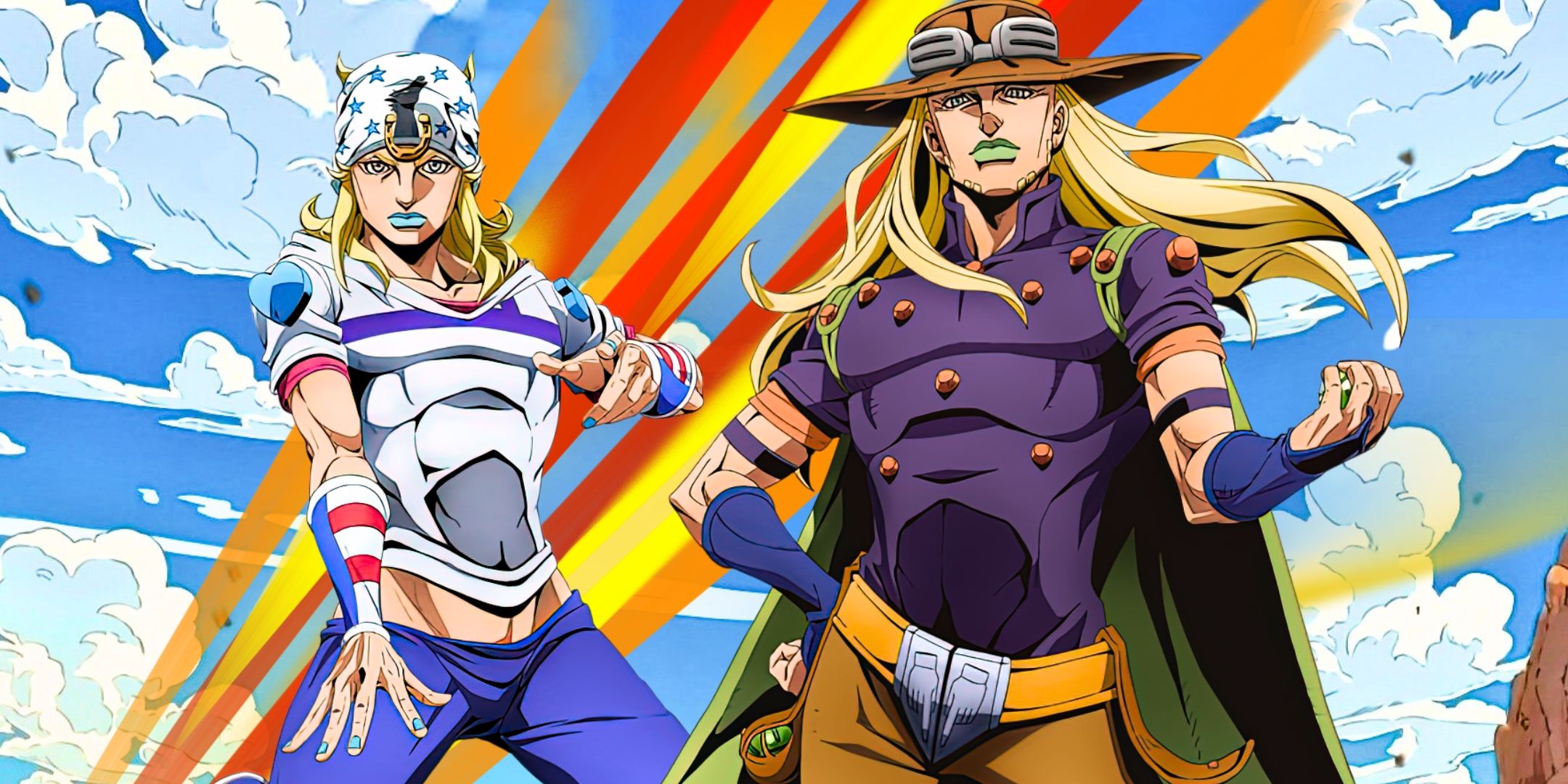
At the beating heart of Part 7’s critical acclaim is the profound, psychologically layered camaraderie between its dual leads: Johnny Joestar and Gyro Zeppeli. Their dynamic represents perhaps the finest character writing of Araki’s forty-year career, trading the bombastic heroism of previous protagonists for raw, human frailty.
Johnny Joestar is unlike any JoJo who came before him. A former prodigy jockey whose meteoric career collapsed when an act of sheer arrogance left him paraplegic, Johnny begins the story as a bitter, cynical shell of a man. He lacks the pristine righteousness of Jonathan or the suave confidence of Joseph. Instead, Araki imbues Johnny with what characters within the text refer to as “dark determination”—an unrelenting, sometimes terrifying willingness to sacrifice anything, including his own moral soul, to reclaim the sensation of standing on his own two feet. Johnny’s Stand, Tusk, mirrors this agonizing psychological evolution, literally metamorphosing through sequential “Acts” as he claws his way from psychological ruin to spiritual maturity.
Contrasting Johnny’s brooding desperation is Gyro Zeppeli, a disgraced executioner from the Kingdom of Naples whose eccentricities—from his customized grill spelling out “GO! GO! ZEPPELI” to his utterly terrible running jokes—mask a noble heart. Gyro enters the grueling trans-American race solely to secure amnesty for a condemned, innocent child back home. Gyro becomes Johnny’s mentor, brother, and philosophical compass, guiding him through the mysteries of the Spin. The slow-burn evolution of their mutual trust against the backdrop of campfire musings and lethal ambushes provides Steel Ball Run with an emotional gravity that an anime adaptation must capture with utter perfection.
The Technical Crucible: David Production’s Equestrian Nightmare
If the narrative potential of Steel Ball Run is limitless, its production reality is terrifying. Within the anime industry, there is an unspoken axiom: animating horses is hell. A quadrupede’s shifting musculature, complex skeletal gait, and kinetic interaction with changing terrain present an unforgiving challenge even for veteran key animators. In Steel Ball Run, characters do not simply ride horses; they duel on them at sixty miles per hour, perform acrobatic mounted gunfights, and drift through rugged mountain paths.
For David Production—the studio that has lovingly shepherded JoJo from its 2012 beginnings through Stone Ocean—adapting Part 7 represents an existential technical hurdle. Pure 2D hand-drawn animation for dozens of galloping steeds across thirty-plus episodes would burn out entire cohorts of animators and inflate budgets to historic proportions. Consequently, industry observers widely anticipate a sophisticated hybrid approach: utilizing stylized, highly rendered 3D CGI models for the horses—akin to the boundary-pushing work seen in modern studio showcases—layered beneath meticulously hand-drawn 2D rider animation, dynamic visual effects, and Araki’s iconic, cross-hatched aesthetic.
Moreover, the transition to wider open-world cinematography demands a distinct visual language. Where Diamond is Unbreakable thrived on claustrophobic suburban pop-art and Golden Wind dazzled with high-fashion renaissance flair, Steel Ball Run requires sweeping, widescreen cinematic vistas reminiscent of Sergio Leone spaghetti westerns, drenched in sun-bleached ambers, sepia horizons, and abrupt, saturated color shifts during moments of lethal Stand awakenings.
The Ideological Duel: The True Man’s World and Funny Valentine
Beyond its leads, Steel Ball Run boasts what is arguably the most compelling rogues’ gallery in modern manga. The narrative is punctuated by philosophical inflection points, none more iconic than the confrontation with gunslinger Ringo Roadagain, whose six-second time-rewinding Stand, Mandom, forces characters to confront the existential threshold of entering the “True Man’s World.”
Standing at the pinnacle of this gauntlet is Funny Valentine, the 23rd President of the United States and one of fiction’s most terrifyingly charismatic antagonists. Wielding the multidimensional Stand D4C (Dirty Deeds Done Dirt Cheap), Valentine is driven by an unyielding, fanatical patriotism. He believes that by securing the Holy Corpse, America will forever hold the “first napkin,” projecting all misfortune onto foreign shores while claiming eternal prosperity for his homeland. The ideological collision between Valentine’s utilitarian statecraft and Johnny Joestar’s hyper-individualistic pursuit of personal redemption elevates Steel Ball Run from a gripping race into an epic, subversive deconstruction of manifest destiny.
The Horizon Awaits
The anticipation surrounding a Steel Ball Run anime is more than just standard sequel excitement; it is the collective yearning to see a landmark work of Japanese graphic literature finally brought to kinetic life. David Production undeniably has a mountainous task ahead. Between the equestrian physics, the sweeping frontier scale, and the dense philosophical underpinnings of the Spin, Part 7 will push the studio to its absolute creative and technical limits.
Yet, if their decade-long stewardship of Araki’s universe has proven anything, it is that David Production possesses the rare, unyielding passion required to make the impossible bizarre. When the crack of Steven Steel’s starting pistol finally sounds in animated form, it will not just be the start of another anime season—it will be a historic cultural milestone for the entire medium.
What are your biggest hopes for the JoJo Part 7 anime adaptation? Do you want to see a hybrid 2D/3D approach for the horses, or should the studio take their time to hand-draw the race? Let us know your dream voice casting for Gyro and Johnny in the comments below!