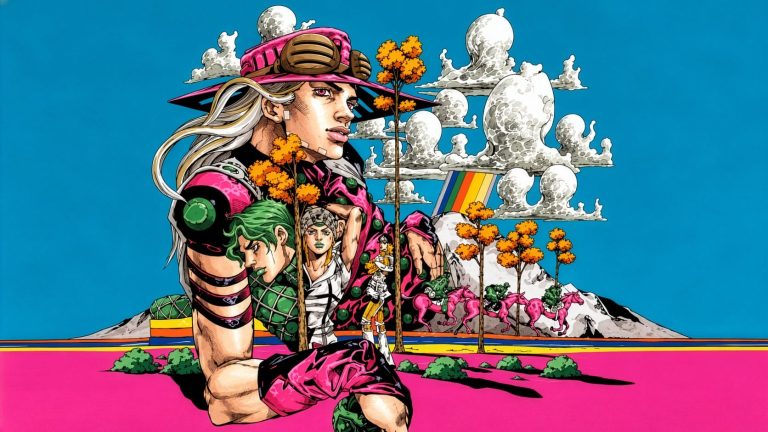
Ever since the melancholic, bittersweet chords of “Distant Dreamer” faded out at the climax of Stone Ocean, the international anime community has found itself locked in a state of suspended animation. The conclusion of Jolyne Cujoh’s tragic yet defiant battle against Enrico Pucci officially closed the book on the foundational Joestar bloodline saga that began back in 1987. Yet for seasoned manga aficionados and casual viewers alike, that ending was never truly a full stop—it was merely a breathless prelude to the true summit of Hirohiko Araki’s creative life: Steel Ball Run.
Consistently locked in fierce combat with the likes of Kentaro Miura’s Berserk and Takehiko Inoue’s Vagabond for the highest-rated manga spots on MyAnimeList, JoJo’s Bizarre Adventure: Steel Ball Run (Part 7) is not merely another installment in a legendary franchise. It is Araki’s undisputed magnum opus. As rumors, cryptic animator tweets, and production whispers circulate through the halls of David Production, the hype surrounding this western epic has transitioned from hopeful fantasy to an urgent cultural event. Here at Wibux.com, we are peeling back the dust, the sweat, and the supernatural grit to examine what an anime adaptation of Part 7 entails, why it presents the greatest technical challenge in modern anime history, and how Johnny Joestar and Gyro Zeppeli are primed to reshape the medium once again.
The Trans-American Odyssey: Araki’s Shift from Shonen Tropes to Seinen Mastery
To understand the immense buzz surrounding Steel Ball Run, one must first recognize the structural metamorphosis the series underwent in the mid-2000s. Originally serialized in Weekly Shonen Jump before migrating to the monthly, mature-leaning pages of Ultra Jump in 2005, Part 7 freed Araki from the grueling weekly deadlines and the creative shackles of adolescent action manga. The result was a dramatic pivot in tone: darker, more philosophical, and unburdened by standard hero-villain binaries.
Set in an alternate-history 1890, the narrative chronicles the titular Steel Ball Run—an audacious, coast-to-coast, 6,000-kilometer horseback race originating on the sun-bleached beaches of San Diego and terminating in the urban sprawl of New York City. With a staggering $50 million grand prize on the line, the cross-country rally draws eccentric outlaws, indigenous warriors, grizzled mercenaries, and international royalty. Yet beneath the veneer of raw Americana and athletic endeavor lies a terrifying occult conspiracy: the race’s path is an orchestrated search for the mummified, scattered fragments of the Saint’s Corpse, holy relics imbued with miraculous reality-warping power.
Araki replaces the globetrotting vacation aesthetics of Stardust Crusaders and the localized mystery of Diamond is Unbreakable with an unforgiving, sun-drenched frontier survival epic. Here, natural elements like hypothermia, dehydration, and treacherous topography are just as lethal as enemy Stand users.
Johnny Joestar and Gyro Zeppeli: Character Psychology at its Absolute Peak
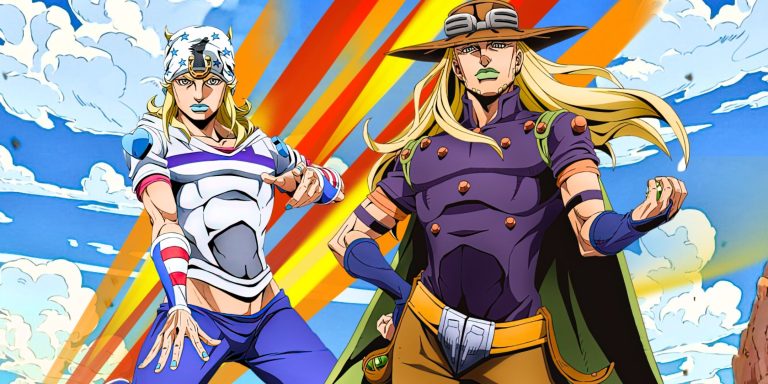
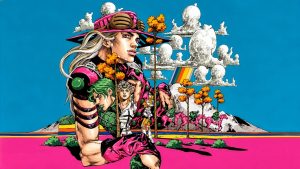
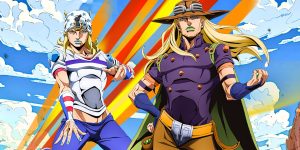
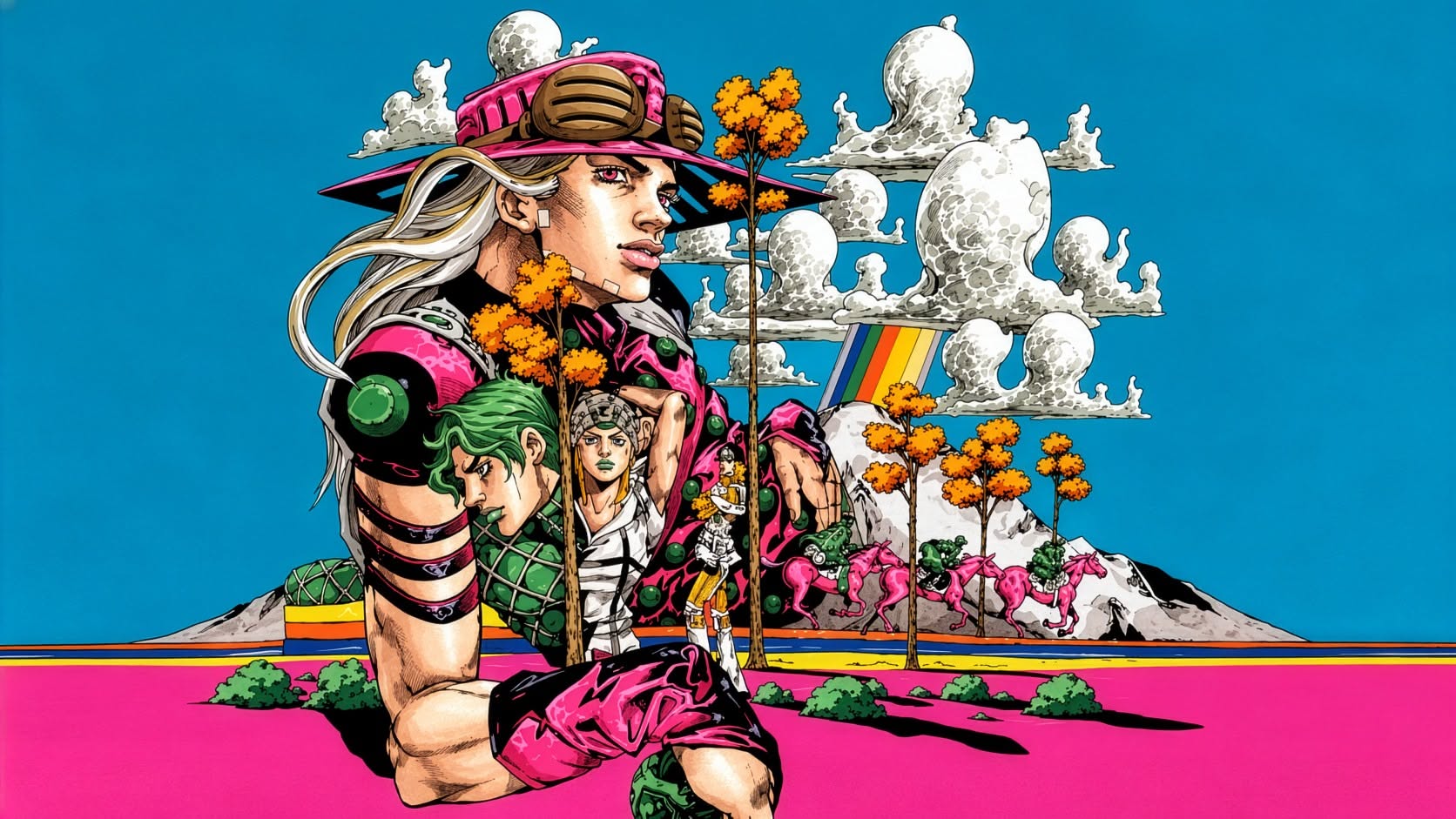
At the center of this bloodstained expedition is arguably the finest dual-protagonist dynamic in modern sequential art. In subverting Jonathan Joestar’s saintly, chivalric archetypes from Part 1, Araki gifts us with Johnny Joestar: an embittered, paraplegic former horse-racing prodigy whose hubris cost him his family, his fame, and his ability to walk. Johnny is not embarking on this transcontinental journey to save the world, rescue a damsel, or claim political vengeance. His motivations are raw, selfish, and desperate. He simply wants to reclaim his humanity—to get back to “zero” from “negative.”
The Complex Anatomy of a Flawed Hero
Unlike the stoic Jotaro or the rebellious Josuke, Johnny possesses what characters throughout the narrative recognize as “the dark determination”—an unsettling, predatory gaze signaling that he will kill without hesitation if it brings him closer to spiritual or physical restoration. His Stand, Tusk, mirrors this harrowing personal evolution, morphing through distinct “Acts” as Johnny moves through denial, trauma, and eventual transcendence.
Gyro Zeppeli and the Philosophy of the Spin
Serving as Johnny’s mentor, foil, and soulmate in arms is Gyro Zeppeli, a disgraced executioner and physician hailing from the Kingdom of Naples. Concealed behind gold-plated teeth and an irrepressibly goofy sense of humor (the legendary “Pizza Mozzarella” gag remains a fan-favorite milestone) lies a man crushed by the impossible moral weight of his family’s trade. Gyro enters the race to win sovereign amnesty for an innocent child condemned to death back home.
Crucially, Gyro does not rely on a traditional Stand for the majority of the journey. Instead, he wields The Spin (Kaiten), a centuries-old rotational technique that weaponizes the mathematical perfection of the Golden Ratio. By channeling the divine geometry of nature through spherical steel balls, the Spin acts as a brilliant spiritual successor to the Ripple (Hamon) from Parts 1 and 2, grounding the supernatural action in kinetic physics, spatial manipulation, and visual spectacle.
The Elephant in the Stable: David Production’s Equestrian Technical Nightmare
If the narrative acclaim of Steel Ball Run is universally recognized, why haven’t we seen a full-fledged anime reveal trailer yet? The answer lies within the stable. In the animation industry, there is an infamous, universally dreaded axiom: animating horses is suicide.
Drawing a four-legged creature in continuous, anatomically accurate, high-speed gallop across changing environments is notoriously labor-intensive. In a typical action anime, horses are featured sparingly in short, static bursts or obscured by camera angles. In Steel Ball Run, horses are not accessories; they are central characters that engage in physical battles, drift around mountain curves, charge across river valleys, and exhibit complex musculoskeletal movement in nearly every single chapter.
David Production, the studio that has helmed every modern iteration of JoJo since 2012, is renowned for its hyper-stylized 2D key animation, onomatopoeic visual kanji, and neon-drenched palatte shifts. However, a traditional hand-drawn pipeline for hundreds of race sequences across a rumored 36-to-48 episode run would break almost any modern studio’s schedule. The burning question among production analysts is whether David Production will leverage high-end, cel-shaded 3DCG (similar to their magnificent work on the Orange-produced models in modern industry standards, or MAPPA’s approach to complex vehicles) blended with 2D close-ups, or if they have spent the last few years quietly engineering a proprietary hybrid workflow to honor Araki’s intricately crosshatched aesthetic.
The Ideological Crucible: Funny Valentine and Cosmic American Ambition
No discussion of Part 7 is complete without addressing its overarching antagonist, the 23rd President of the United States: Funny Valentine. Boasting an absolute, unwavering belief in American exceptionalism, Valentine seeks the Saint’s Corpse not out of tyrannical pettiness, but to make his country the undisputed beacon of the world, deflecting all global misfortune onto neighboring nations.
Armed with Dirty Deeds Done Dirt Cheap (D4C)—a dimension-hopping Stand capable of traversing parallel realities by sandwiching objects between two surfaces—Valentine serves as a terrifying thematic mirror to Johnny. His famous “First Napkin” monologue is a chilling masterclass in political pragmatism and social philosophy. When Johnny’s ruthless, individualized micro-ambition finally clashes with Valentine’s grandiose, utilitarian macro-patriotism, Steel Ball Run ascends beyond high-octane shonen brawls and transforms into an extraordinary ideological war.
Verdict: The Horizon Awaits
The transition into the alternate continuity of Steel Ball Run represents David Production’s greatest gamble, but also its most monumental opportunity. If handled with the reverence, stylistic audacity, and technical innovation that the studio brought to Golden Wind and Stardust Crusaders, this adaptation will not simply dominate social discourse—it has the potential to stand as one of the definitive achievements of anime in the modern era.
The race has not yet officially been called to the starting line, but the track is being cleared, the crowd is deafening, and the golden rectangle beckons. Prepare your horses.
What do you think will be David Production’s biggest obstacle in adapting Part 7? Do you think the horse races should be full 2D or stylized 3DCG? Drop your thoughts, voice-actor dream casts, and favorite Spin moments in the comments below!