

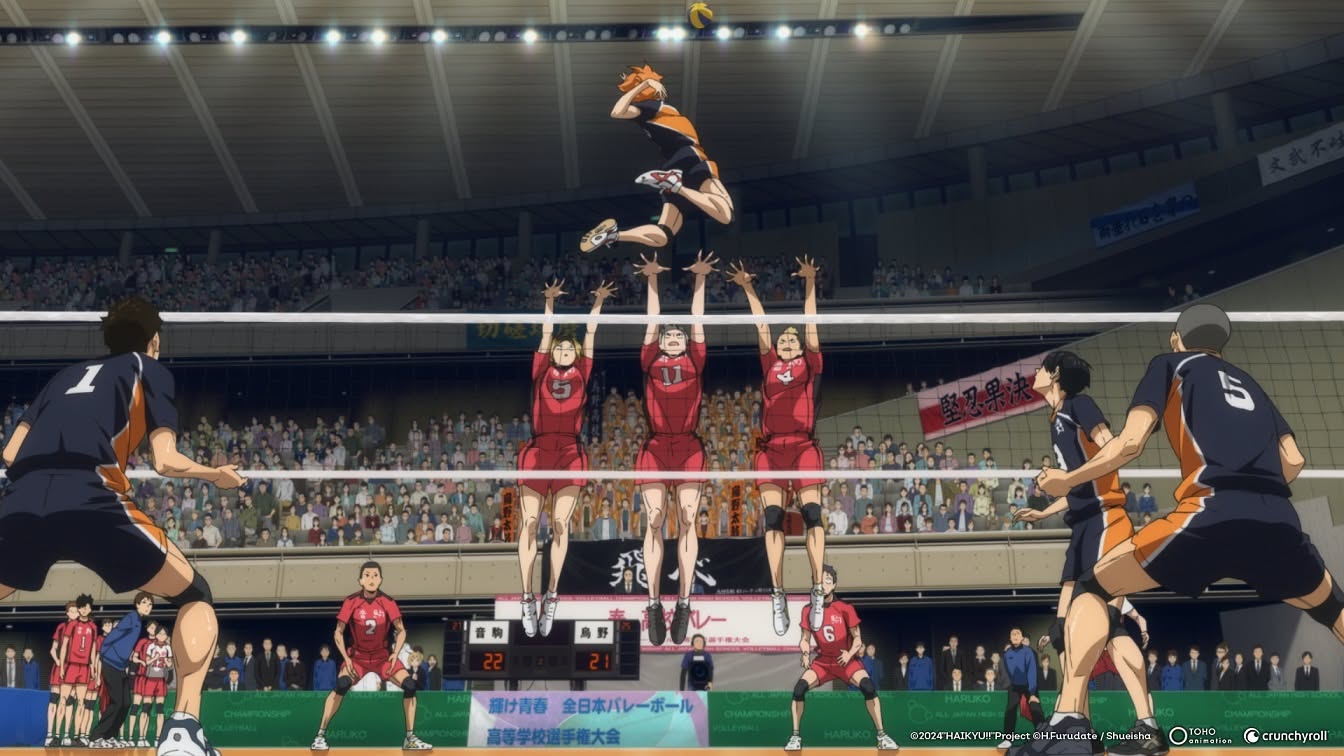
When Haruichi Furudate first pitted Karasuno High against Nekoma High in the sunlit, dusty gymnasiums of Tokyo’s summer training camps, fans were introduced to an ancient narrative archetype: the ravenous crows of Miyagi versus the calculating cats of Tokyo. Yet, when Haikyu!! The Dumpster Battle (Gomi Suteba no Kessen) shattered box office records in Japan with an astronomical 11.5 billion yen haul before marching through global theaters, it proved this was never just another tournament round. Now that the cinematic event has officially arrived on global streaming platforms, couch-bound fans worldwide can finally bear witness to what theatrical audiences celebrated: an unrelenting, eighty-five-minute distillation of athletic euphoria, tactical claustrophobia, and profound emotional closure. This is not merely a high-octane sports film; it is the gold standard of contemporary athletic storytelling.
The Promise of the Dumpster: A Rivalry Forged in Respect, Not Rancor
Sports anime has historically drawn its narrative fuel from resentment, personal grudges, or seemingly insurmountable walls of hubris. Karasuno’s road to the Spring Tournament followed this exact traditional cadence: Aoba Johsai was an exercise in exorcising middle-school trauma against Toru Oikawa, Shiratorizawa was an ideological war against Wakatoshi Ushijima’s sheer brute force, and Inarizaki was a trial by fire against the chaotic swagger of the Miya twins.
Nekoma, however, inhabits an entirely different emotional landscape. The legendary “Battle at the Garbage Dump” does not stem from animosity, but from an inherited, multi-generational promise between former head coaches Ikkei Ukai and Yasufumi Nekomata. For decades, the two programs met exclusively in unofficial practice matches, forever dreaming of colliding on the grandest stage in Japanese high school athletics: the orange court of the Spring Tournament (Harukou). When the first referee whistle echoes through the Tokyo Metropolitan Gymnasium, there are no villain arcs and no cheap antagonism. It is a collision between two teams that understand each other down to their physiological limits. The beauty of the match lies in its terrifying finality—unlike practice games where a coach can simply demand “one more set,” this is a single-elimination reality where one team’s high school journey permanently ends.
The Tactical Chess Match: Suffocating the Sun
At the center of the film’s tactical engine is the psychological tug-of-war between Karasuno’s irrepressible decoy, Shoyo Hinata, and Nekoma’s cerebral setter, Kenma Kozume. Where Hinata represents pure kinetic instinct and infectious enthusiasm, Kenma navigates volleyball through the cold, detached calculus of an RPG strategist searching for an opponent’s exploit.
The Birdcage: Kenma’s Algorithmic Trap
Kenma’s game plan against Karasuno is deviously subtle. Instead of trying to out-jump or out-hit Hinata’s supernatural quick attacks, Nekoma constructs an invisible prison. By methodically directing serves and spikes to pin Hinata deep on defense, Kenma strips away his takeoff runway. Without forward momentum, Karasuno’s high-flying spiker is effectively grounded, neutering the terrifying speed of his sync attacks with Tobio Kageyama.
The brilliance of Furudate’s writing—and director Susumu Mitsunaka’s visual staging—is how suffocating this tactical trap feels. Viewers watch Hinata’s wide-eyed panic as Nekoma’s floor defense absorbs Karasuno’s best offensive bullets. Morisuke Yaku, Tetsurou Kuroo, and Nobuyuki Kai turn the back row into quicksand. But Haikyu!! refuses to let this trap devolve into tragedy; it becomes the exact crucible required for Hinata’s next leap. When Hinata finally breaks the cage—not by sprinting faster, but by slowing down, adjusting his tempo, and leaping high into the rafters off an “Open” toss—it delivers an emotional and technical payoff that stands among the most triumphant moments in modern shonen.
Production I.G’s Kinetic Masterclass: Directing Sweat, Speed, and Perspective
Initial community discourse voiced legitimate concern over adapting the entirety of this fabled showdown into an 85-minute feature rather than a full television cour. However, Production I.G answered those fears by delivering technical direction that could only thrive within a dedicated cinematic canvas. Susumu Mitsunaka, returning to the director’s chair after stepping aside during Season 4’s visually contested To the Top, restores the hyper-dynamic line work, elastic kineticism, and visceral impact frames that defined the series’ golden era.
The film’s crowning technical achievement arrives during its climactic final rally, delivered almost entirely through Kenma Kozume’s first-person POV. The camera wobbles with dizzying, sweat-streaked realism. Long-time composers Yuki Hayashi and Asami Tachibana make the audacious choice to drop the musical score entirely, leaving the soundscape dominated by the sharp squeak of court sneakers, the frantic panting of dehydrated lungs, and the heavy, rhythmic thud of a leather ball that refuses to die. Through Kenma’s blurring vision, we are no longer passive observers in the bleachers; we are dragged directly into the asphyxiating physical toll of elite volleyball. The final ball slipping from Kenma’s sweat-soaked palms is not an anti-climax—it is a stroke of narrative and cinematic genius.
“It Was Fun”: The Emotional Metamorphosis of Kenma and Kuroo
Behind the tactical warfare and dazzling spikes, The Dumpster Battle is fundamentally an ode to friendship anchored by Nekoma’s captain, Tetsurou Kuroo. Kuroo is the unsung catalyst of the entire series. He is the boy who gently pulled a reclusive, video-game-obsessed Kenma out of his shell and handed him a volleyball; he is also the mentor who spent late nights at training camps refining the blocking instincts of Karasuno’s Kei Tsukishima.
Kuroo effectively helped sharpen the very blades that ultimately carve Nekoma out of the tournament. When Karasuno secures the final point and an exhausted Kenma lies flat on the hardwood, turning to Kuroo to utter the quiet confession—“Kuroo, thank you for teaching me volleyball. It was fun”—the emotional core of the film crystallizes. For a character who spent four seasons treating the sport as an exhausting chore, acknowledging that it was “fun” is a seismic breakthrough. Kuroo masking his tears behind his iconic black fringe captures what makes Haikyu!! truly transcendent: victory is fleeting, but the shared crucible of youth is indelible.
The Gold Standard of Modern Sports Anime
In a modern anime landscape saturated with world-ending stakes, reality-bending curses, and multiversal warfare, Haikyu!! The Dumpster Battle proves that the human heart requires none of those embellishments to forge edge-of-your-seat drama. The entire tension of the world hinges solely on keeping a twelve-ounce ball off the ground, yet the emotional resonance dwarfs almost every supernatural finale in recent memory.
Its debut on global streaming services cements this duel as a timeless classic. It honors every single player on the floor, proving that rivalries do not need malice to burn with an all-consuming flame. As Karasuno moves forward to face Kamomedai, the crow and cat have shared their ultimate match—and sports anime has never looked better.
Now that The Dumpster Battle is streaming worldwide, how did the showdown hold up to your expectations? Did Kenma’s dizzying POV finale leave you speechless, or do you still wish the match received a multi-episode TV cour? Drop your thoughts in the comments below!