

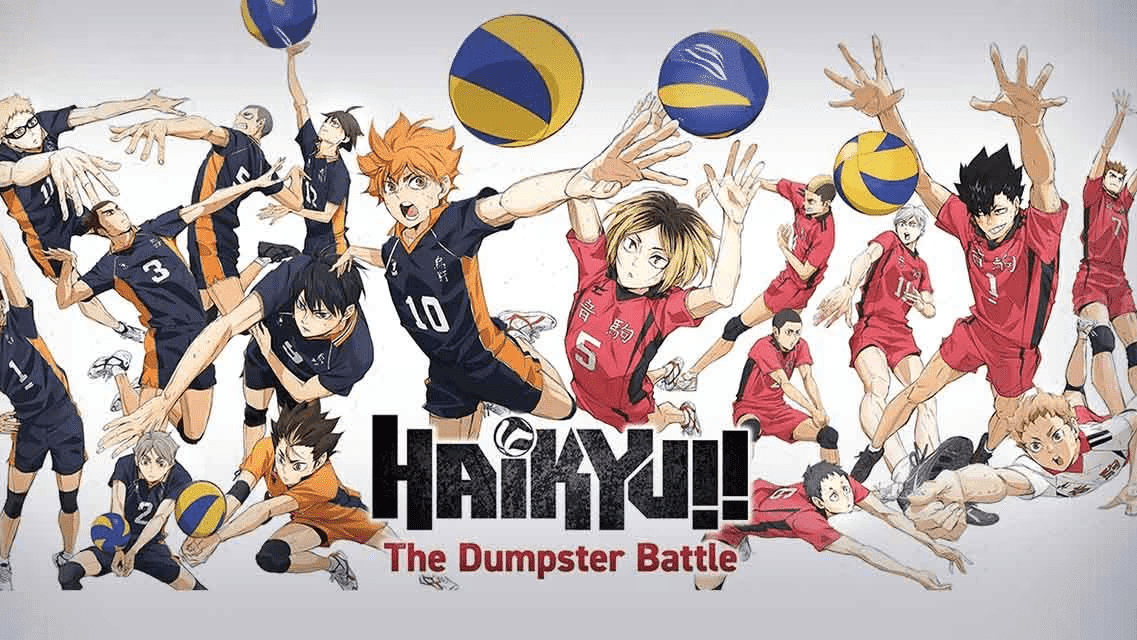
After conquering the Japanese box office with a staggering 11-billion-yen haul and captivating theatrical audiences across the globe, Haikyu!! The Dumpster Battle (Gekijōban Haikyu!! Gomi Suteba no Kessen) has finally arrived on global streaming services. For years, the anime adaptation of Haruichi Furudate’s magnum opus built toward this singular flashpoint: the official tournament clash between Karasuno High and Nekoma High. It is a rivalry forged not in animosity or bitter grudge, but across decades of mutual reverence, inherited promises, and shared sweat. Clocking in at a breathless, tightly wound 85 minutes, the film is more than just a box-office phenomenon—it represents the absolute zenith of sports anime storytelling.
By bringing this long-awaited “Garbage Dump Showdown” into living rooms worldwide, the film provides an accessible masterclass in how kinetic direction, rich character psychology, and genuine thematic maturity can elevate a high school volleyball match into an existential drama. In an era where sports anime often leans toward supernatural theatrics or hyper-individualistic cynicism, The Dumpster Battle proves that the purest distillation of athletic competition lies in human connection.
The Inherited Ghost Match: Lore, Legacy, and Single Elimination
To understand why this specific matchup carries such colossal emotional weight, one must look at the foundation laid across four television seasons. The rivalry between Karasuno’s Crows and Nekoma’s Cats did not begin with Shoyo Hinata and Kenma Kozume; it began decades prior with their elderly mentors, Ikkei Ukai and Yasufumi Nekomata. Throughout their youth and coaching careers, the two tacticians staged countless practice games, yet fate repeatedly denied them the ultimate prize: a face-off on the national stage, where defeat means instant elimination.
Every practice match in Tokyo training camps served as a prologue to this single hour on the court. Furudate’s narrative brilliance lies in contrasting Karasuno’s untamed, vertical aggression with Nekoma’s suffocating, cerebral floor defense. Karasuno represents flight—a chaotic, multi-pronged flock that attacks from every conceivable angle. Nekoma is the floor—a flexible, interconnected organism dedicated to keeping the ball in the air until the opponent self-destructs under the weight of their own impatience.
When the whistle finally blows at the Spring Interhigh, the stakes are painfully absolute. This is no longer a friendly scrimmage where coaches can call a do-over or switch rotations. For the third-years—Daichi, Sugawara, Asahi, Kuroo, Yaku, and Kai—this is the end of the line. The tension is palpably suffocating, not because someone might lose a battle, but because someone’s childhood is about to conclude.
The Gamer vs. The Beast: Kenma Kozume’s Algorithmic Birdcage
At the center of this narrative hurricane sits the psychological tug-of-war between Karasuno’s middle blocker Shoyo Hinata and Nekoma’s setter Kenma Kozume. Kenma has always been a fascinating anomaly in shonen sports media. He lacks physical stamina, despises sweating, and approaches volleyball not as a blazing passion, but as a tedious strategy RPG requiring careful resource management. Hinata, conversely, is pure athletic exuberance—an untamed force of nature whose joy is infectious.
Clipping the Wings: The Tactical Stranglehold
The film treats Kenma’s defensive scheming like a terrifying psychological thriller. Rather than trying to out-jump Hinata, Kenma methodically deconstructs his movement patterns. By manipulating serve placements and narrowing Karasuno’s offensive lanes, Kenma executes an algorithmic masterclass designed to “clip the bird’s wings.” Hinata is systematically starved of his runway, forced into awkward approach angles, and denied the very sensation that defines his identity: the freedom of full flight.
The visual metaphor of a literal birdcage descending over Hinata highlights director Susumu Mitsunaka’s uncanny ability to externalize interior monologue. We watch Hinata’s boundless energy transform into suffocating claustrophobia. It is a terrifying display of how analytical intellect can paralyze raw, intuitive genius.
The Open Spike: Shattering the Ceiling
Yet, true to Haikyu!!’s ethos, true brilliance does not emerge in spite of pressure, but because of it. Hinata’s response to Kenma’s cage is not a desperate, frantic scramble, but a moment of sublime evolution. Guided by Tobio Kageyama’s audacious setting and the fundamentals taught to him throughout his journey, Hinata executes a high, looping approach—a four-step run-up that takes him above Kenma’s calculations. The cage does not merely bend; it explodes. The dynamic between them evolves past a tactical feud into an exchange of gifts: Hinata provides Kenma with an exhilarating challenge he cannot predict, and Kenma forces Hinata to fundamentally reinvent how he leaps.
Directorial Kinesis: Susumu Mitsunaka and Production I.G’s Peak Form
From an animation standpoint, The Dumpster Battle serves as a triumphant vindication of Production I.G’s technical supremacy. After the mixed visual reception to certain outsourced episodes in Season 4 (To the Top), the return of veteran series director Susumu Mitsunaka injects the franchise with unprecedented theatrical pedigree. The layout work, supervised key animation, and camera dynamics are executed with fluid, breathless intensity.
The absolute crown jewel of the film’s visual sequencing is the climatic match-point rally, executed from Kenma’s first-person perspective. The camera locks behind his exhausted, sweat-streaked eyes. We hear the labored, rasping inhalation of his breath; we feel the disorienting weight of his rubber sneakers sliding across hardwood; we see the ball blur as sweat stings his vision. The camera whips erratically between Kuroo’s desperate dive, Kageyama’s predatory gaze across the net, and the descending Mikasa ball.
By shifting to an unvarnished POV, Production I.G strips away the glamorous abstraction of sports and grounds the audience in the visceral, brutal physical reality of an extended rally. It is an astonishing feat of cinematic empathy that reminds us just how excruciating—and exhilarating—elite competition truly is.
Subverting the Shonen Rivalry: The Catharsis of “That Was Fun”
What firmly elevates The Dumpster Battle into sports anime perfection is its profound subversion of athletic rivalry. In modern media dominated by the dog-eat-dog ethos of works like Blue Lock, where rivals must actively devour and crush each other to validate their existence, Haikyu!! champions radical kindness and mutual elevation.
Nekoma captain Tetsurou Kuroo spent his high school years actively teaching Karasuno’s players how to defeat him. He mentored Kei Tsukishima during the Tokyo training camp, imparting the nuances of read-blocking that Tsukishima now uses to shut down Nekoma’s own hitters. There is no jealousy in this realization; there is only pride. Kuroo cultivated his own executioners because he loved the game too much to see it played poorly.
This emotional philosophy culminates in the film’s quietest, most devastating moment. The final point does not conclude on an earth-shattering spike or an impossible defensive save; it ends on an unforced error, the ball slipping out of Kenma’s sweat-soaked palms due to sheer bodily exhaustion. In the stunned silence that follows, Kenma—the boy who never cared, who found volleyball annoying, who only played out of routine—looks up at Kuroo through a curtain of drenched hair and simply says:
“Kuroo… thank you for teaching me volleyball. It was fun.”
With those four words, the entire franchise shifts. The decades-long contest between two schools concludes not with a roar of dominance, but with a confession of gratitude. Kenma didn’t beat the game; the game finally caught up to his heart.
The Verdict: An Unrepeatable Triumph of the Medium
Now streaming globally, Haikyu!! The Dumpster Battle cements its status as a landmark event in contemporary anime. It is a rare adaptation that justifies its theatrical runtime by cutting away filler and zeroing in on the emotional nervous system of its cast. While some fans may mourn the minor manga moments sacrificed at the altar of pacing, the resulting film is an airtight, visually breathtaking celebration of youth, sport, and mutual respect.
Whether you are a longtime Karasuno faithful revisiting this match for the tenth time or an anime enthusiast diving into its streaming premiere, The Dumpster Battle will leave you breathless, tearful, and aching to step onto a court. It is the pinnacle of Furudate’s world—and proof that when rivals push each other to the brink, everyone walks away victorious.
Over to you, Wibux readers: Did Kenma’s POV sequence leave you as emotionally shattered as it left us? How do you think Production I.G should handle the upcoming battle against Kamomedai? Drop your thoughts, hot takes, and favorite moments in the comments below!