
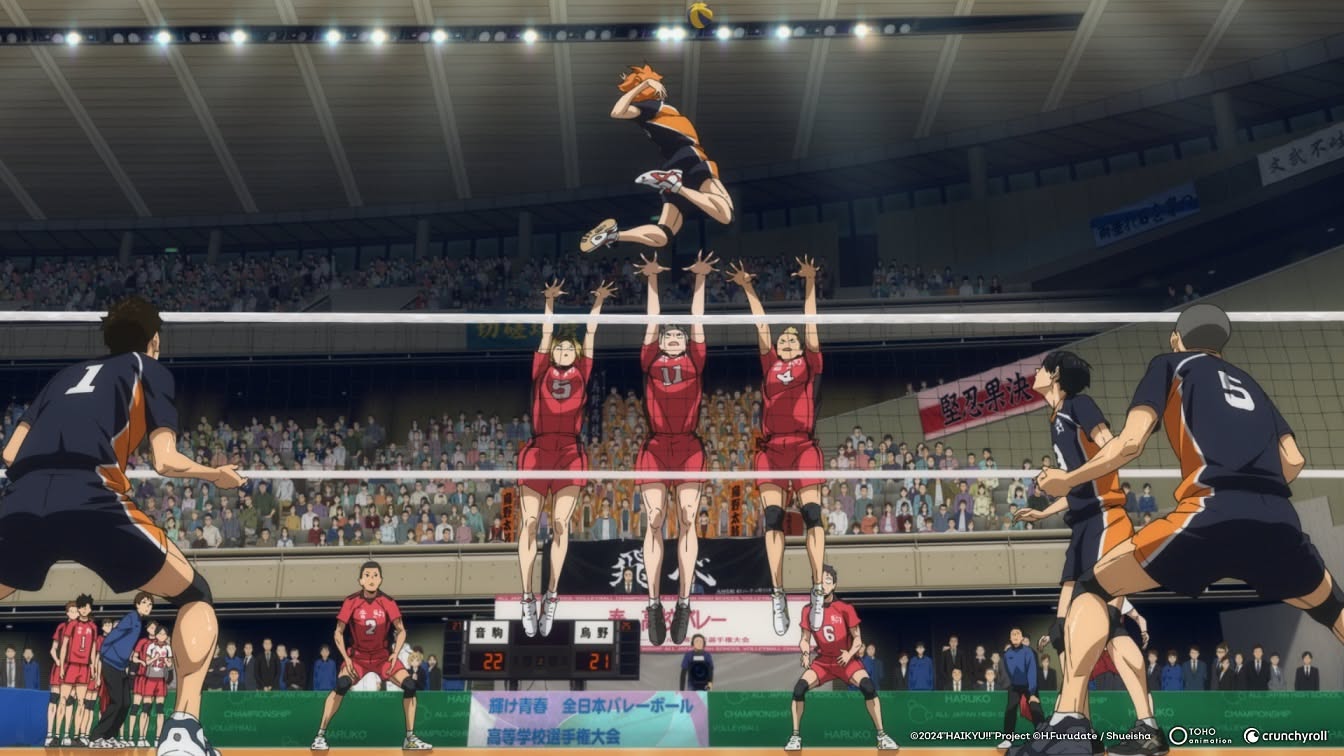
Few matchups in modern anime carry the generational weight, emotional nuance, and sheer athletic majesty of Karasuno High versus Nekoma High. When manga author Haruichi Furudate first planted the seeds of this rivalry—introducing the vintage, smoke-filled memories of former coaches Ikkei Ukai and Yasufumi Nekomata clashing on makeshift neighborhood courts—it sparked an inevitable destiny. For four television seasons, fans watched that promise hover over the Tokyo gymnasium like an unfulfilled vow. Now, following a thunderous theatrical run that grossed over 11 billion yen in Japan alone, Haikyu!! The Dumpster Battle has officially landed on global streaming platforms. Its digital arrival is more than just a win for international distribution; it marks a watershed moment for the sports genre at large.
Clocking in at an economical, relentless 85 minutes, the film bypasses the standard recap bloat to deliver pure, uninterrupted kinetic poetry. It answers a question fans have debated for nearly a decade: can a climactic tournament arc, stripped of malicious antagonism and life-or-death stakes, still feel like the most essential spectacle in contemporary animation? The answer is an emphatic, breathless yes.
The Generational Thread: Why This Rivalry Transcends Shonen Tropes
Most shonen sports epics rely heavily on ideological warfare or existential dread to manufacture tension. Series like Blue Lock lean into ruthless, hyper-individualistic egoism, while classics like Kuroko’s Basketball treat opposing aces as borderline supernatural demigods. *Haikyu!!* has always championed a more grounded ethos, but The Dumpster Battle elevates that groundedness into high art. Karasuno and Nekoma are not enemies; they are mirror reflections forged in the same developmental fire.
Dubbed the “Battle at the Garbage Dump” (Gomi Suteba no Kessen), this contest represents the scavengers—the flighted crows and the predatory cats—scraping for survival in the national underground. What makes their rivalry narrative perfection is the total absence of malice. Neither team desires the other’s destruction. Instead, their relationship is rooted in mutual elevation. Nekoma taught Karasuno how to defend; Karasuno forced Nekoma to evolve their offense. By the time both squads step onto the orange court of the Tokyo Metropolitan Gymnasium, the spectator realizes the true tragedy of the format: this match can only ever happen once. There are no practice rematches left. When the final whistle blows, the high school careers of their beloved third-years simply cease.
The Tactical Chess Match: Kenma Kozume’s Claustrophobic Cage
At the center of this cinematic storm sits the ideological duel between Karasuno’s boundless decoy, Shoyo Hinata, and Nekoma’s detached setter, Kenma Kozume. Where Hinata represents the untamable id of athletics—pure instinct, verticality, and infectious passion—Kenma is the ultimate gamer, analyzing life through stamina bars, processing power, and pathfinding mechanics.
Designing the Perfect Labyrinth
The first half of the film plays out like a psychological horror film disguised as a volleyball match. Kenma doesn’t try to out-jump Hinata; he systematically deletes his runway. Through pinpoint service placement and calculating defensive rotations, Nekoma forces Karasuno into uncomfortable passes, gradually pushing Hinata wider and deeper until his wings are pinned to his sides.
Director Susumu Mitsunaka visually frames this tactical stranglehold with striking metaphorical brilliance. A translucent, ghostly birdcage descends over Hinata as Kenma watches dispassionately from across the net. The visual shorthand is devastating: Hinata, whose entire identity is defined by open-sky flight, is trapped in a room with a low ceiling. The psychological tension suffocates the viewer, turning standard court-mapping into a masterclass in narrative tension.
The Breakthrough of the “Open” Set
Hinata’s salvation does not come through an awakening of raw power, but through trust and tactical maturation. When Tobio Kageyama recognizes that Hinata’s runway has been eliminated, he offers him the one thing Kenma didn’t account for: vertical patience. The high, looping “open” toss buys Hinata the fractions of a second needed to gather his momentum and leap into the light, shattering the metaphoric cage. It is a euphoric sequence that underlines the core appeal of Furudate’s writing—problems are solved not with magical power-ups, but with technical adjustments honed across hundreds of unseen hours in the gym.
Kinetic Visceralism: Production I.G’s Masterclass in Animation
When it was announced that the Karasuno vs. Nekoma showdown would be adapted into an 85-minute feature rather than a full television cour, portions of the fandom voiced immediate skepticism. Condensing over thirty manga chapters into a single film risked stripping away the secondary character beats that give *Haikyu!!* its soul. Yet, under the returning direction of Susumu Mitsunaka, Production I.G utilized the cinematic medium to unlock visual storytelling that episodic television simply could not accommodate.
The animation pedigree on display here rivals the very best action cinema of the decade. Rather than relying on static speed lines or looping impact frames, the animators treat the volleyball court as a three-dimensional ecosystem. The physics of the ball—its spin, the air resistance on float serves, the jarring deceleration when hitting a forearm platform—possess tangible physical weight. Character animator Takahiro Kishida’s fluid layouts allow the camera to whip between receives, dives, and transition runs with breathless continuity.
The POV Climax: The Reality of Exhaustion
The artistic zenith of the film arrives in its third set, featuring a continuous, first-person point-of-view sequence mapped entirely through Kenma Kozume’s eyes. It is, without exaggeration, one of the most audacious sequences in modern sports anime. The audience hears Kenma’s labored, shallow breathing; sweat stings the lens of our vision; the camera stumbles, shifts, and blurs as his stamina bar dips toward zero.
In this sequence, the glamour of shonen heroism evaporates, replaced by the punishing, hyper-focused reality of high-level athletics. Every receive hurts. Every step feels like running through wet cement. By forcing the viewer directly inside Kenma’s failing physiological engine, Production I.G transforms a routine rally into an agonizing, beautiful struggle for survival.
“It Was Fun”: Subverting the Climax for Emotional Truth
In an era where action cinema continually defaults to louder, more explosive crescendos, The Dumpster Battle makes a radically subversive choice: it ends on a whimper, and that whimper is devastatingly profound. Match point does not conclude with an earth-shattering spike or a miraculous block. The ball simply slips out of Kenma’s sweat-soaked palms. A mundane, unglamorous handling error finishes the most anticipated match in the franchise.
It is a creative decision that re-anchors the film in reality. High school sports do not care about cinematic timing; sometimes, you lose simply because your hands are wet and your body is spent. Yet, as the ball hits the hardwood and the whistle sounds, Kenma collapses onto his back, looks up at Tetsuro Kuroo—the childhood friend who dragged him into this world—and utters the words that bring Kuroo to silent tears: “Thank you for teaching me volleyball. It was fun.”
In that single line, Kenma’s entire character arc concludes. The boy who treated sports as a chore, who hated sweat and exertion, who played only to pass the time, finally found the thing that made him feel alive. The battle wasn’t won on the scoreboard; it was won in the conversion of a cynic into a believer.
The Benchmark for Sports Anime Moving Forward
With its arrival on global streaming, Haikyu!! The Dumpster Battle cements its place as the definitive sports anime film of the 2020s. It proves that emotional resonance does not require world-ending consequences—only genuine characters, mechanical honesty, and a creative team willing to push the boundaries of visual kineticism. As Karasuno now turns its eyes toward the impending quarter-final clash with Kamomedai, the bar has not merely been raised; it has been launched into the rafters.
Have you streamed the Dumpster Battle yet? Did the movie pacing do justice to the manga, or did you miss the weekly episodic tension? Sound off in the comments below, and stay locked to Wibux.com for all your deep-dive anime analysis!