

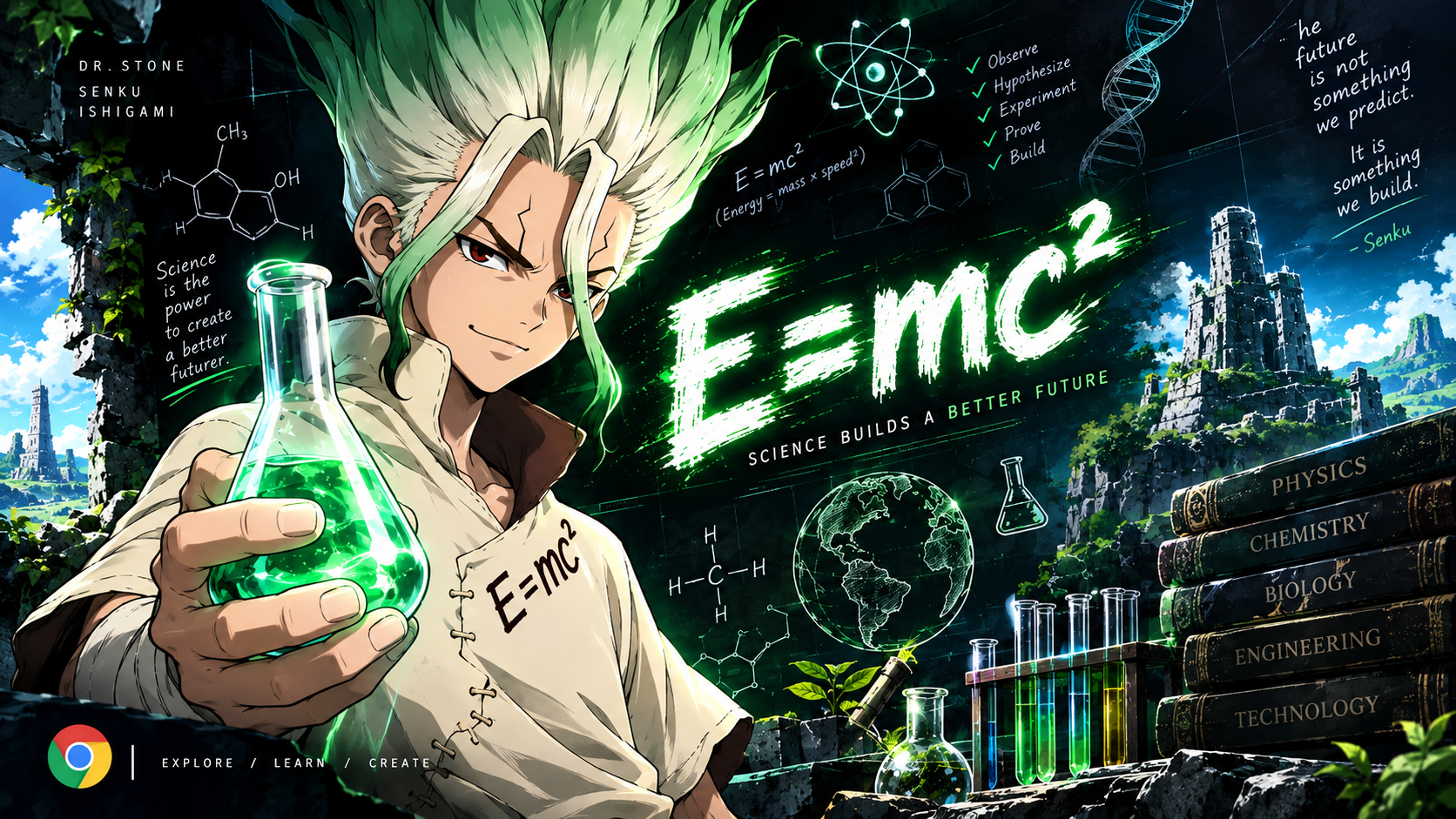
When Riichiro Inagaki and Boichi first introduced readers to Senku Ishigami methodically counting every single second across 3,700 years of petrification, few could have anticipated the staggering macro-evolutionary trajectory of Dr. STONE. What kicked off in 2017 as a primitive survivalist procedural in the overgrown ruins of Tokyo has systematically blossomed into one of the most intellectually intoxicating, deeply humanist epics in modern shonen history. Now, with the impending arrival of Dr. STONE: Science Future—the officially designated fourth and final anime season produced by TMS Entertainment—the Kingdom of Science stands on the precipice of its grandest logistical nightmare and philosophical zenith: breaching Earth’s atmosphere to confront the shadowy architect of humanity’s petrification directly on the lunar surface.
For three seasons and a television special, the narrative engine of Dr. STONE has relied on an intoxicating feedback loop: identify an insurmountable natural boundary, calculate the prerequisite steps, fail forward, and conquer it with cumulative human ingenuity. From crafting crude iron tools and sulfa drugs to crossing the Pacific Ocean aboard the Perseus, the series has celebrated the blood, sweat, and calculus of civilization-building. But Science Future shifts the stakes entirely. This is no longer merely about carving out a comfortable habitat in the post-apocalyptic greenery; it is an audacious, Apollo-level offensive against an omnipresent existential dread known simply as Why-Man.
The Apollo Blueprint in the Stone World: Humanity’s Greatest Engineering Sprint
Adapting the final stretch of Riichiro Inagaki’s manga means charting an industrial escalation that dwarfs everything that came before. To build a moon-capable spacecraft from zero requires more than just clever chemistry—it demands a global economic network, computational power, synthetic materials, precision rocketry, and automated guidance systems. Where Season 3’s New World tackled maritime navigation and agricultural expansion, Science Future demands nothing less than an accelerated Industrial and Digital Revolution compressed into months.
From Metallurgy to Mathematics
Viewers who relish the series’ educational granularity are in for a masterclass in hyper-speed modernization. The Kingdom of Science must transition from analog crafting into the microscopic precision of the silicon age. We are set to witness the creation of primitive computers, advanced metallurgy capable of surviving atmospheric reentry, and rocketry test runs that mirror the agonizing, fiery trial-and-error of early NASA and Soviet space programs. Inagaki’s writing never trivializes the sheer lethality of rocket science; the anime will undoubtedly preserve the terrifying reality that one miscalculated Newton of thrust or a microscopic structural flaw means instant vaporization in the upper atmosphere.
Decoding Why-Man: The Cosmic Ghost in the Machine
At the center of this cosmic campaign lies the singular mystery that has haunted the franchise since the radio waves crackled to life during the Treasure Island arc: Why-Man. The chilling, automated voice mimicking Senku’s cadence over Morse code frequencies—broadcasting the solitary word “WHY” on repeat—remains one of the most effective tonal shifts in contemporary anime, abruptly re-framing a vibrant adventure yarn into an eerie hard-sci-fi psychological thriller.
Unlike previous ideological adversaries such as Tsukasa Shishio or Ibara, Why-Man cannot be reasoned with through diplomatic overtures or overpowered with dynamic martial arts. Why-Man operates from the absolute coldness of deep space, wielding the petrification beam (the Medusa device) as both a global guillotine and an incomprehensible evolutionary paradox. The narrative brilliance of this final showdown lies in its subversion of traditional battle tropes:
- The Nature of the Petrification: Is the Medusa a biological weapon manufactured by malevolent extraterrestrial entities, a doomsday failsafe from a forgotten terrestrial cabal, or an autonomous technology operating on corrupted survival logic?
- The Philosophical Conflict: Why-Man represents the absolute negation of human momentum—stagnation disguised as eternal preservation. Senku, conversely, embodies humanity’s chaotic, self-destructive, yet fundamentally beautiful impulse to explore, question, and progress.
TMS Entertainment’s Final Stand: Animating Boichi’s Hyper-Detailed Canvas
From a production perspective, TMS Entertainment faces its most formidable logistical gauntlet to date. The latter half of the Dr. STONE manga features some of the most intricate, hyper-rendered, two-page mechanical spreads ever put to ink by legendary artist Boichi. Replicating the microscopic circuitry of Stone World computers, the atmospheric beauty of space exploration, and the staggering weight of a Saturn V-equivalent launch demands a leap in compositing, CG vehicle integration, and dynamic lighting.
Director Shuhei Matsushita, who previously guided Ryusui and New World, understands the audio-visual rhythm required to make technical infodumps hit with the emotional velocity of a classic shonen brawl. The musical direction from Tatsuya Kato, Hiroaki Tsutsumi, and Yuki Kanesaka must now elevate beyond jaunty folk melodies and energetic brass into atmospheric, cosmic orchestration. Capturing the sensory silence of the lunar vacuum, contrasted against the rhythmic, kinetic roar of a chemical rocket ignition, will be the decisive benchmark determining whether Science Future secures a permanent place in the anime pantheon.
The Triumvirate of Spacefarers: Psychological Dynamics on the Launchpad
A mission to the Moon under Stone World constraints affords zero luxury for redundancy. Every gram of payload must be ruthlessly accounted for, leading to the selection of a three-person crew that serves as a profound encapsulation of humanity’s core archetypes: the intellect, the instincts, and the sheer physical fortitude.
The character dynamic driving the launchpad sequence represents the emotional harvest of the entire franchise. Senku’s calculated calm masks an unbearable historical pressure; he does not merely fly for himself, but as the living avatar of millions of years of human thinkers, mathematicians, and dreamers who perished during the long petrification. Alongside him, the navigation mastery and boundless greed of Ryusui Nanami—a man who unironically demands the Moon simply because it exists—provides the fuel of ambition. Anchoring them is the unmatched martial defense of Tsukasa Shishio, completing an extraordinary narrative arc: the young man who once sought to cleanse the world of technological civilization now puts his life on the line in a spacesuit to protect its ultimate triumph.
The Legacy of Riichiro Inagaki’s Anti-Nihilist Gospel
In an anime landscape frequently dominated by bleak dark fantasies, apocalyptic cynicism, and power-fantasy escapism, Dr. STONE has always dared to be aggressively, unapologetically optimistic. It is an anti-nihilist gospel that insists human beings are neither inherently evil nor doomed to self-destruction, but rather an astonishing species whose greatest super-power is cumulative collaboration.
Senku has never possessed magical lineage, cursed energy, or mystical prophecies. His strength lies entirely in the historical fact that when one person dies, their notes, blueprints, and ideas are inherited by the next. As the Kingdom of Science lights the engines of their spacecraft in Science Future, they are not escaping their broken world; they are claiming the birthright of every human who ever looked up at the night sky and wondered what lay beyond the dark.
The countdown to launch is ticking. What technological revelation or narrative twist are you anticipating most as Senku takes his “one small step” in Dr. STONE: Science Future? Sound off in the comments below, join the debate on our social channels, and keep your transceivers locked to Wibux.com for comprehensive weekly breakdowns when the final season touches down!