Ever since the bittersweet notes of “Distant Dreamer” drifted across the credits of Stone Ocean, a seismic rumble has echoed through the global anime zeitgeist. For over a decade, David Production has undertaken one of the most audacious, faithful adaptations in modern pop-culture history, transforming Hirohiko Araki’s multi-generational bloodline into an immortal anime phenomenon. Yet, for millions of readers who hold the sacred pages of the manga close to their chests, everything up to this point has felt like an elaborate prelude. The true Holy Grail, resting comfortably near the very summit of MyAnimeList’s all-time rankings, is JoJo’s Bizarre Adventure: Part 7 – Steel Ball Run. It is Araki’s undisputed magnum opus, a sweeping reinvention of his entire artistic universe, and currently the most heavily scrutinized prospective anime project in the industry.
Araki’s Magnum Opus: The Seinen Paradigm Shift
To understand the sheer weight of the buzz surrounding Steel Ball Run, one must appreciate the context of its creation. Serialized initially in 2004 within Weekly Shonen Jump before transitioning to the monthly Ultra Jump, Part 7 freed Hirohiko Araki from the grueling, breakneck release schedules and editorial constraints of mainstream shonen. The result was transformative. Steel Ball Run shed the cartoonish bravado of traditional battle manga, blossoming into a mature, gritty, and historically resonant American period piece set in 1890.
The premise is intoxicating: thousands of eclectic racers from around the globe assemble on the beaches of San Diego to race 6,000 kilometers across the North American continent to New York City for a staggering $50 million purse. But what begins as an eccentric transcontinental steeplechase rapidly devolves into a desperate, supernatural geopolitical conspiracy. Araki uses the panoramic majesty of Monument Valley, the harsh plains of the Midwest, and the claustrophobic alleys of late-19th-century Chicago as a canvas for themes of destiny, national ambition, and the visceral cost of personal salvation.
Johnny Joestar and Gyro Zeppeli: Flawed Anti-Heroes and the Sacred Bond
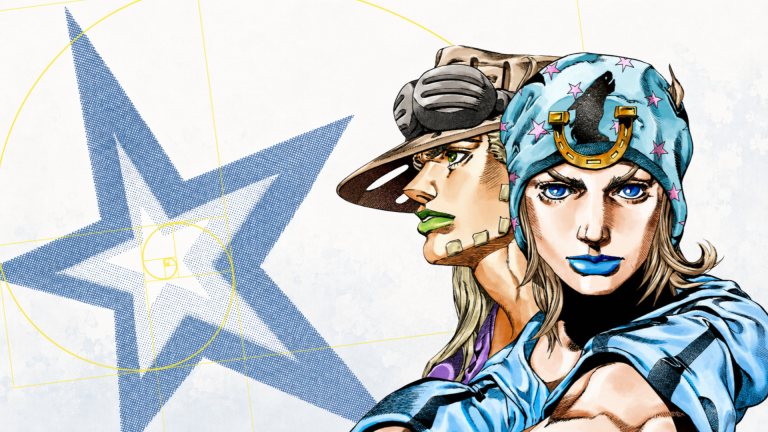
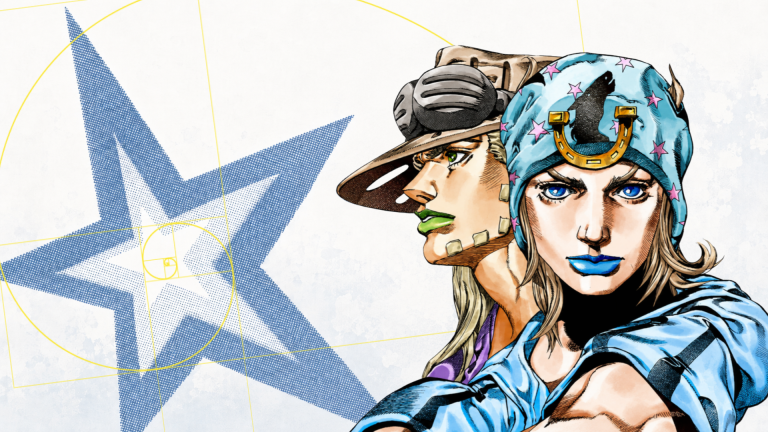
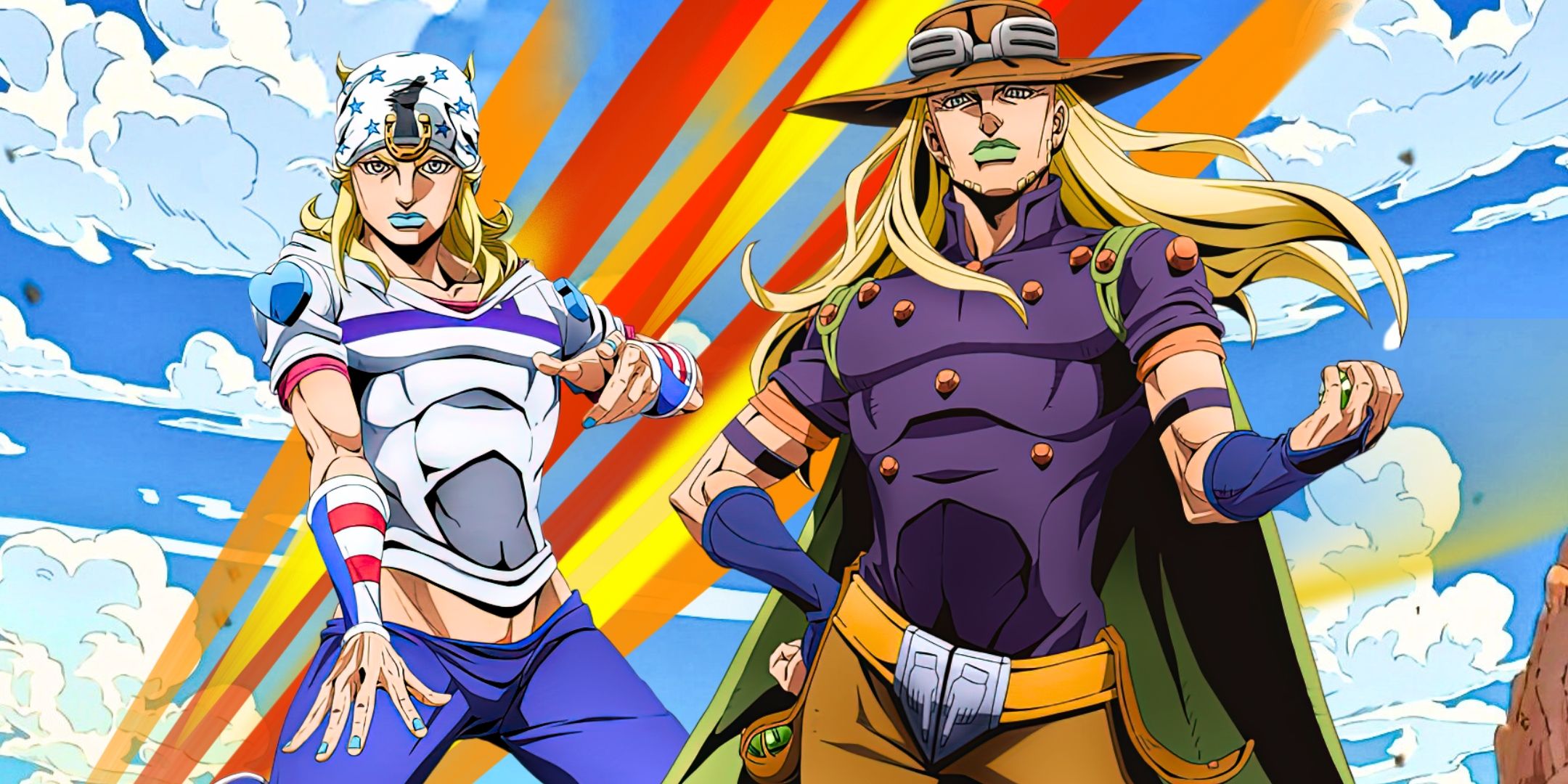
At the beating heart of this sprawling epic lies arguably the greatest duo in modern sequential art: Johnny Joestar and Gyro Zeppeli. Unlike the immaculate moral compass of Jonathan Joestar or the cool, calculating detachment of Jotaro Kujo, Johnny represents a radical departure for the lineage. Former jockey prodigy turned paraplegic through an act of sheer arrogance, Johnny is bitter, spiritually broken, and morally compromised. He is not driven by justice; he is a man desperately clawing to bring his life back from “negative” to “zero.”
The Anatomy of the Spin
Enter Gyro Zeppeli, a disgraced Neapolitan executioner wielding mystical, rotating steel spheres and flashing gold teeth engraved with “GO! GO! ZEPPELI.” Gyro introduces both Johnny and the audience to the Spin—an ancient, mathematical martial art rooted in the Fibonacci sequence and the ubiquitous Golden Ratio. While previous parts leaned heavily on punch-ghost Stands, the Spin re-grounds the narrative in tactile combat mechanics. The way the Spin interacts with Johnny’s evolving Stand, Tusk, shifting from nail-bullets to dimensional rifts, offers an escalating kinetic progression that animators will relish translating to the screen.
Their dynamic is not the standard shonen mentorship. It is an authentic, deeply moving partnership forged over campfire jokes about mozzarella cheese, existential crises, shared trauma, and unyielding loyalty. For David Production, capturing the subtle nuance of their psychological growth—balancing Gyro’s flamboyant eccentricity against Johnny’s cold, occasionally terrifying resolve—will be as crucial as any visual spectacle.
The David Production Dilemma: Overcoming the Equestrian Crucible
Why hasn’t the production committee immediately fired the starting pistol on an official Part 7 greenlight? The answer boils down to four hooves and the harsh realities of the anime industry. Animating horses is notoriously the single most difficult, resource-draining, and reviled task in hand-drawn animation. An authentic gallop demands an intricate understanding of skeletal motion, weight distribution, muscle deformation, and rapid foreshortening.
In Steel Ball Run, horses are not incidental background set dressing; they are primary characters. The race hinges on the psychology of the mounts—Johnny’s slow dance with his horse, Slow Dancer, and Gyro’s synergy with Valkyrie are foundational to their tactical battles. Historically, studios that attempt high-speed equestrian action either collapse under production bottlenecks or lean heavily on jarring, low-frame-rate CGI models that alienate purists.
If David Production takes the reins, they face their greatest technical Everest yet. To maintain the prestige of the franchise, the studio must pioneer a sophisticated hybrid pipeline, combining fluid 3D cel-shaded models for complex tracking shots with expressive, highly detailed 2D keyframes for crucial moments of impact. Fans are watching closely to see if DP takes a prolonged pre-production window—perhaps leveraging insights from their work on Urusei Yatsura and Fire Force—to ensure that the desert chases retain Araki’s raw, cross-hatched intensity without breaking the animators tasked with rendering thousands of galloping strides.
Patriotism, Relics, and the Menace of Funny Valentine
No discussion of Steel Ball Run can be complete without confronting its narrative centerpiece: the search for the scattered parts of the Saint’s Corpse, and the 23rd President of the United States, Funny Valentine. Valentine remains one of fiction’s most magnetic antagonists, a terrifyingly charismatic nationalist whose mantra—symbolized by his famous “first napkin” monologue—explores the terrifying consequences of utilitarian righteousness.
Valentine’s multidimensional Stand, Dirty Deeds Done Dirt Cheap (D4C), pushes the boundaries of JoJo’s trademark cerebral, high-stakes tactical chess. The thematic friction between Johnny’s selfish pursuit of personal healing and Valentine’s selfless, horrifyingly imperialist patriotism elevates Part 7 into high art. It forces the audience to interrogate the nature of righteousness: who is truly the hero when the villain fights for the collective glory of a nation, and the protagonist fights merely to stand on his own two feet again?
The Horizon Awaits: When Will the Starting Gun Fire?
The anticipation for Steel Ball Run is no longer quiet speculation; it is an omnipresent cultural hum. Industry insiders speculate that if an adaptation is in active development, an official announcement could surface during an anniversary milestone or major David Production showcase over the next year or two. The scale of the project demands patience. Unlike the urban confines of Morioh or the episodic prison corridors of Green Dolphin Street, Part 7 is a sun-drenched, dust-caked cinematic epic that requires unprecedented cinematic scope, an inspired Western-infused orchestral score, and top-tier voice casting.
When the dust finally settles in the desert and the starting bell tolls, the anime world will bear witness to a masterwork that completely redefines what a battle anime can achieve. The race of the century is lurking just beyond the horizon, and the anime landscape will never be the same once the first steel ball is spun.
How do you think David Production should handle the equestrian challenge of Steel Ball Run? Who is your dream voice cast for Johnny Joestar and Gyro Zeppeli? Drop your theories, favorite moments, and hopes in the comments below, and keep your browsers locked to Wibux.com for all breaking JoJo updates!