
Ever since the melancholic strains of “Distant Dreamer” faded over the rebooted horizon of Stone Ocean‘s finale in late 2022, a singular, deafening murmur has reverberated throughout the global anime community. The conclusion of Part 6 marked the definitive end of the original Joestar-Brando bloodline saga, neatly wrapping up over three decades of generational warfare. Yet, for veteran manga readers and animation purists alike, that cataclysmic ending was never viewed as a farewell. Instead, it was an overture to the true holy grail of modern sequential art: JoJo’s Bizarre Adventure: Steel Ball Run.
Widely considered author Hirohiko Araki’s magnum opus, Steel Ball Run regularly contests the topmost echelons of critical rankings on MyAnimeList and AniList, standing shoulder-to-shoulder with titans like Berserk and Vinland Saga. Now, as speculative teasers, trademark whispers, and industry murmurs converge around David Production, the anticipation has shifted from a tentative “if” to an agonizing “when.” Bringing Part 7 to life is not merely the continuation of a profitable franchise; it represents an unprecedented artistic frontier for David Production—a technical gauntlet involving hyper-complex kinetic physics, sprawling desert landscapes, and the infamous animator’s graveyard of equestrian choreography.
The Trans-American Odyssey: Why Part 7 Transcends Its Shonen Heritage
To understand why the buzz surrounding Steel Ball Run reaches near-mythic proportions, one must first recognize its unique publishing history. Serialized between 2004 and 2011, Part 7 initially began without the official “JoJo” monicker in Weekly Shonen Jump before migrating to the monthly seinen magazine Ultra Jump. This structural migration liberated Araki from the breakneck pacing and strict content guidelines of standard demographic publishing.
The result was a transformative recalibration of Araki’s creative voice. Steel Ball Run is set in an alternate 1890 America, chronicling a grueling, cross-country horse race stretching from the shores of San Diego to the avenues of New York City. With a grand prize of fifty million dollars on the line, the narrative initially masquerades as a historical sporting spectacle. However, it quickly metastasizes into a relentless supernatural conspiracy woven through the fabric of American frontier mythology, body horror, geopolitical intrigue, and the existential pursuit of personal salvation.
Johnny, Gyro, and the Geometry of Fate: A Flawed Brotherhood
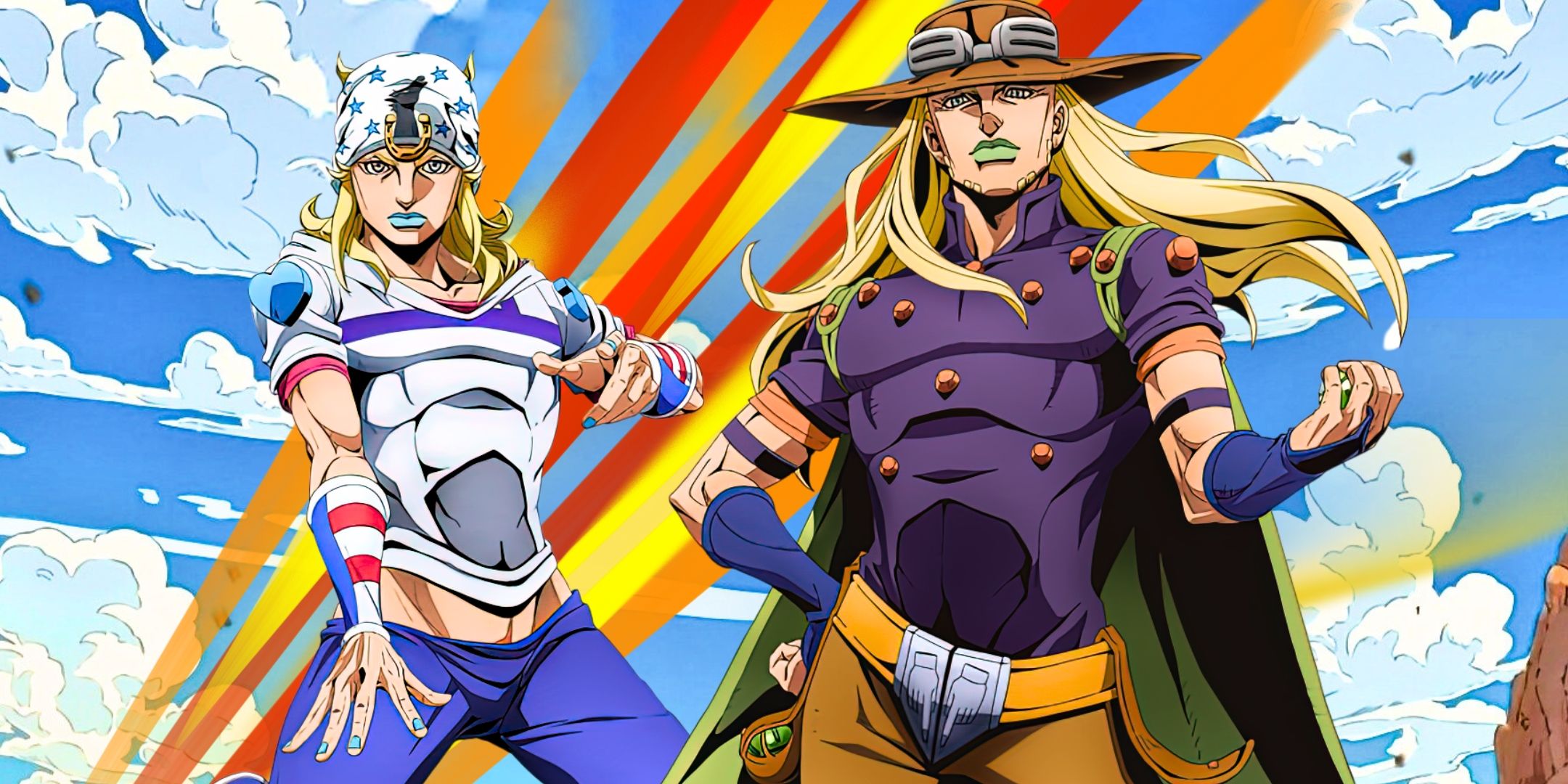
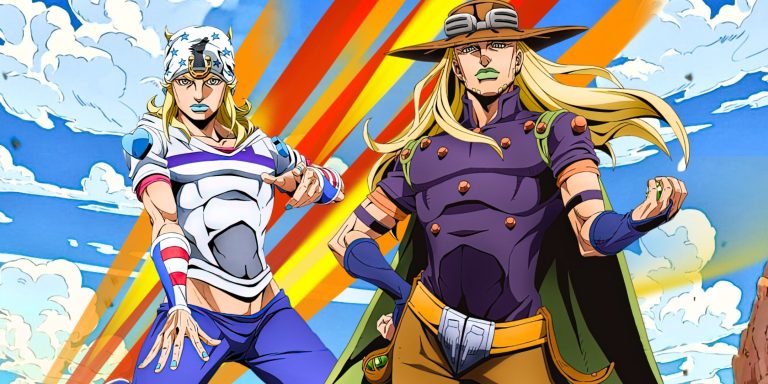
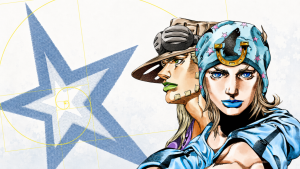
At the center of this 6,000-kilometer crucible lies what is unquestionably Araki’s most nuanced emotional partnership: Johnny Joestar and Gyro Zeppeli. Deviating dramatically from the stoic honor of Jonathan or the effortless swagger of Jotaro, Johnny Joestar is introduced as a broken, paraplegic former horse-racing prodigy whose career was ruined by his own hubris. Bitter, spiritually hollowed out, and stripped of dignity, Johnny’s initial motivations are completely devoid of altruism.
Enter Gyro Zeppeli, a disgraced Neapolitan executioner wielding mystical, rotating steel spheres and a grill inscribed with “GO! GO! ZEPPELI.” Gyro rides not for personal glory, but to secure amnesty for an innocent nine-year-old boy sentenced to death in his homeland. The dynamic that blossoms between them rejects typical shonen tropes of immediate camaraderie; it is a hard-won, often co-dependent journey of mutual spiritual resurrection. Araki bestows Johnny with what the fandom reverently terms “Dark Determination”—a terrifying, flame-eyed willingness to commit atrocities if it means achieving his personal “negative to zero” redemption.
The Spin vs. The Stand: Deconstructing the Golden Ratio
Narratively, Part 7 also marks the introduction of the Spin, an esoteric martial discipline that revitalizes the tactical ingenuity of early JoJo Hamon while intertwining seamlessly with Stands. Grounded in mathematical aesthetics, the Spin requires its users to locate the ubiquitous Golden Rectangle within nature to unleash infinite rotational energy.
Where previous parts relied heavily on punch-ghost skirmishes, Steel Ball Run transforms Stand battles into visceral, high-velocity tactical shootouts. Johnny’s evolution through the stages of his Stand, Tusk (from localized fingernail projectiles to dimensions-shattering, infinite gravitational anomalies), mirrors his internal psycho-spiritual progression. The technical execution of these concepts onscreen promises some of the most psychedelic and scientifically speculative visual sequences David Production has ever drafted.
The Equestrian Dilemma: Conquering the Animator’s Ultimate Trial
For all its narrative mastery, the primary obstacle standing between Steel Ball Run and an anime adaptation has always been physical reality: animating horses is notoriously one of the most punishing assignments in the medium. In 2D hand-drawn animation, the anatomy of a galloping equine—quadrupedal motion, shifting muscular bulk, mane physics, and foreshortening under dynamic camera angles—demands an obscene number of frames and virtuoso layout artists.
Consider the scale of the narrative: dozens of jockeys navigating rocky canyons, dense blizzards, and sun-baked plains at breakneck velocity, often while trading Stand fire. An uncompromised adaptation simply cannot rely on the budget-conscious shortcuts that occasionally emerged during Stone Ocean‘s more troubled production cycles. Industry analysts widely project that David Production will have to engineer an intricate hybrid visual pipeline, utilizing state-of-the-art 3D CGI cel-shading (akin to Orange’s work on Trigun Stampede or MAPPA’s equine sequences in Attack on Titan) augmented by meticulously illustrated 2D correction layers.
Securing the schedule, budgetary leverage, and directorial prowess capable of wrestling this logistical leviathan to the ground is precisely why the studio has taken a deliberate breather since Part 6. For David Production, Steel Ball Run is a legacy project; stumbling here would severely compromise their standing as the definitive custodians of Araki’s universe.
Manifest Destiny and Sacred Relics: Thematic Weight of the Corpse Parts
Beneath the thunder of hooves, Steel Ball Run stands tall because its ideological core is utterly uncompromising. The catalyst driving the race’s clandestine supernatural conflict is the quest to assemble the mummified remains of a Holy Corpse (heavily implied to be Jesus Christ), which bestow miraculous Stand abilities upon whoever claims them.
This premise brings the protagonists into direct collision with Funny Valentine, the 23rd President of the United States and arguably the greatest antagonist Araki has ever penned. Armed with the multiverse-hopping Stand Dirty Deeds Done Dirt Cheap (D4C), Valentine is not a cartoonish conqueror, but an unyielding, hyper-patriotic zealot convinced that concentrating the world’s divine fortune within American borders justifies any measure of suffering inflicted on the rest of humanity. The collision between Valentine’s twisted imperialist utilitarianism and Johnny Joestar’s deeply selfish, desperate struggle to walk again elevates the story beyond a supernatural western into a staggering philosophical critique of Manifest Destiny.
The Verdict: Anime’s Next Cultural Epoch Awaits
As industry rumors swirl around production calendars and pre-production rumors gather steam in Tokyo, the hype surrounding Steel Ball Run is no longer just localized fan yearning; it is an impending cultural event. The adaptation of Part 7 has the raw dramatic potential to do for historical supernatural thrillers what Attack on Titan did for dark fantasy, bridging the gap between niche anime discourse and prestige global television.
David Production stands at a momentous crossroad. If they can muster the technical discipline, time, and budgetary courage required to mount this gargantuan race across nineteenth-century America, they will not just deliver another successful season of JoJo—they will cement one of the crowning triumphs in modern animation history.
What do you think is the biggest hurdle for David Production in adapting Steel Ball Run—the equine animation, the pacing, or capturing Gyro’s unforgettable presence? Drop your thoughts in the comments below, and stay tuned to Wibux.com for breaking anime developments!
One thought on “JoJo’s Bizarre Adventure: Steel Ball Run Anime Buzz: Johnny Joestar, Gyro Zeppeli, and David Production’s Next Frontier”