When Satoru Nii’s Wind Breaker made its anime debut in the spring of 2024, it arrived under the looming shadow of modern delinquent titans. Pundits and casual viewers were quick to label it as merely another entry in the resurgent yankee subgenre—a clean-cut younger sibling to Tokyo Revengers or a nostalgic nod to classic street-brawling epics like Crows. Yet, within mere episodes, CloverWorks shattered those simplistic comparisons with bone-crunching choreography, vibrant character writing, and a radical thematic subversion: delinquents who fight not to dominate, but to protect. Furin High School wasn’t a den of nihilistic degenerates; it was the shield of Makochi Town, christened as the “Bofurin.”
With Wind Breaker Season 2 officially arriving, the stakes have escalated beyond neighborhood defense and intramural scuffles. The upcoming arc propels protagonist Haruka Sakura and the Bofurin guardians straight into the neon-drenched territory of the Roppo Ichiza, a rival faction that controls Makochi’s bustling entertainment and nightlife district. This new conflict threatens to rupture the delicate peace maintained by Furin’s charismatic leader, Hajime Umemiya, challenging Haruka Sakura’s nascent understanding of what it truly means to belong.
The Evolution of Haruka Sakura: From Stray Dog to Reluctant Pillar
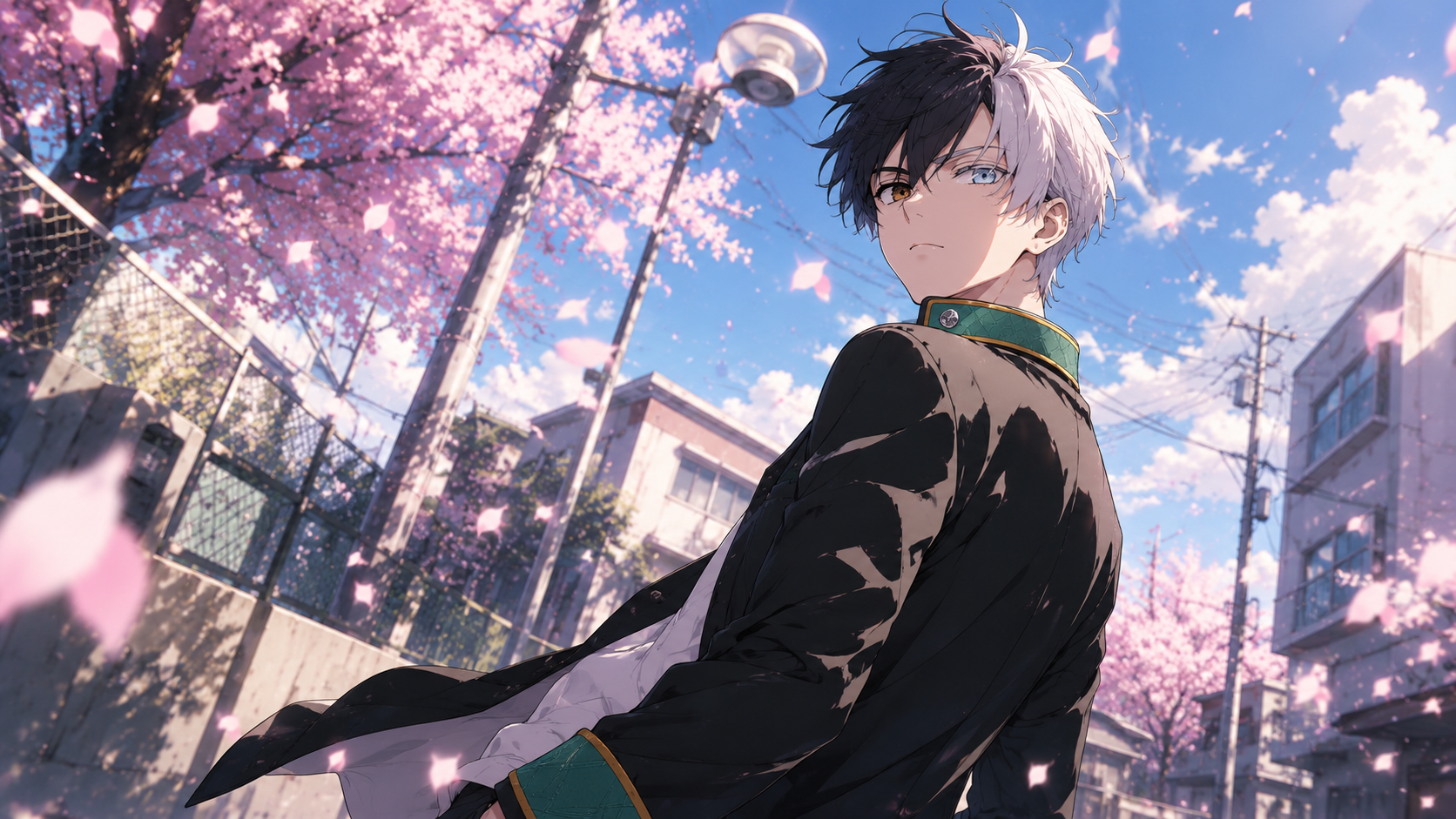
At the beating heart of Wind Breaker lies the psychological metamorphosis of Haruka Sakura. When audiences first met the split-haired protagonist, he was defined entirely by his trauma. Marked by his natural heterochromia and stark bi-colored hair, Sakura had endured a lifetime of ostracization, treated as an omen of bad luck and discarded as human garbage. His response was a defensive wall of absolute misanthropy: if the world deemed him a monster, he would become the strongest monster of all, clawing his way to the apex of Furin High purely through violence.
Season 1 dismantled that armor with breathtaking emotional precision. Instead of encountering a gladiatorial wasteland, Sakura walked into a town that showered him with vegetables, offered warm meals, and smiled in gratitude whenever he threw a punch. By the time he settled into his role as a first-year class captain alongside tactical savant Jo Suo and the devoted, information-gathering Akihiko Nirei, Sakura’s worldview had fractured. Fighting was no longer his only means of survival—it had become a language of connection.
The Weight of the Class Captain Badge
As Season 2 opens, Sakura grapples with an acute bout of imposter syndrome. He is a boy who knows how to survive an alleyway ambush with his fists up, but has zero vocabulary for reciprocal affection. Being crowned a leader by Umemiya and having peers who look to him for direction terrifies him far more than any blade or pipe ever could. When the Bofurin clash with the Roppo Ichiza, Sakura will not be fighting merely to preserve his own skin; he will be forced to carry the physical and emotional safety of those walking behind him.
Enter the Roppo Ichiza: Aesthetic Warfare in the Neon District
While the first season pitted Bofurin against the Shishitoren—a martial faction whose internal rot stemmed from an obsession with absolute strength—the Roppo Ichiza represents an entirely different sociological beast. Rooted in the glamorous, chaotic underbelly of Makochi’s theater and nightlife sector, this crew brings a theatrical, flamboyant flair to street warfare that sharply contrasts with Furin’s windbreaker uniforms and martial order.
The Roppo Ichiza operate under their own moral calculus. They are not mindless anarchists; they are performers, hustlers, and guardians of the nocturnal economy. Their presence highlights the geographical and cultural nuances of Makochi Town, proving that the municipality is not a monolithic utopia sheltered exclusively by high school brawlers. Tensions rise when jurisdictional boundaries blur, forcing Furin’s leadership to navigate political friction alongside physical confrontations.
Where the Shishitoren conflict was an ideological dispute over whether weakness deserved compassion, the confrontation with the Roppo Ichiza interrogates the nature of public order. How far does Furin’s vigilante mandate extend? Can high school students truly dictate morality to an adult entertainment district without causing catastrophic collateral damage? These are the volatile questions hovering over every flying kick and shattered storefront in Season 2.
CloverWorks’ Kinetic Precision: Hand-to-Hand Choreography as Pure Cinema
A delinquent narrative lives or dies by the weight of its violence, and CloverWorks proved in Season 1 that they are currently operating at the pinnacle of television animation craft. Under the visionary direction of Toshifumi Akai and an exceptionally disciplined action staff, Wind Breaker distinguished itself by ditching the hyper-stylized superpowers of standard battle shonen in favor of grounded, visceral, momentum-driven martial arts.
Every punch carries distinct weight, physics, and characterization. Sakura fights like an acrobatic, desperate feral cat—utilizing walls, parkour, and unpredictable angles. Suo glides with Chinese martial arts-inspired redirection, neutralizing brute force with fluid economy. Season 2 promises to push these compositional boundaries even further:
- Spatial Awareness: Roppo Ichiza’s theater district provides tight alleyways, illuminated scaffolding, and vibrant neon signage, granting the animators a complex three-dimensional canvas for dynamic camera tracking.
- Impact and Foley Work: The bone-crunching audio design elevates CloverWorks’ keyframes, ensuring that every jaw-checking right hook reverberates in the viewer’s chest.
- Emotional Staging: The choreography functions as an extension of dialogue. CloverWorks excels at using micro-expressions mid-brawl to show characters realizing their ideological flaws right before taking a boot to the chin.
The Delinquent Subgenre Reimagined: Why Makochi Matters
To fully grasp why Wind Breaker has ignited such fervor across the international anime landscape, one must look at how it subverts the historical cynicism of the yankee archetype. For decades, Japanese delinquent fiction revolved around doomed youth—young men burning their lives out in cycles of cyclical violence, police friction, and inevitable self-destruction. It was a romanticization of tragedy.
Wind Breaker, conversely, acts as a restorative fantasy. It presents a society that chooses to embrace its delinquent youth rather than exile them to the societal margins. The townspeople of Makochi do not call the authorities when they see a teenager with bleached hair and ear piercings; they hand him an apple and ask how his grades are. This social contract elevates the series from a generic slugfest into an emotionally resonant meditation on community care. When Sakura fights to defend Makochi, he is defending the only community that ever dared to treat him as human.
Final Verdict: What Lies Ahead for Furin High
As Wind Breaker Season 2 kicks into high gear, the narrative margin for error shrinks to zero. Haruka Sakura must reconcile his self-loathing with the terrifying reality that he is becoming someone people rely on. The approaching storm with the Roppo Ichiza is not merely another turf dispute to be settled with fractured knuckles; it is a crucible that will determine whether the Bofurin code can withstand the complex realities of the world outside their immediate neighborhood.
With CloverWorks firing on all creative cylinders and the Makochi lore expanding in thrilling new directions, Season 2 is poised to cement Wind Breaker as modern shonen royalty. The guardians of Furin High have made their vow, and the neon lights of the theater district are waiting to see if they can hold the line.
Are you ready to see Sakura face off against the Roppo Ichiza, or do you think Furin High is stepping way out of its depth this season? Drop your theories and favorite fight sequences in the comments below, and stay locked to Wibux.com for episode recaps, sakuga breakdowns, and manga analysis!