

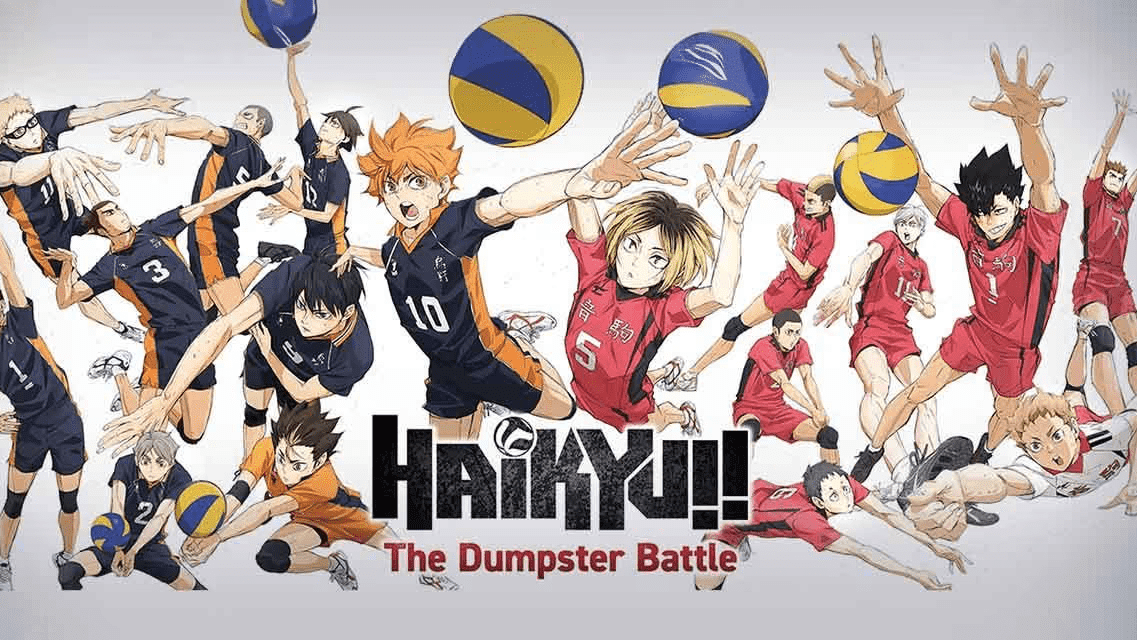
For nearly a decade, sports anime enthusiasts have lived under the quiet spell of an unfulfilled promise: a generational, winner-takes-all clash held on the national stage between two historic rivals who could never quite meet when it counted. Now, following an earth-shattering domestic theatrical run in Japan that hauled in over 11 billion yen, Haikyu!! The Dumpster Battle has officially landed on global streaming platforms. For international audiences, the arrival of this cinematic milestone is not merely another seasonal catalog update; it represents the emotional and thematic zenith of Haruichi Furudate’s magnum opus, condensing years of sweat, structural storytelling, and agonizing anticipation into an exhilarating, breathless 85-minute sprint.
Directed by series veteran Susumu Mitsunaka at Production I.G, the film captures the mythical “Battle at the Garbage Dump”—the long-awaited official tournament match between Miyagi’s Karasuno High and Tokyo’s Nekoma High. Where typical shonen tournaments lean on escalating villainy or earth-shattering stakes, The Dumpster Battle achieves something far rarer: pure, unadulterated sports anime perfection built entirely on mutual reverence, tactical claustrophobia, and the tragic finality of a game that cannot be replayed.
A Decades-Long Bloodline: The Tragedy and Triumph of “No Next Time”
To understand why this specific matchup detonates with such emotional force, one must understand the ancestral weight baked into every rally. The rivalry between Karasuno’s Crows and Nekoma’s Cats wasn’t birthed by Shoyo Hinata and Tobio Kageyama; it was forged decades prior by former coaches Ikkei Ukai and Yasufumi Nekomata. For years, their respective teams clashed in back-alley practice gyms, trading ideological blueprints without ever locking horns on the sacred orange court of Tokyo’s Spring High National Tournament. Their contests were perpetually labeled “practice matches”—contests where losing merely meant running hill sprints and adjusting rotations for the next morning.
The transition from casual practice matches to the win-or-go-home reality of Nationals alters the psychological landscape entirely. In The Dumpster Battle, the phrase “mou ippon” (“one more ball”) ceases to be an invitation for endless rematches; it becomes a desperate plea against the dying of the light. For the third-years—Karasuno’s Daichi Sawamura, Koshi Sugawara, and Asahi Azumane alongside Nekoma’s Tetsuro Kuroo, Morisuke Yaku, and Nobuyuki Kai—the final whistle marks the definitive end of their youth. Production I.G weaponizes this melancholy, ensuring that every spiked ball carries the haunting subtext that fifty percent of the boys on screen are playing their final set together.
Kenma’s Labyrinth: Tactical Nihilism vs. Kinetic Joy
At the beating heart of the film lies an asymmetric psychological duel between two players who could not be more diametrically opposed: Karasuno’s high-flying decoy Shoyo Hinata and Nekoma’s reclusive setter Kenma Kozume. Where Hinata represents pure kinetic vitality—a human sun driven by an insatiable appetite to touch the sky—Kenma treats volleyball as a taxing, friction-heavy video game requiring optimal pathfinding and systematic resource denial.
Suffocating the Sun
Kenma’s strategy against Karasuno is nothing short of algorithmic cruelty. Recognizing that Hinata feeds off momentum and spacial freedom, Kenma systematically walls off his takeoff zones. Through deep, precision-guided pushes and coordinated multi-man block commitments, Nekoma slowly deprives Karasuno’s middle blocker of his horizontal runway. The cinematography brilliant captures this claustrophobia: wide, sweeping court shots gradually collapse into tightly framed, vertical compositions. Hinata is framed within a geometric birdcage, grounded and starved of oxygen.
The “Fun” Breakthrough
The catharsis of this encounter does not stem from a magical power-up, but from mutual philosophical evolution. When Kageyama provides Hinata with the legendary “open toss”—granting him the vertical hang-time needed to shatter Kenma’s spatial trap—it is not merely an athletic victory. It is the moment Kenma’s analytical apathy breaks. Kuroo’s years-long project of introducing Kenma to the sport culminates in an exhausted, sweat-soaked boy gasping for air on the court floor, smiling through unkempt hair, and uttering the words that shatter his best friend: “Kuro, thank you for teaching me volleyball. It’s fun.” In that single second, Haikyu!! transcends athletic competition to deliver one of the most transcendent coming-of-age moments in contemporary anime.
Cinematic Vertigo: Production I.G’s Technical Tour de Force
When the production committee initially announced that the remaining manga arcs would be adapted across a two-part film project, purists feared the worst. How could a dynamic, multi-set war fit into a feature film without discarding crucial character beats? Mitsunaka’s answer was to throw out the serialized television playbook and embrace the kinetic vocabulary of pure cinema.
The technical crown jewel of the film arrives in the third set: a prolonged, seamless first-person point-of-view sequence anchored entirely behind Kenma’s eyes. As physical exhaustion sets in, the camera wobbles, drops, and jerks with terrifying tactile authenticity. Sweat blurs the periphery of the frame. The audio mix aggressively suppresses crowd roars, amplifying instead the wet, rhythmic slapping of sneakers against polished hardwood and the ragged, shallow wheezing of a body operating on biological fumes. The audience ceases to be spectators in the stands; we are trapped inside the biomechanical breakdown of an elite setter whose brain wants to compute, but whose limbs refuse to comply. When Kenma’s hands finally slip on the match-ending ball, slick with the sweat of his own labor, it feels less like a technical error and more like an act of divine mercy.
The Verdict: An Unrepeatable High-Water Mark for Sports Media
By bypassing conventional sports anime melodrama, Haikyu!! The Dumpster Battle cements its status as a timeless classic. It understands an essential truth that lesser sports series routinely miss: true rivals are not adversaries to be conquered, but mirrors that pull the absolute utmost potential out of our fragile, finite selves. Nekoma’s defense existed to forge Karasuno’s offense, just as Hinata’s radiance was the only catalyst capable of igniting Kenma’s hidden fire.
As the film arrives on global streaming services, it offers fans both a celebration and an agonizing realization: we are officially in the endgame. The Crows have survived the trash heap, but the looming shadow of the Kamomedai match and the fabled “Battle of the Little Giants” against Korai Hoshiumi awaits on the horizon. Until then, cue up the replay, turn the volume up, and savor every point. Sports anime rarely—if ever—gets better than this.
What was your favorite moment from The Dumpster Battle? Did Kenma’s POV sequence blow you away, or are you still weeping over Coach Ukai Sr. shaking hands with Nekomata through his television screen? Sound off in the comments below!