

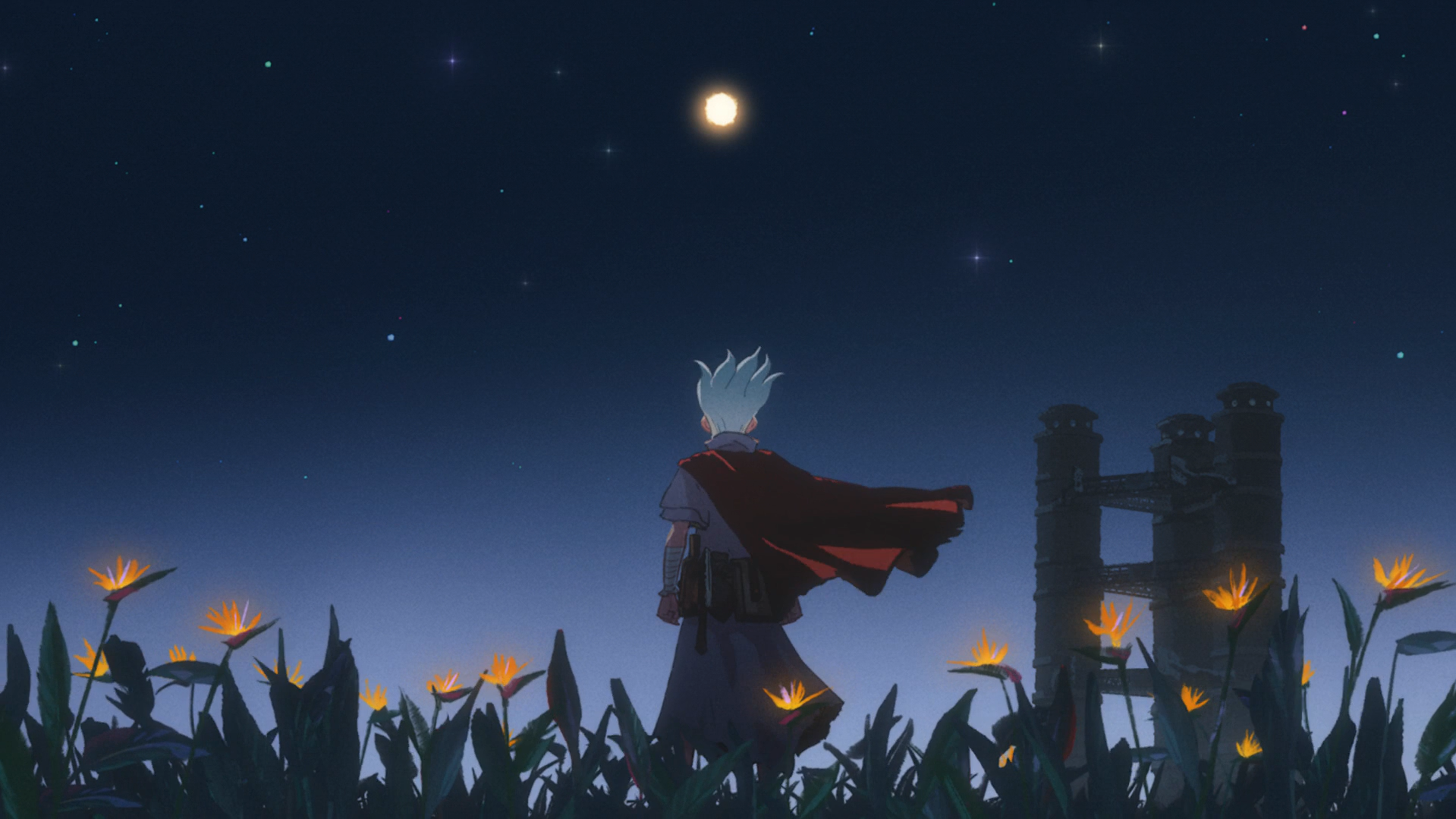
When Riichiro Inagaki and Boichi first introduced audiences to Senku Ishigami—waking naked in a post-apocalyptic forest with nothing but unyielding grit and an encyclopedic mental archive—few could have anticipated the sheer cinematic velocity of the journey ahead. What commenced as an intimate survival experiment revolving around calcium carbonate and pottery kilns has steadily metastasized into modern shonen’s most audacious hard sci-fi masterwork. Now, with the curtain officially set to rise on Dr. STONE: Science Future, the fourth and final season from TMS Entertainment, the Kingdom of Science stands at the precipice of its grandest narrative pivot: breaking orbit, conquering the lunar void, and coming face-to-face with the architect of humanity’s 3,700-year petrification, the elusive Why-Man.
For an industry currently saturated with bleak dark fantasies and hyper-violent supernatural combat, Dr. STONE has always occupied a singular, celebrated niche. It has elevated the scientific method into a pulse-pounding battle system. Yet, Science Future is not merely another step along the tech tree; it is an epochal shift. By taking the fight from the fertile dirt of the Stone World into the vacuum of space, the series transforms its foundational premise from an earthly reconstruction effort into an existential space opera. It is the definitive anime climax we have been waiting years to witness.
The Apollo Blueprint: From Primordial Mud to Extraterrestrial Trajectories
The progression of Dr. STONE has always been rooted in logical compounding. The narrative works because it treats human innovation not as a magical power-up, but as a grueling, iterative continuum. In earlier arcs, crafting a single vacuum tube or generating an electrical current carried life-or-death tension. In Science Future, that exact same philosophy scales up to aerospace engineering, rocketry mechanics, and orbital navigation.
Senku’s mission to build an Apollo-style spacecraft out of rudimentary, reclaimed resources demands unprecedented global cooperation. The narrative transcends localized faction skirmishes between regional villages and embraces globalized supply chains. Constructing a spacecraft capable of breaking Earth’s gravity requires rare earth metals, astronomical volumes of fuel, and precision manufacturing. This isn’t just about crafting a ship; it is an ideological testament to the entirety of human history. The production of the rocket becomes an epic saga within itself, validating every single alliance Senku has forged, from the muscle-bound former combatants of Tsukasa’s Empire to the logistical geniuses of the Nanami conglomerate.
Unlike standard battle shonen, where power scaling frequently breaks narrative consistency, Inagaki’s writing maintains a crystalline integrity: human advancement is collective, unforgiving, and rigorously chained to physical law. Senku doesn’t get to bypass thermodynamics because the plot needs him to; he has to solve the math, or the mission burns upon atmospheric exit.
The Enigma on the Lunar Surface: Decoding Why-Man
While the rocket project fuels the mechanical engine of the narrative, the overarching narrative thrust rests entirely on the mystery that has haunted the series since Season 2: the entity known only as Why-Man.
The Voice on the Frequency: Shifting Tone into Cosmic Dread
The introduction of Why-Man fundamentally altered the psychological landscape of Dr. STONE. The terrifying sequence featuring a synthesized broadcast echoing Senku’s own voice over global radio frequencies—monotonously demanding, “WHY, WHY, WHY”—injected a potent dose of cosmic horror into what had previously been an optimistic post-apocalyptic romp. It shattered the illusion that humanity’s petrification was a natural anomaly or a random cosmic accident. It proved intent. It proved malice. Or, perhaps most terrifyingly of all, it proved profound indifference.
The showdown awaiting viewers on the lunar surface represents a brilliant clash of thematic philosophies. Why-Man is not simply a theatrical villain waiting to be pummeled into submission; the entity is the ultimate biological and sociological riddle. Unraveling the nature of the petrification device—the Medusa—means deciphering the biological mechanics of eternal life, the morality of stasis, and whether humanity’s ceaseless drive toward industrialization is a blessing or an existential parasite on the universe. The intellectual duel between Senku’s pure faith in human progress and Why-Man’s cold, cosmic calculation promises to be one of the most conceptually layered finales in modern anime history.
The Ghost in the Stars: Byakuya’s Orbit and Character Psychology
Beyond the sprawling physics and the high-stakes extraterrestrial mystery, Science Future carries an immense emotional resonance centered on the Ishigami family legacy. The moon mission is not just an empirical venture; it is an emotional pilgrimage.
Senku’s adoptive father, Byakuya Ishigami, spent his final living moments gazing up at the cosmos from the wreckage of civilization, spending decades collecting resources and recording data so that his son might one day inherit the tools to reclaim the planet. Byakuya died looking to the stars; Senku will now pierce the sky to reach them. The symmetry is breathtaking. As Senku approaches the void of space, he isn’t just seeking Why-Man—he is tracing the atmospheric ghosts of the International Space Station crew who fought so desperately to preserve humanity’s cultural memory.
Furthermore, the high-risk nature of the three-person lunar lander creates an intense character crucible. The selection process highlights how every facet of human capability must be concentrated: the supreme scientific intellect, the raw warrior instinct, and the transcendent physical commander. The psychological stakes for the Kingdom of Science’s core cast—particularly Tsukasa, Ryusui, Kohaku, and Chrome—reach their zenith. Chrome’s evolution from an ignorant “sorcerer” collecting curious stones to a legitimate aerospace collaborator stands as one of the series’ most moving character arcs, reflecting humanity’s collective leap from superstition to hard-won enlightenment.
TMS Entertainment’s Monumental Task: Animating the Infinite
Adapting the final stretch of Boichi’s manga is no small undertaking for TMS Entertainment. Boichi’s signature visual style—defined by hyper-kinetic line work, hyper-detailed mechanical schematics, and an almost tactile rendering of anatomy and textures—reaches near-impossible peaks during the space race arc. Translating that breathtaking level of illustrative density into sequential animation requires a formidable production pipeline.
The visual language of the show must dramatically pivot. The directors must transition from the vibrant, pastoral greens and earthy browns of the primitive world to the stark, chilling, hyper-contrasted monochrome of the lunar landscape. Rendering zero-gravity physics, photorealistic rocketry, atmospheric re-entry dynamics, and the terrifying, silent desolation of the lunar regolith demands a visual gravity that the production team has never had to deploy before.
Coupled with what will inevitably be an orchestral-electronic score designed to capture both the terror of the cosmic void and the triumphant euphoria of human triumph, the final season represents a technical proving ground for TMS. If the studio nails the scale and temporal weight of the launch sequences, Dr. STONE: Science Future has the potential to set a gold standard for technical, hard-science animation.
The Enduring Legacy of Modern Shonen’s Smartest Hero
As we approach the endgame of this landmark series, it is impossible to ignore the cultural mark Dr. STONE has left on the medium. In a shonen landscape frequently governed by divine lineages, mystical awakenings, and catastrophic magic, Senku Ishigami stood tall on the shoulders of Galileo, Newton, and Curie. He proved that curiosity, cooperation, and the humble trial-and-error of empirical truth can be every bit as thrilling as a spirit bomb or a domain expansion.
Science Future is not merely a grand farewell; it is the ultimate thematic crystallization of its premise. As the rocket engines ignite and the Kingdom of Science leaves the cradle of the Earth, the final season invites viewers to marvel not at what lies hidden in fantasy, but at what humanity has genuinely achieved—and what mysteries we have yet to conquer.
Will Senku conquer the cosmos, or will the chilling voice of Why-Man silence humanity once and for all? What are your theories regarding the true origin of the Medusa devices? Sound off in the comments below, and keep your dials locked to Wibux.com for in-depth episodic breakdowns, scientific retrospectives, and complete coverage of the final season.